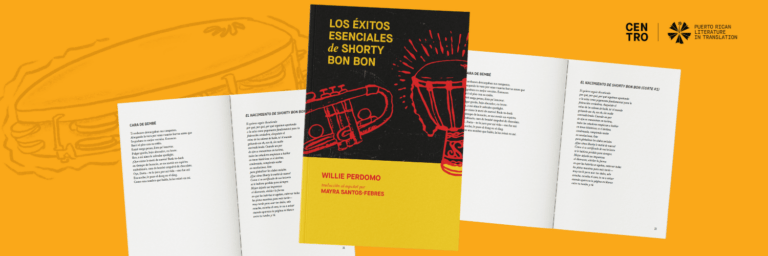


I was recently able to sit down and have a conversation with Willie Perdomo and Mayra Santos Febres on her recent translation of Willie’s award-winning poetry collection The Essential Hits of Shorty Bon Bon. This conversation has been edited for clarity only. The following is a small excerpt—
YM: What a lucky life that you are able to see the fruits of your labor in translation, Willie. So many writers never have the opportunity to collaborate with their translator. It must almost feel sort of miraculous that you have the opportunity to do so. I’m deeply curious about how much collaboration was involved in this project. Was there a lot of back and forth? Were there any moments where you, Willie, might have had strong opinions on some of Mayra’s choices? And Mayra, this translation is so thoughtful, I can tell how much reverence and how much respect you have for Willie and his work. It was just beautiful to be swept up in Willie en Español. So with regards to navigation, particularly some of the Nuyorican expressions, those moments in the work where the references were purely the seeing and being of a Boricua in Spanish Harlem, was there much negotiation in your approach? Ever any moments where the both of you had to collaborate deeply on how to name a thing that might not have been easily translatable?
MSF: Well, this is not the first time that I have translated Willie. We have collaborated for about 25 years in many, many endeavors. In El Festival de la Palabra, when Willie was invited to the University of Puerto Rico he visited my classes, so we know each other pretty well. And we read each other, not only in literature, but also in life. It wasn’t that difficult to translate Shorty. And there was not a lot of back and forth. But how we approached it was that I first provided Willie with a very rough translation, and there were some moments where I got stuck with a few phrases that were very particular not only to the poem, but also to specific references in the culture. I would just ask him: what do you mean by this? With regards to music, I knew it was a poetry piece, but I also engaged with it almost like an opera. I knew that he was interested in doing pieces for theater, and I had watched many videos of him performing spoken word; so I knew the tumba. I understood his music, his movement and his inflections, I could hear his voice in my head so it was not difficult to find the musicality in the text and also to understand what he was doing in terms of poetry to be performed even if it was laid out in a book to be read. I understood it from the get-go but references to particular scenes and moments and the intimate commotion of several words that he used in the text—that is what we spent some time on. But we’re compadre and comadre so it was easy for me because I know him very well not just in terms of him being an incredible poet, and I respect him very much. He’s not only a friend, but also a colleague, a teacher; we teach each other that has been very important and it was a blessing for me because I wasn’t confronted with the text I was confronted with a whole system of references that made it possible for me to translate the book not literally but emotionally.
WP: So like for the last year, I worked on a piece for Miguel Luciano’s installation at the Whitney for the People’s Pulpit from the People’s Church, where Pedro [Pietri] read his Puerto Rican obituary, and they had the obituary coming out of the pulpit, but I reinterpreted it in a way. And I’m bringing this up because what happens is: you’re in a position where an artist is entrusting you with their work. And this is the same thing that happens between, I think, Mayra and I. Without Mayra, I don’t get introduced to Puerto Rico, like period. This is 25 years ago. And it’s important for the dialogue between the archipelago and what’s called the mainland to happen. This is not the first time that we worked on translations or really that Mayra has translated my work. So when I say that—that’s 25 years of a poet, compay, comadre relationship. So the trust is inherent. In other words, I can look the other way. I said, Mayra, she got that. I really had not that much input. I think one of the things that I recognized about this particular process because the book for me is very much like an album, and so what Mayra does is take the album and she does her own cover of the songs of the music so that it becomes her album. It’s a collaboration and we’re sort of in this jam session and because that’s a musical motif that we’re sort of very aware of the experience becomes something that is rewarding for both the author who’s being translated and the translator. She’s going into the studio with a different way of sort of looking at a particular song and she’s thinking she wants to put her imprint on it without sacrificing the larger structure of the book and keeping that shape. So I think the short answer is that I inherently trust Mayra Santos Febres, like inherently with my work at all times.
MSF: Que lindo. Beautiful. I love seeing that.
WP: La verdad, la verdad, la verdad. You already know.
YM: This camaraderie feels so authentic and as a poet and translator of poetry it is a model for me. Listening to you both talk about your reverence for one another, because as you said Willie you think of this book very much like an album, I was thinking a lot about how for the musician [Shorty] and the poet [Willie] the dream is to connect, to transport, to transform. And so I am asking you, Mayra: What is the dream of the translator?
MSF: I am not a translator of many poets. I mean I’ve translated Julia de Burgos poems and Willie Perdomo and that’s about it. CENTRO reached out and said that Willie had asked for me to do this work. And of course, I will not say no, I cannot say no. It is, it is impossible. Well, you have to do it then. Okay, so I do it. But as a writer that is from the island or the archipelago, and that looks at the literature that is written by Puerto Ricans in the States as a continuum I don’t see a difference between the emotional language and the references in Puerto Rico and our community in the States. I do not see a difference. Classical Puerto Rican literature includes Pedro Pietri, of course, Tato La Viera, of course, Sandra Maria Estevez, of course, Puerto Rican writers born and raised in Puerto Rico. However, what I call white Ricans, in terms of this derivative writing that produces texts that only repeats literary prestige and literary connection to Hispanophilia maybe I would kick some of those out but in my tradition this literature is also mine and I want to make it available for people like me who love literature but are not interested that much in a repetition of El Cantar de los Cantares or Romancero, I don’t know what. I like el RomanceroGitano from Federico García. But other people, I think that, you know, with all due respect, Spanish literature should be Spanish literature, but it shouldn’t be the norm to write that literature in the Caribbean. And I come from a place that is also Diasporic and half of my family has lived in the States. And whenever things were tough on the island, we had to go to Casa de titi in order to make it that summer. So I grew up in this back and forth that is so common in people from the mainland that were always, you know, doing the back-and-forth thing; even if it is just emotionally. And I know the story. I know our history, our diasporic Puerto Rican history. I know it very, very well because I was very curious about that other way of being Puerto Rican from the bottom up that was so similar, maybe not in the specific words, but in the beat, in the heartbeat within that language. That’s inherent. That music that we all have is sort of inherent and comes out. And that’s how we connect—
To keep reading this beautiful conversation and indulge yourself on beautiful poetry check out Los éxitos esenciales de Shorty Bon Bon at La Bodega.
Yesenia Montilla is an Afro-Latina poet, translator & educator. Her first collection The Pink Box was published by Willow Books in 2015. Her second collection Muse Found in a Colonized Body was published by Four Way Books and was a finalist for an NAACP Image Award. She currently works as a technical project coordinator at CENTRO and teaches poetry at The Juilliard School. She lives in Harlem, NY. Find her at www.yeseniamontilla.com