

At a time when Latina representation still falters, Nelson Santiago brings Nuyorican women to the forefront of his work, highlighting their strength and determination.
I am trying to remember the first time I came across the work of artist Nelson Santiago, or the first time we crossed paths, and it’s difficult because it feels like he is someone I’ve just always known. He is someone whose work is synonymous with Nuyorican culture, so you would see it at any cultural event, whether as a part of PRIDA or as part of the LOSIADA Festival, or on a banner for the Puerto Rican Day Parade. Maybe it was at a fundraiser for a local Nuyorican congressperson’s campaign. Or when there is a pop-up to celebrate our Puerto Rican heroes like Roberto Clemente, or to launch a new Salsa museum in the Bronx – Nelson’s art is there to commemorate it all. And bearing witness to that in itself is a gift.
A self-taught artist, Santiago grew up in New York City under the influence of 1980s graffiti and comic books. Emulating the styles from the comics he read as early as nine years old, he learned to draw figures. And that influence still shines through with his use of bright, bold colors that feel animated and graphic. Women who appear like heroines – bodies strong and commanding, but instead of a bodysuit, their superhero uniform consists of jeans and sneakers, and a Puerto Rican flag in some capacity. Instantly transforming what mainstream sees as around-the-way girls into commanding leading ladies. Dignifying our everyday wear sends a message that the unsung hard work of women at home, at work and in our communities happens in all sorts of uniforms, not just ones we see on TV – oversexualized. Their identity is their superpower .
Being part of the Nuyorican community is so unique and so nuanced that it is not often captured or reflected in mainstream art spaces. It’s about finding home away from home, while still finding connection to our roots on the island. You see it in pieces like “Raices” where half of the backdrop is in metropolitan New York City – representing the diaspora while half is in the forest of the isla, representing our cultural duality in both places. It’s a very nuanced culture that traverses many spaces. It’s infused with the rhythms of Salsa and Hip-Hop and the grit of New York City. That’s what you’ll immediately recognize when you see a painting by Nelson Santiago. All those worlds colliding in one, in a way that feels bold and empowering. Instead of less-than or othered, which is a narrative we fight against daily. Especially when it comes to women. The minute you turn on mainstream television you see the tropes, the oversexualized, loud, uneducated Latina, the drug and crime ridden Bronx, the spicy-attitude, “hood” Puerto Rican women. It gets demoralizing seeing hardly any representation and then it’s tied to negativity. Having the general public describe our homes and communities as “bad neighborhoods” to be feared and avoided.
Being a Nuyorican woman myself, it’s so rare and special to see myself in works of art, or symbolism that is like our own secret language. A train stop that I frequent in the Bronx visiting family, an outfit or clothing style I’ve donned, anything that says I was here and it matters. People from the Bronx matter. A secret head nod, if you will, that counters the many stigmas we face daily. From feeling displaced here in the US and not Puerto Rican enough, to not feeling American enough, to the horrific femicides taking place on the island and everywhere. To be labeled dumb and loud by society. Just always being left as an afterthought, these pieces remind us that we matter. That taking up space and feeling safe in our bodies is a heroic act in itself. Take the piece titled, “Orgullo Boriken.” In it, you see a young woman standing on the rooftop, wrapped in a Puerto Rican flag almost like a protective cloak. Behind her, you see the NYC skyline and an elevated train whizzing by. It’s almost like a scene from Batman’s Gotham or a Spider-Man comic book or a graphic novel. She looks powerful, like a super Boricua, our super Nuyorican hero. But she is one of us, wearing jeans and a white tee, a very standard NYC uniform. When asked about the inspiration for this painting, Nelson replied: “the girls I grew up with in The Bronx.” Which makes me love it even more.

Or take the piece “Raices” (below), which is representative of our ancestors. It was inspired by the annual National Puerto Rican Day Parade and pays homage to “the beauty of our culture,” Santiago says. In it, you see a female split in half – one side reflects a Taina in native wear along with the red markings around her eyes, which were a tradition at that time. On the other side, a traditional Bomba dancer, complete with the Bomba skirt and headwrap. Two different scenes of the same history. The strength of culture and resistance comes alive within her. The Taino sun symbol shining brightly in the sky over the colorful building of Viejo San Juan. It’s a cute Easter egg, almost visual wordplay. It tells the tale of survival and defiance in one intimate gaze. Again, the bright colors and sculpted body pay homage to Santiago’s influence of comic book culture blended to present another superhero in the form of our ancestors.

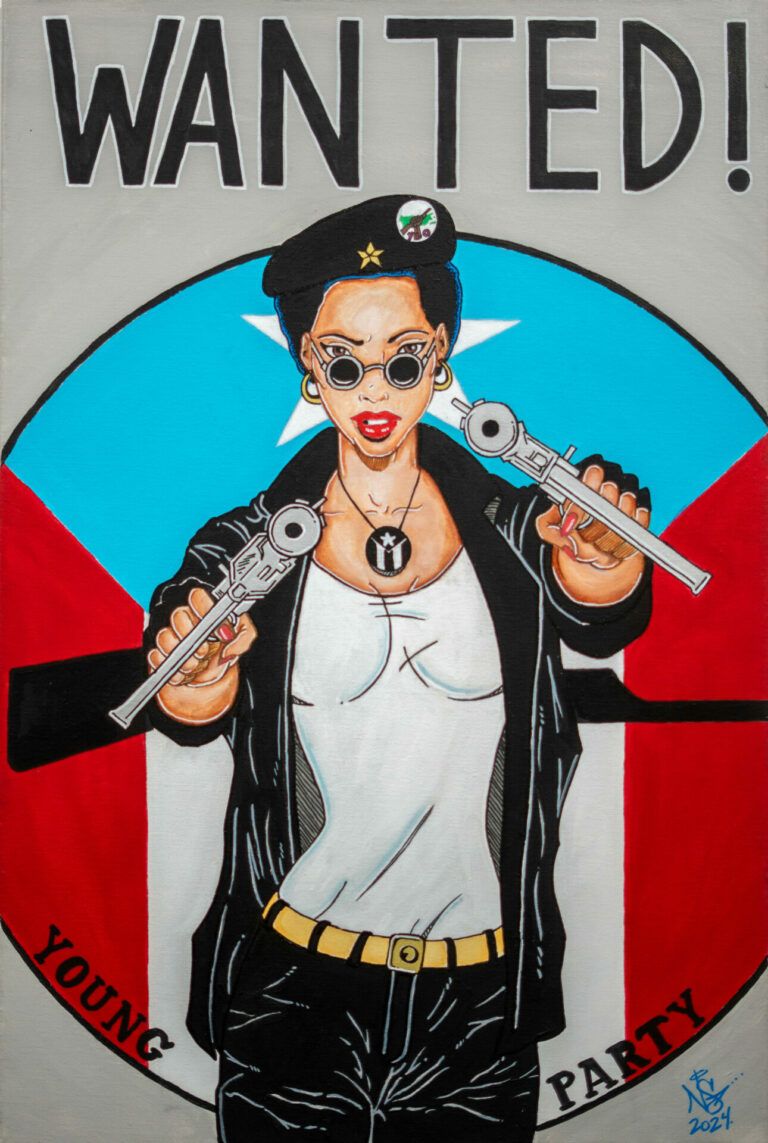
I still struggle with finding representation of myself in history books. Or stories where our contributions are highlighted from a place of empowerment. That’s why Santiago’s portrait of former Young Lord and Black Panther Party member Denise Oliver Velez stands out to me. Especially since her passing on July 15, 2026. Not only does it memorialize someone who was not herself Boricua but took the Puerto Rican cause on personally as a Black woman as a loving act of solidarity but it’s like an animated piece of history come to life. In it, Velez is wearing the black beret – a symbol that’s become synonymous with civil rights movements from the 1960s. Two pins adorn it, one representing the Black Panthers and one the Young Lords, both of which she was an active member of. She has guns drawn, ready for war, an image you might see in a Science Fiction comic, except this is based on a real person. A real woman who fought for liberation and in return is now wanted. A little-known hero from our own community, not some far-away multiverse.

Sometimes strength can be as simple as catching a small, tender unspoken moment. Nelson reminds us we are also worthy of awe and wonder in his recent piece “She Carries the Light.” In it, you see a woman looking up to the full moon, mesmerized by it. This painting is holding onto a quiet moment. As Nelson describes it, the lighthouse “represents a meeting point between strength and calm—much like her.” It’s a moment of strength and calm meeting together, and one we are not always used to seeing of Latinas. We also deserve moments of peace and tranquility.

For Nelson, highlighting strong women figures in his work is no coincidence. He tells me, “It’s a conscious choice – the people who have been the most supportive, checked on me, taking care of me, that I’m most close with have been women. Even as a kid where I didn’t have a great relationship with my mom, women have always been there for me. Plus, the fact that women who are most responsible, who hold families together and hold houses down – it’s always been the women in my life.” And it’s fitting that his style has a comic, graphic-novel appeal because these snapshots of everyday women are all our superheroes. Feeling seen turns out never to go out of style. I just wish I had been privy to art like this when I was younger, what it would have done for my self-esteem as a young girl to see this alternate take on being Nuyorican. I’m excited for the next generation to have it though, and to learn early on that we are a story worth telling, worth capturing, worth celebrating just as we are.