

When I last arrived in Puerto Rico in October 2025 and climbed the stairs to my grandmother’s house in Gurabo, my Tití Wanda pulled me into an embrace and said, “Welcome home: to your house and to your país.” Her words landed with a kind of force I hadn’t anticipated; they collapsed a distance I was quietly (though anxiously) carrying. As a lifelong diasporican, my relationship to Puerto Rico is often contested as partial and conditional. What I feel when I’m in Puerto Rico is complicated in all the ways that diasporic belonging often is: it is layered and slippery, resting in the liminal space between grief and gratitude. I ache at feeling perpetually adjacent to the place that is my familial home, and always still find the grace of being received by it anyway.
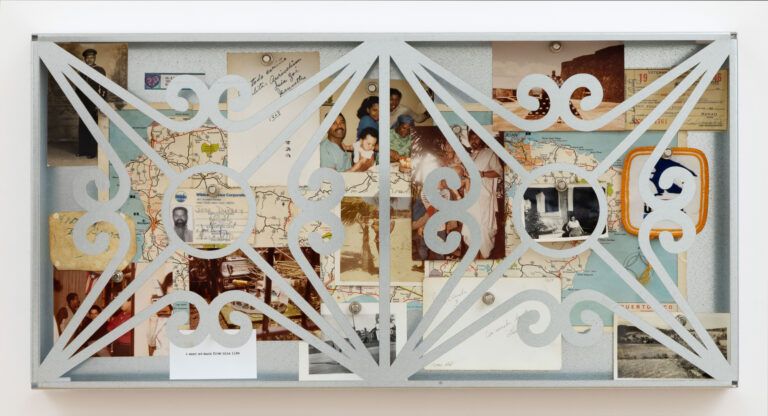
This tension between intimacy and distance, a sort of doubleness, provides a critical framework for reading Andina Marie Osorio’s artistic practice. In particular, Osorio’s use of archival family photographs placed behind intricate metalwork (metalwork which is reminiscent of fencing that is popular throughout Puerto Rico) reconstitutes domestic space as an analytic site. The fences in Osorio’s works, like the one that surrounds my abuela’s house, operate simultaneously as frames and barriers: they protect, delimit, and mark what is held within and what remains withheld. Diasporic belonging emerges here as an affective and spatial condition structured by proximity, reception, and constraint.
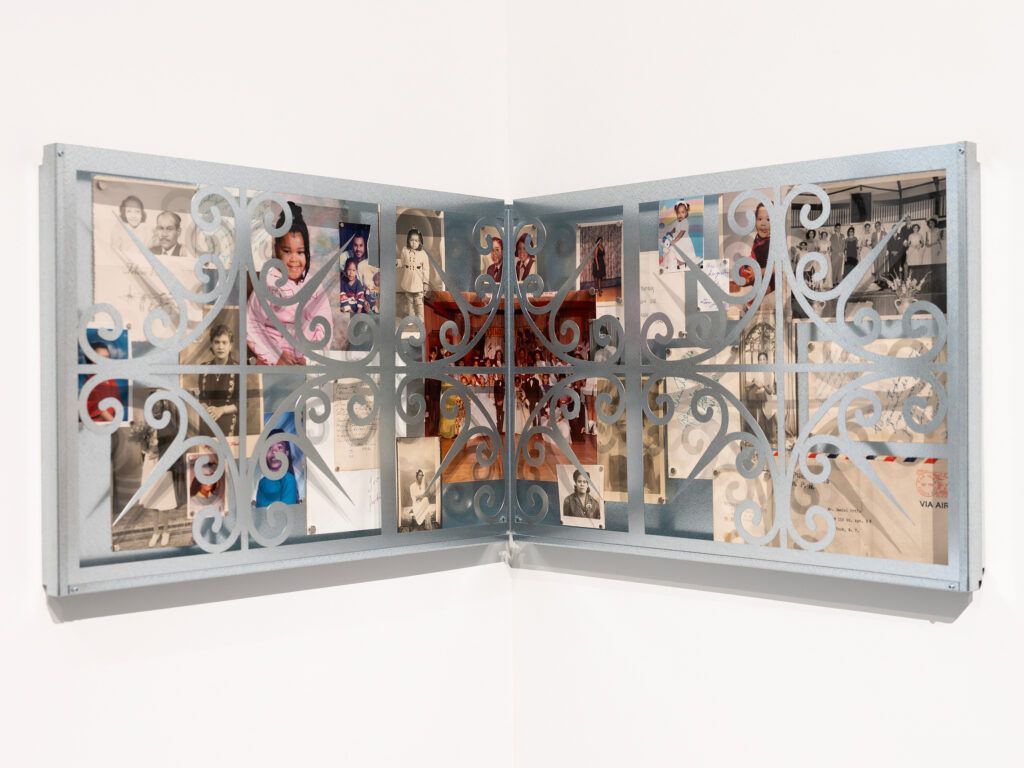
This condition of doubleness is sustained within Osorio’s formal practice. The archival photographs, conventionally understood as stable indices of kinship, inheritance, and familial continuity, are destabilized by the metalwork that overlays them: the images persist even as their legibility is mediated. The fencing that surrounds my grandmother’s home (like many others across the Caribbean and United States) incorporates visual motifs that resonate with West African design traditions, including forms associated with Adinkra symbolism. In the case of my family’s home in Urbino O’Reilly, the repeating pattern recalls the cowrie shell, a form linked across West African and diasporic contexts to abundance, fertility, and feminine power. Adinkra symbols historically functioned as a semiotic system through which philosophical concepts, ethical principles, and ancestral memory were transmitted, carried across the Atlantic by enslaved artisans whose labor remains largely unarchived (Kirkland-Mullins, 2008). Osorio’s use of these metalwork forms situates her work within a longer genealogy of Black material and aesthetic practice. In works such as ven sin nombre (2026), fences emerge as a structure shaped by colonial histories of property, boundary-making, and exclusion while also carrying traces of diasporic memory as these structures retain traces of the artisans who produced them, even as those histories remain obscured within dominant archival frameworks.
Zaire Dinzey-Flores’ analysis of gated communities in Ponce (2013) demonstrates how fences shape everyday life in Puerto Rico. In Locked In, Locked Out: Gated Communities in a Puerto Rican City, Dinzey-Flores argues that gates and barriers influence who can move freely, who is surveilled, and who is made to feel secure or out of place. Through these boundary markers, space becomes organized and experienced in uneven ways. Reading Osorio through Dinzey-Flores reveals how her layered metalwork transforms these social dynamics into visual form, placing the archival photograph within the same structures of boundary, access, and exclusion that organize life beyond the frame.

The viewer encounters the image through interruption and partial visibility, a mode of engagement that mirrors the uneven distribution of access structured by gated environments. Through Dinzey-Flores and Osorio, we gain a deeper understanding of the stakes of diasporican return. If spatial infrastructures like fences regulate movement by determining how and where bodies can circulate, then return cannot be understood as a singular act of arrival. The diasporic subject may traverse geographic distance, but access to land, neighborhoods, and social belonging remains mediated through these same spatial logics. For diasporican subjects, this movement is often imagined as uncomplicated precisely because it occurs through air travel rather than through the dangerous terrestrial or water crossings more commonly associated with immigration discourse and scholarship. However, the relative safety of flight does not dissolve the affective weight of crossing water: to return to Puerto Rico from the diaspora still requires traversing the same maritime routes that have long structured Caribbean histories of colonialism, labor, and (im)migration. Osorio’s work resists any easy distinction between movement and belonging, reminding viewers that the ability to arrive does not guarantee unmediated access to place, memory, or recognition. Osorio’s articulation (via the artist’s instagram) of visiting Puerto Rico as “less of [a] homecoming and more of an investigation around who has the right to return” resonates with the understanding that return is not only geographic but, also juridical and infrastructural, conditioned by the very regimes that govern inclusion and exclusion.
Osorio’s recent stated engagement (again, via the artist’s Instagram page) with landscape extends this analysis. Gated landscapes cannot be approached as neutral or continuous terrain without considering how such lands are already partitioned, surveilled, and stratified. To attend to a gated landscape is to read its boundaries and to recognize the spatial production of difference. Dinzey-Flores argues that gating practices in Puerto Rico reinforce racial and class hierarchies through the built environment, and in so doing, shape who is understood as deserving of safety and belonging and conversely, who is treated with suspicion or exclusion. Within this context, whiteness becomes associated with greater access to mobility, security, and property. Osorio’s work draws on a visual language shaped by African diasporic memory while placing it within structures that unevenly distribute safety, belonging, and privilege. In her work, the fence remains a persistent condition of everyday life, one in which diasporic forms and histories exist within spaces marked by exclusion. Osorio’s work makes clear that Black diasporic memory cannot be separated from the racialized landscapes through which belonging is negotiated in Puerto Rico.
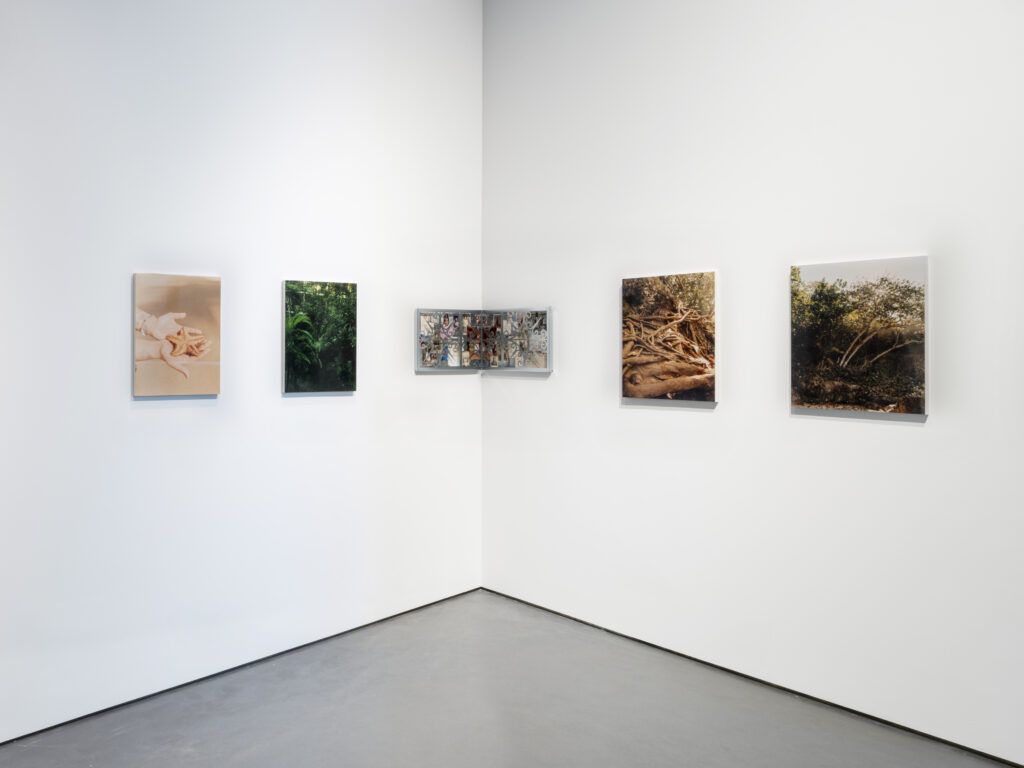
In Listening to Images, Tina Campt (2017) theorizes the archival photograph as a site of quiet frequency, one that exceeds visual representation and requires an attunement to an image’s affective and embodied registers. According to Campt, photographs have the possibility of operating as encounters that demand a different mode of engagement beyond the static. Osorio’s work seems to take this insight quite literally: the metalworks she utilizes disrupts the immediacy of visual consumption, requiring the viewer to look through, across, and around to see the image. The act of looking at one of Osorio’s fenced works becomes durational and embodied, shaped by obstruction and proximity.
This mediated encounter takes on additional significance given that Osorio’s archival images overwhelmingly depict Afro-diasporic subjects whose histories have been persistently underdocumented within official Puerto Rican archives. The limits of the archive in Puerto Rico cannot be separated from the colonial regimes that structured Black life under slavery and its aftermath. As Daniel Morales-Armstrong argues, Black life in Puerto Rico has historically been subjected to expansive systems of regulation and surveillance that governed Black movement, gathering, labor, and mobility (2025). These conditions produced not only material restriction but also archival illegibility, rendering Black sociality and memory difficult to preserve within official historical frameworks. Read in this context, the relative absence of Afro–Puerto Rican histories within dominant archives reflects an active historical process tied to the whitening of Puerto Rican national identity rather than an accidental omission (Bruno, Diaz, Morales-Armstrong, and Johnson, 2025).
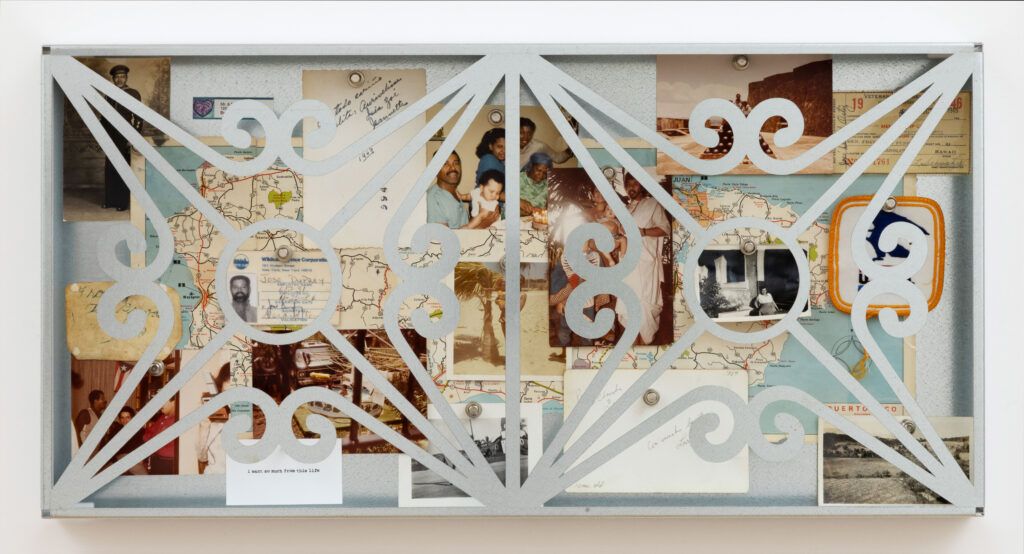
Osorio’s use of archival photographs intervenes within this history of Black boricua erasure. Her work does not seek to restore archival completeness or transparency but instead, the fencing layered over the photographs foregrounds the conditions through which Black histories in Puerto Rico have been mediated, constrained, and rendered partially illegible. We might choose to consider this illegibility in Osorio’s work through the lens of Édouard Glissant’s theory of opacity (1997), which allows it to register less as absence than refusal: a resistance to the colonial demand that Black life be made fully accessible through the archive. In overlaying archival images, which arrive in the works as already marked by a family’s intimacies and losses, with metal fencing, Osorio frames Afro-diasporic/diasporican memory as something that survives despite constraint.
What emerges through Osorio’s use of metalwork, then, is not a complete history but fragments of memories that are shaped by survival, distance, and uneven visibility. Her work asks how Black diasporic histories are carried forward through the spaces and materials that surround everyday life. In these works, fences are central to the ideas of belonging and return, acting at once as protection, boundary, surveillance, and remembrance. Within Osorio’s layered metalwork, histories of violence and creativity continue to exist side by side and (much like the repeated curve of a cowrie shell pattern in an ironwork fence) persisting quietly across generations and distance.
References
- Bruno, Sarah, Essah Diaz, Daniel Morales-Armstrong, and Jessica Marie Johnson. 2025. “Introduction: Entre Aguas/Between the Waters.” CENTRO: Journal for the Center for Puerto Rican Studies 37 (1): 5–20.
- Campt, Tina M. 2017. Listening to Images. Duke University Press.
- Dinzey-Flores, Zaire Zenit. 2013. Locked In, Locked Out: Gated Communities in a Puerto Rican City. University of Pennsylvania Press.
- Glissant, Édouard. 1997. Poetics of Relation. University of Michigan Press.
- Kirkland-Mullins, Karina. 2008. “Breaking Down Fences — Revealing The Past: Curriculum Unit 08.03.03,” Pride of Place: New Haven Material and Visual Culture: Curriculum Units by Fellows of the Yale-New Haven Teachers Institute, Volume III.
- Morales-Armstrong, Daniel. 2025. “Cimarrones, Rebels, and Plaintiffs: Strategies Enslaved Africans and Their Descendants Used to Resist Slavery in Puerto Rico (Sixteenth to Nineteenth Centuries).” Centro Journal for the Center for Puerto Rican Studies 37 (1): 111–34.