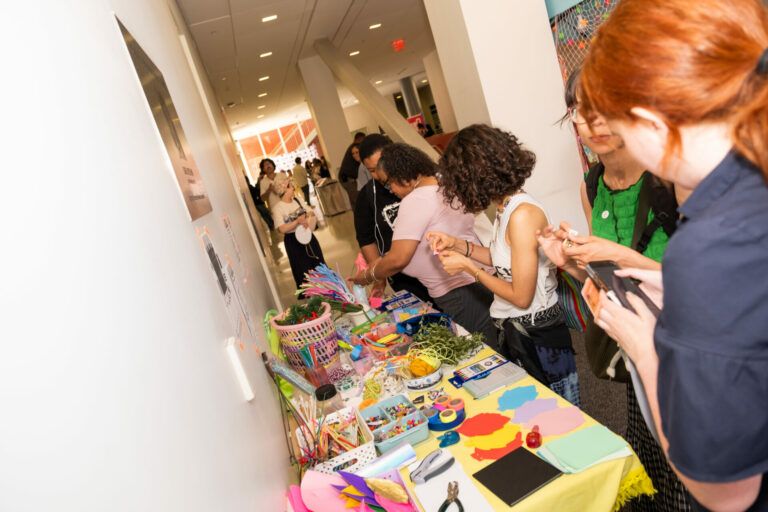


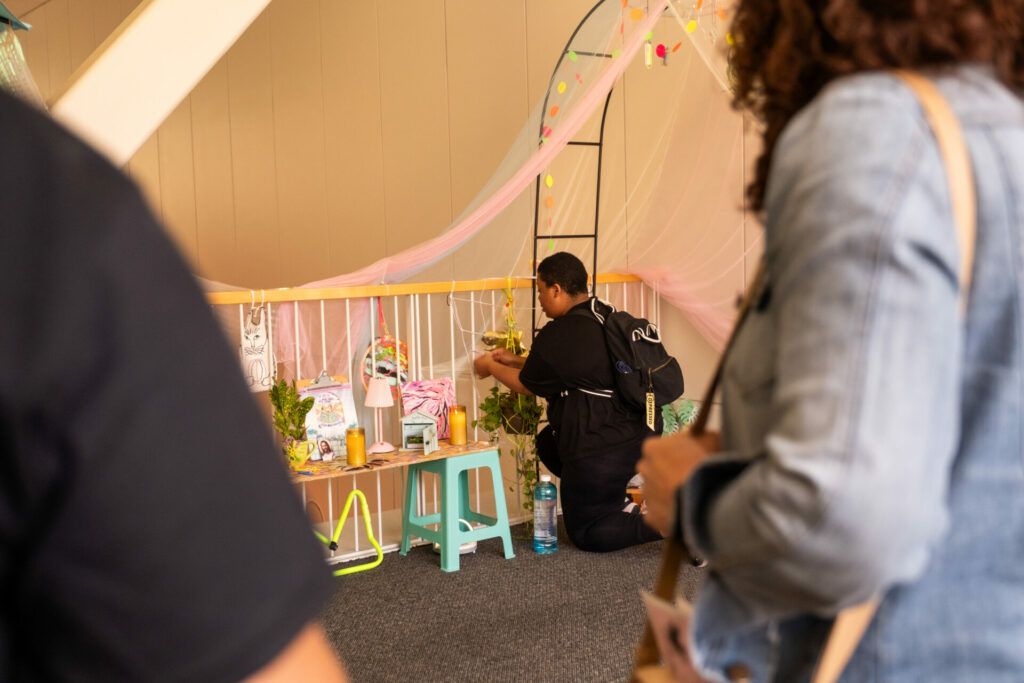
Melissa Díaz’s work offers a different way of thinking about Caribbean art, one rooted less in representation or political declaration than in relation, participation, and shared presence. While much Caribbean and diasporic art has understandably centered histories of colonial violence, racial formation, migration, activism, and visibility, Díaz’s practice moves along another register: the creation of spaces where people can gather, interact, make, touch, and simply exist together. As both an artist and art therapist, Melissa Díaz approaches art not primarily as an object to be interpreted, but as a living environment activated through participation. Her installations are deeply tactile and relational, built around the idea that viewers are not passive spectators but co-creators whose presence completes the work (see Figure 1). As Díaz explains in a video accompanying her Nature vs. Nurture project, “Art for me has always been a way for communicating and creating events where you can really celebrate art, celebrate one another and celebrate other artists.” This emphasis on communication and collective encounter shifts the role of art away from isolated contemplation and toward forms of connection that unfold in the “here and now.”
Díaz’s background as a licensed and board-certified art therapist is important here, not because her artwork should be reduced to therapeutic function, but because her understanding of participation, mindfulness, and emotional presence clearly informs the spaces she creates. Her experience working across museums, shelters, schools, mental health programs, and community initiatives has centered individuals navigating trauma, anxiety, stigmatization, developmental disorders, addiction, and major life transitions. Throughout these contexts, Díaz has consistently approached creativity as something relational and accessible rather than exclusive or intimidating. Her work through Open House BK, a community arts initiative dedicated to affordable exhibitions and therapeutic workshops, further reflects this commitment to collective engagement. Creativity, in her practice, becomes less about artistic authority and more about creating conditions where people feel welcomed into relation with one another.
What makes Díaz’s work particularly compelling is the extent to which her practice centers relational experience itself as a meaningful artistic and cultural act. In many discussions of Caribbean contemporary art, artists are often expected to visibly perform identity, trauma, resistance, or historical critique. Caribbean art is frequently approached through representational frameworks that ask what histories or political realities the work depicts. Díaz’s work certainly emerges from Caribbean and diasporic experiences, yet her installations resist reducing identity to stable visual symbols or direct political messaging. Díaz’s work does not need to announce Caribbean identity through fixed symbols. Its significance lies in how it creates relation among people, materials, memory, and place. Rather than illustrating community, her work temporarily produces it.
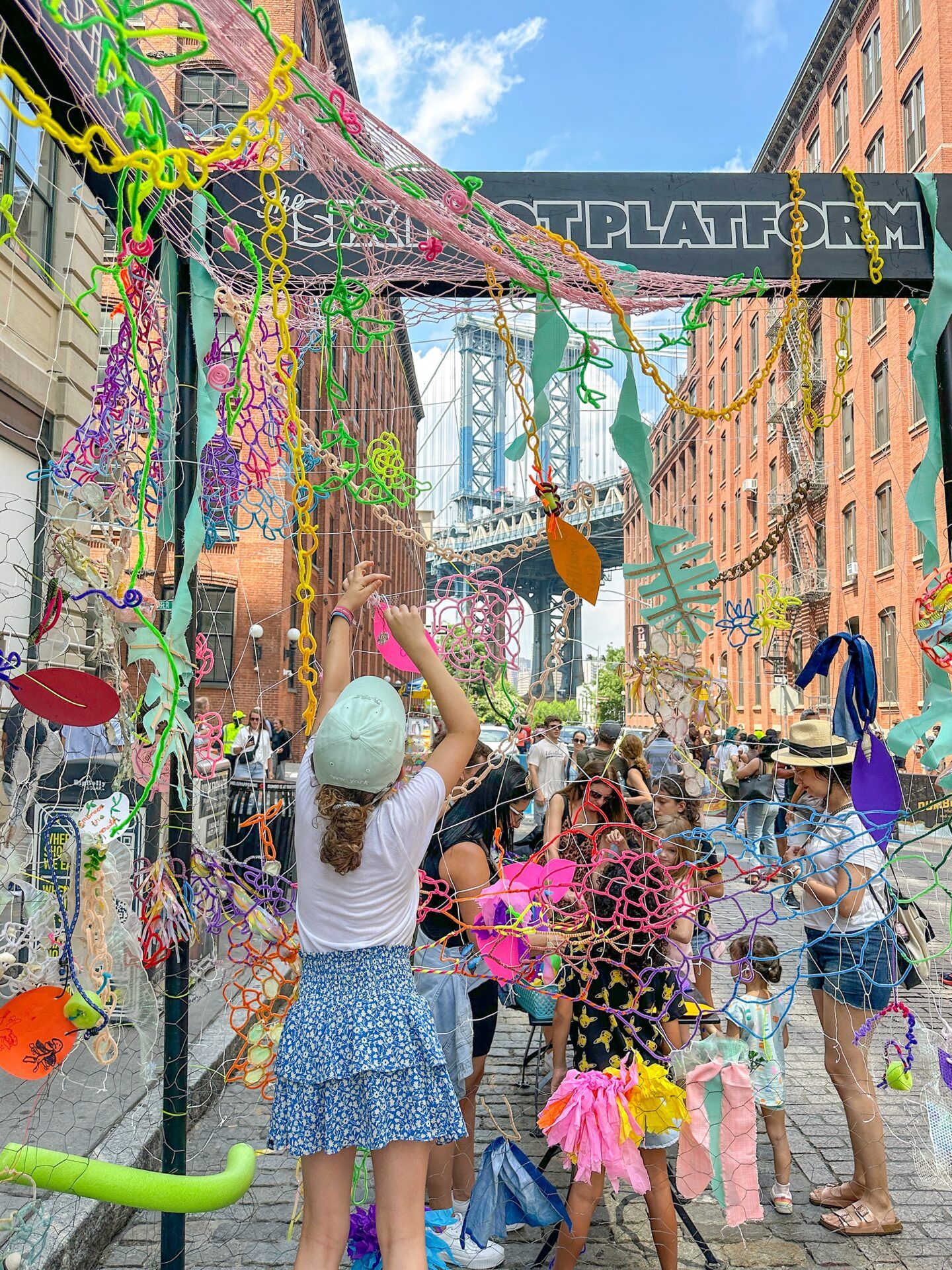
collaboration with/ Dumbo Improvement District, Dumbo, Brooklyn, NY.
This distinction is important because Díaz’s installations are fundamentally experiential. Her use of found materials, woven structures, suspended forms, organic textures, and participatory arrangements encourages viewers to move through the work physically and sensorially. The installations are rarely fixed or distant; they invite proximity and bodily awareness. Participants encounter texture, repetition, softness, fragility, movement, and layering. In doing so, the work asks viewers not simply to look, but to inhabit a shared environment. Díaz repeatedly emphasizes that she carefully considers “how the viewer will interact…I really want to make a place-space for people.” The artwork therefore exists not as a closed composition but as a relational process unfolding among people, materials, and space.
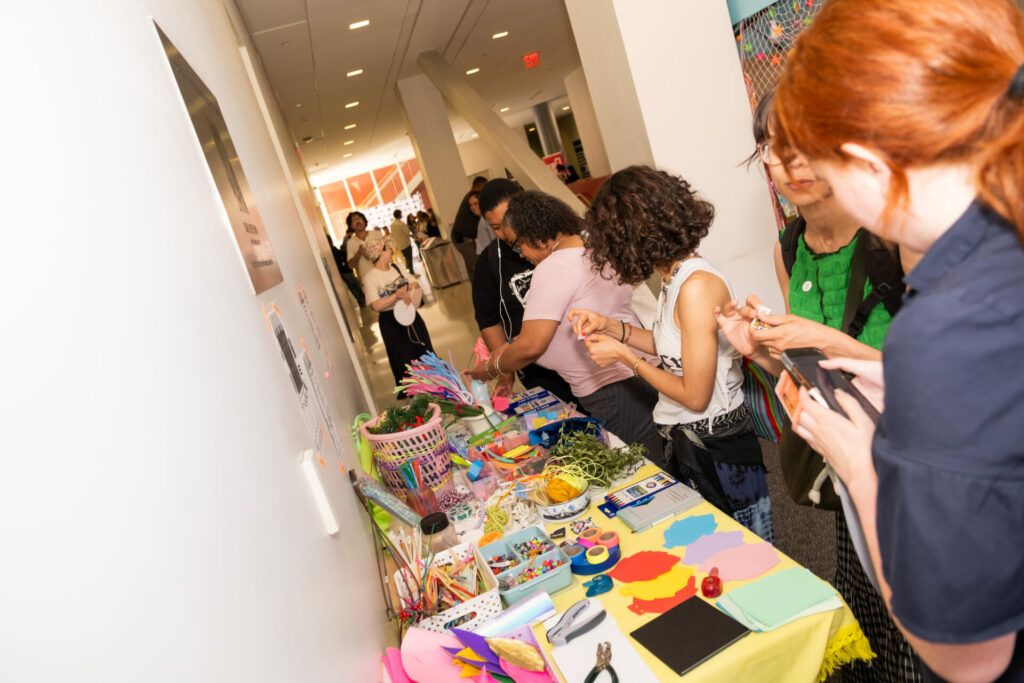
This participatory and tactile quality becomes especially meaningful when viewed through the lens of memory care and dementia-informed art engagement. As an art educator working with older adults and people living with dementia, I am particularly drawn to the way Díaz’s work values presence over mastery and connection over interpretation. In memory-care settings, creative engagement often moves away from correcting memory or restoring narrative coherence and instead focuses on sensory participation, emotional resonance, and shared experience. Touch, rhythm, repetition, and play become essential forms of communication. Díaz’s work intuitively operates within this framework. Her installations do not require viewers to “understand” the work through analytical interpretation alone. Rather, they create opportunities for people to remain active participants through tactile and sensory engagement (see Figure 2).
For people living with dementia and their caregivers, creativity is more than pastime. It can become a form of presence, dignity, and even quiet activism. In a society quick to relegate those with changing cognitive abilities to the margins —to treat them as diminished, forgotten, or reduced to diagnosis— the act of making becomes a declaration of continued personhood. Whether through painting, singing, cooking, playing an instrument, or engaging in imaginative conversation, creative practice insists that relation is still possible and that communication can take forms beyond verbal recall. This perspective opens a productive dialogue with Díaz’s work. Her installations are not designed around passive viewing, but around communication, co-creation, and shared presence. The value of the experience lies less in producing a finished object than in sustaining connection through gesture, touch, imagination, and relational attention. This is perhaps why the “here and now” aspect of her practice feels so important. Díaz describes her work as “very interwoven and in the here and now,” a phrase that resonates deeply within dementia-informed art engagement. Dementia often disrupts chronological memory and verbal recall, yet moments of sensory and emotional connection remain profoundly meaningful. In this context, the present moment becomes not a diminished space of forgetting, but a meaningful site of creativity and relation. Díaz’s work honors that kind of presence. Her installations encourage participants to linger, touch, move, notice, and create alongside one another without demanding certainty, expertise, or fixed interpretation. The experience becomes valuable precisely because it allows people to remain connected within a collective sensory environment.
The tactile dimension of Díaz’s work is central to this process. Texture, weaving, layering, and repetitive gestures operate not simply as aesthetic strategies but as forms of communication. Touch becomes a way of establishing relation between bodies, materials, and memories. This emphasis on tactile interaction is especially powerful because contemporary art culture so often privileges visuality and intellectual distance. Díaz instead foregrounds the hand, the body, and the sensory encounter. Her use of found and upcycled materials further reinforces this accessibility. School supplies, fabric, thread, paper, and organic matter create an atmosphere that feels familiar rather than intimidating. The materials invite participation precisely because they resist elitism and virtuosity. Creativity becomes something communal and available rather than specialized or exclusive.
In this sense, Díaz’s work also recalls ancestral textile traditions throughout the Afro-Caribbean diaspora. Textile practices such as weaving, sewing, embroidery, and knotting have historically functioned not only as decorative labor but as communal forms of care, storytelling, and memory-making. As Rachel L. Mordecai argues, Caribbean textile practices operate as sites where women’s hands “perform tasks of taking care, bearing witness, and rendering memory material.” These tactile traditions carry histories of migration, kinship, labor, and resilience through repetitive and embodied acts of making. Díaz’s installations echo these traditions through their emphasis on interconnection and accumulation. The repeated gestures within her work suggest that memory is not stored statically in objects alone, but sustained through process, touch, and relation. The hand itself becomes archival.
This understanding of embodied memory is especially important when considering the limitations of traditional archives in representing Afro-Caribbean histories. Colonial archives have frequently fragmented or excluded Black Caribbean experiences, privileging official documentation over sensory, oral, and communal forms of knowledge. Diana Taylor’s concept of the repertoire is useful here, as she argues that embodied practices such as gesture, movement, orality, and performance function as forms of cultural memory often excluded from traditional archival systems. Díaz’s tactile and participatory installations similarly position memory as something enacted collectively through touch, repetition, and relation rather than preserved solely through official documentation. As Diana Taylor states in The Archive and the Repertoire (2003), “The repertoire enacts embodied memory: performances, gestures, orality, movement, dance, singing —in short, all those acts usually thought of as ephemeral, nonproducible knowledge.”
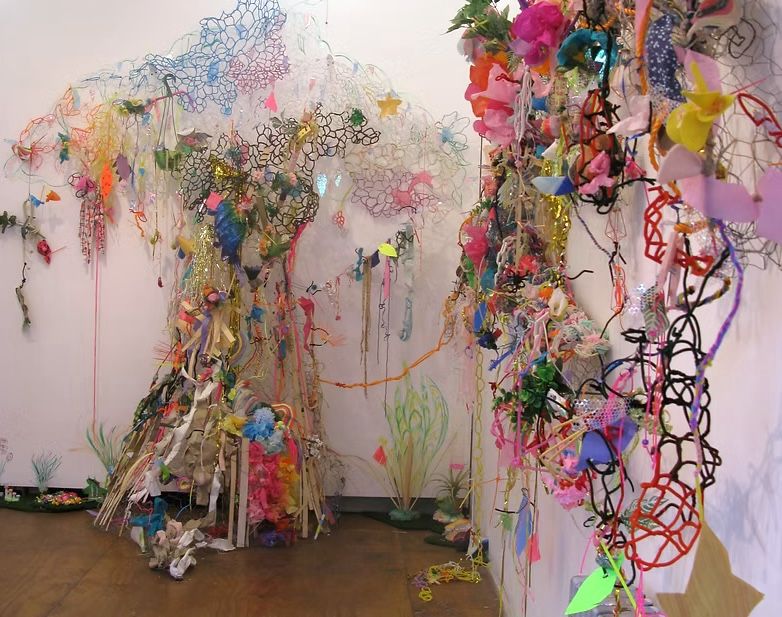
The organic and ecological dimensions of her work deepen this relational framework even further. Díaz frequently references habitats, coexistence, growth, and natural systems within her installations. Nature in her work is not simply represented visually but functions as a conceptual model for relation itself. Organic materials, woven forms, and layered environments mirror ecosystems built through interdependence and adaptation. Nothing exists in isolation. The work grows through contact and proximity, much like the communities it temporarily gathers together. From a memory-care perspective, these organic and tactile environments can also provide grounding and familiarity for participants experiencing cognitive decline. Natural textures, repetitive forms, softness, and sensory materials encourage calm attentiveness and embodied engagement (see Figure 3).
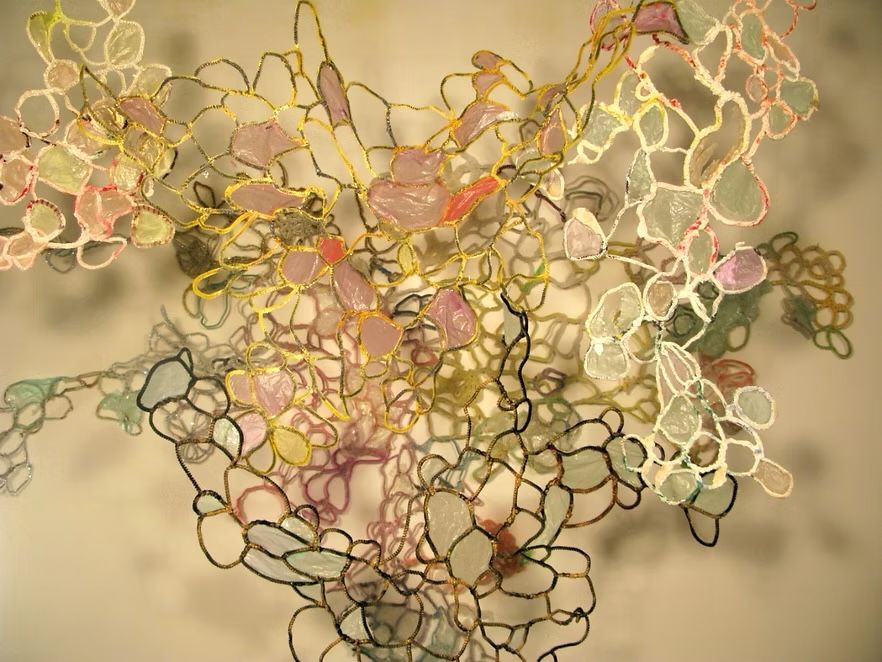
Ultimately, Melissa Diaz’s work offers an important intervention within contemporary Caribbean and diasporic art because it foregrounds connection itself as a meaningful cultural practice. Through tactile interaction, co-creation, and sensory participation, her installations create temporary communities grounded in shared presence rather than fixed identity. Her work reminds us that art can function not only as representation or critique, but as a relational environment where people gather, communicate, and care for one another in real time. This is what makes her practice particularly significant within both Afro-Caribbean artistic discourse and memory-care pedagogy. Diaz demonstrates that creativity is not simply about producing objects or preserving narratives, but about sustaining forms of relation through touch, participation, and the ongoing experience of being together in the here and now.
References
- Díaz, Melissa. 2014. Melissa Diaz at Artspa. Vimeo, October 13.
- Díaz, Melissa. “Nature vs. Nurture. Melissa Diaz, Tumblr, Video https://melissadiaz-art.tumblr.com/ Timestamp 0:30 – 2:20.
- Mordecai, Rachel L. 2021. “Scenes of (Un)Making: Caribbean Women’s Textile/Textual Practice.” SX Salon, Small Axe Project. <https://smallaxe.net/sxsalon/discussions/scenes-unmaking-caribbean-womens-textiletextual-practice>.
- Taylor, Diana. 2003. “The Repertoire Enacts Embodied Memory: Performances, Gestures, Orality, Movement, Dance, Singing—in short, all those acts usually thought of as ephemeral, nonreproducible knowledge.” The Archive and the Repertoire: Performing Cultural Memory in the Americas. Duke University Press.