


Part two of a four-part series.
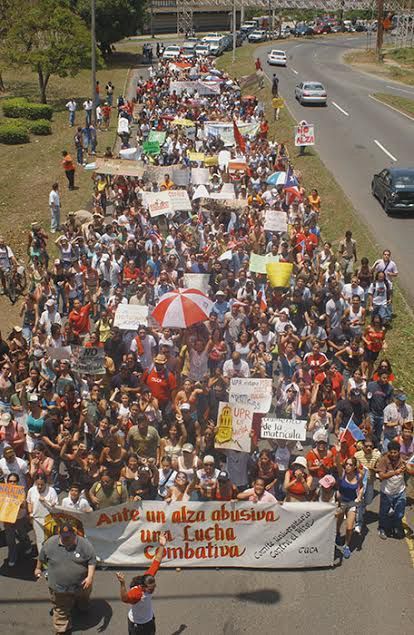
The second half of the 1980s was relatively uneventful at the University of Puerto Rico (UPR). Student organizations that had been at the forefront of the 1981-82 UPR student strike remained active, but remained small amidst the growing political crisis of the Puerto Rican and international political Left.
When the possibility of the first tuition increase in 10 years began to be discussed in early 1991, it set off a series of paros (stoppages) leading up to a three-week strike that involved campuses beyond Río Piedras and Mayagüez.[1] The Río Piedras general assembly declared two 24-hour paros prior to the increase, which was approved by the Consejo de Educación Superior (CES) in July, and a 48-hour paro demanding an income-adjusted system, as soon as the fall semester began in late August. Amidst tensions between pro- and anti-strike students, the spokesperson of Unión de Juventudes Socialistas (UJS), María Judith Oliveros, was elected student council president.
Students continued to demonstrate, holding a fourth paro in early April of 1992. This fourth paro prompted the formal adoption of a “Non-confrontation Policy” by the Academic Senate, whose spirit is still often invoked by campus groups when conflict emerges. The policy did not bar the possibility of student or employee paros, it merely expressed a commitment to working them out through institutional mechanisms, rather than resorting to the police.
A fifth paro began on the morning of April 23, which was extended indefinitely. The Chancellor then declared a recess which kept the campus closed until a general assembly voted to end the strike in a tight vote in mid-May, ratified by yet another assembly a week later. The tuition increase remained in place, without any partial gains for the students.
Despite the large attendance at several of the student assemblies that took place, limited participation (the actual student occupation of the campus during the “indefinite strike” lasted only three days) and the administration’s resolve to avoid confrontation at all costs resulted in an inability of the movement to gain any traction. The end of the strike was followed by a five-year lull in student protest, aside from support for employee unions.
Barely one year later, a new law was passed transforming the CES into a Junta de Síndicos (Board of Trustees), charged with transforming the UPR into a leaner, more “efficient” revenue-generating institution.[2] The student Left agitated against the measure, but the general response was limited. It was not until 1997, with talk of the privatization of the Telephone Company in the air, that tensions began to stir again, when the Secretary of State sparked a near-riot by showing up unannounced at the Río Piedras campus.
This and other events leading up to the “People’s Strike” against the privatization of the Telephone Company in the summer of 1998 reignited the student movement. Broader student presence was visible at marches and other large events, while student Left organizations were active at picket lines throughout the duration of that conflict. However, it was the eruption of the renewed struggle against the U.S. Navy’s presence on Vieques, following the death of David Sanes in April of 1999, that marked the revival of the UPR student movement at large.
Hundreds of the more than 1,000 activists who received and carried out one- to six-month long sentences at the Guaynabo federal detention center for trespassing on U.S. Navy property during the four-year long civil disobedience campaign were UPR students. In April 2001, a picket at the now off-campus Río Piedras ROTC headquarters resulted in the sentencing of UJS member Pedro Colón Almenas to one year in federal prison for allegedly striking an ROTC officer.
U.S. wars in Iraq and Afghanistan also fanned the flames of student activism. On the day the U.S. invaded Iraq in February 2003, hundreds of UPR students immediately walked out and mobilized to Fort Buchanan in Guaynabo, where they were joined by other activists in a sizeable demonstration, which resulted in confrontations with Military Police. At the Mayagüez campus, student mobilization led to the formation in 2001 of the Frente Unido por la Desmilitarización y la Educación (FUDE).
In September 2003, FUDE set up a civil disobedience camp on land slated for the construction of a new Air Force ROTC building with UPR funds. In March 2004, following six months of pickets, marches, building occupations, and a one-week hunger strike, an agreement was reached with campus administrators, stating that the new building would be put to other uses. However, a faculty member who had supported the students was fired from his post, prompting an abortive and unsuccessful 24-hour paro at Mayagüez and Río Piedras demanding his reinstatement in October.
Although anti-militarism was the main focus of the student movement during the first half-decade of the new century, it was not the only issue that students rallied around. In October 2003, a march against privatization plans at the UPR drew a considerable turnout at the Río Piedras campus. In early April 2004, a student general assembly at Río Piedras approved an indefinite strike against cuts in summer classes, despite the opposition of some Left organizations, which insisted the movement was ill-prepared for a prolonged struggle. Nonetheless, the strike took place and the administration repealed the hike three day later. This deceptively simple success seemed to some student leaders, in retrospect, like an attempt by the administration to take the movement’s “pulse” in preparation for what was to come.
In late March of 2005, the Board of Trustees approved a new, across-the-board tuition increase, to be implemented at the beginning of the next semester. The announcement, following an at an extraordinary meeting of the Board, caught a fragmented and dispersed student movement off guard.[3]
The differences within the student movement were evidenced at an informational meeting organized by the newly elected Río Piedras student council in early April. At Río Piedras, a general assembly of the student body to discuss the issue was celebrated a week after the hike was certified. The student Left again argued against striking, proposing instead to use what remained of the semester to build and organize support for a strike in the fall, if the hike was not repealed.
Nonetheless, the generalized mood was one of hostility towards an administration perceived as extravagant in spending unrelated to students’ direct needs. In that context, the strike proposal carried the day and a Comité Unido Contra el Alza (CUCA) was hastily put together. Despite their misgivings, the organizations of the student Left now took the initiative, determined not to suspend the strike without securing concessions.
Students at 9 of the UPR system’s 10 other campuses also declared paros ranging from 24 hours to indefinite over the following weeks. Unlike previous strikes, there was no consensus within the CUCA itself to support an income-adjusted alternative to the across-the-board-hike, as some now argued for universal free tuition. The only cohesive demand of the 2005 strike was a repeal of the tuition increase.
It soon became evident that fears about the movement’s readiness had not been unfounded. Despite the majority vote and large turnout at the assembly, student presence at the gates of the Río Piedras campus the next morning was reduced to a few dozen, mostly from the existing organizations. Nonetheless, a march from the campus to the Central Administration building, held on the following Monday, drew over a thousand students, as well as members of the faculty and employee unions. In addition, the strike was ratified by majority vote at an extraordinary assembly called by the Río Piedras student council, held two days later.
A few days later, a group of students and faculty rallied in protest against the strike. The division manifested itself within the student council, after the president resigned. She was succeeded as interim president by vice-president Ernesto Chévere, a known strike supporter. On April 20, the council met without Chévere, voted to replace him, and immediately announced a new assembly to consider ending the strike. The assembly was held at an off campus site on April 26, and was cut short by a violent altercation between CUCA members and those against continuing the strike.
Demoralization within the ranks of the movement itself, nurtured by lack of public support, had already decimated the number of students actively defending the picket lines at campus entrances. A further violent incident among nominal strike supporters, which took place upon returning to campus after the aborted assembly, further demoralized strikers and worsened already extremely negative press coverage. As in 1992, the administration had opted to bet on time rather than repression, resisting calls for police intervention.
On the night of April 28, CUCA negotiators and the UPR President reached a preliminary agreement, which was ratified by the Board of Trustees and an impromptu student assembly on the following day. The agreement, which was harshly criticized as insufficient by some CUCA members, postponed the hike for at least one semester, and established a committee to study the financial situation, composed of representatives of the student, faculty, and administration. This committee published a partial report in the summer in which it concluded that the hike was not necessary.
However, under the pressure of intensely negative perceptions among the student body, CUCA soon fell apart, and was unable to sustain mobilization to defend the report’s conclusions once classes began in the fall. The administration withdrew its participation in the study, and implemented the hike in the spring semester, with little opposition.
The student leaders that emerged from the Vieques movement and other anti-military mobilizations of the early 2000s were highly committed, eager, and tactically experienced, but strategically lacking, according to the self-assessment of those whom I have interviewed. Although largely remembered as a catastrophic failure (when remembered at all), for many participants, the 2005 UPR student strike was crucial learning experience. Many who would go on to become celebrated as leaders of widely celebrated, more recent movements within and beyond the university, first “cut their teeth” in real-world politics during that process.
References
Laguarta Ramírez, José A. 2016. Struggling to learn, learning to struggle: Strategy and structure in the 2010-2011 University of Puerto Rico Student Strike. Ph.D. diss., The Graduate Center, City University of New York. Accessed February 6, 2026 <https://academicworks.cuny.edu/gc_etds/1359/>.
Ramos Rodríguez, Isabel, et al. 2008. Lucha y conciliación en la universidad: Contexto, desarrollo y proyección de la política de no confrontación. San Juan: Publicaciones Puertorriqueñas.
[1] The following summary is adapted from Laguarta Ramírez 2016: 193-194, which is largely based on Ramos Rodríguez, et al. 2008.
[2] The following paragraphs are adapted from Laguarta Ramírez 2016: 193-197.
[3] The following summary is adapted from Laguarta Ramírez 2016: 197-200.