

Porto Rico non existe! – exclaimed a frustrated mail clerk in Italy. I had been visiting a friend and decided to send a care package to my family back home. Fabio, the employee, was unable to locate Puerto Rico in the system. I sank as I heard his words. Eventually the matter was resolved but for a few moments, I was filled with an existential dread I didn’t realize I carried. There’s an inherent ambiguity that comes with being Puerto Rican: a country with a strong sense of self but is not sovereign, an ex-colony of Spain that is often excluded from Latin American discourse, a US territory that is not quite part of the United States. The shaky foundation on which our identity is built often creates a sort of longing for recognition or some form of acknowledgment of our existence. I was reminded of the incident with Fabio while researching Pablo Delano’s participation in the Biennale di Venezia. Curator Adriano Pedrosa included the Puerto Rican artist in the central pavilion exhibition titled Foreigners Everywhere.1 Puerto Rico has been represented in the Biennale before, though not as a participating country with its own pavilion.2 Reflecting on the exposition, the artist wrote: “Puerto Ricans epitomize the notion of Foreigners Everywhere. While we may possess U.S. citizenship, we live as foreigners in our own country, in the land of our colonizer, and wherever we may travel.” (Delano 2025). Porto Rico non existe, the phrase uttered long ago seems to once more rub the proverbial salt into the colonial wound.
The idea of being a constant foreigner relates to Pablo Delano’s life and work and of the Puerto Rican Diasporic experience. He is the son of two artists, Jack Delano and Irene Delano, who moved to Puerto Rico in the 1940s and deeply embedded themselves in Puerto Rican art and culture. After being born and raised on the island, Pablo Delano left to study art in the United States and has lived there for most of his career despite always referring to Puerto Rico as his home. In a 1997 exhibit held at Dartmouth College, he was described as a “foreigner in America”, emphasizing the sense of displacement (Irizarry 2029, 8) many Puerto Ricans feel.3
Formally trained as a painter, Delano began to gravitate towards photography after moving to New York City in 1979. (Irizarry 2019, 5). Through artistic framing, Delano conjured images that can eloquently speak of the lived experiences of the marginalized Puerto Rican and Dominican communities of the Lower East Side. He captured buildings in ruin and improvised housings with the Empire State Building looming in the background,4 images that showed the juxtaposition of the capitalist rhetoric of the American dream with the reality of those who are excluded from it. Delano explored similar themes in his series of photographs of Hartford, Connecticut, contrasting abandoned and impoverished areas with high rise modern architecture.5
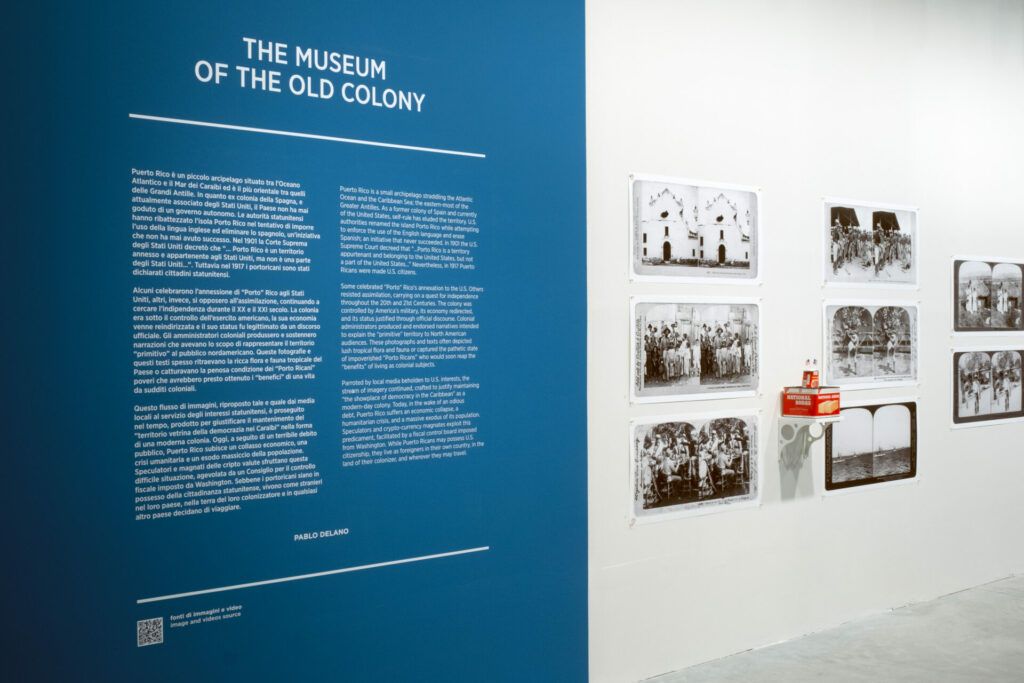
Between 1997 and 2008 he did a series of photographs in Trinidad and Tobago, In Trinidad, documenting traditions and religions of this multicultural Caribbean island that had a similar colonial past to Puerto Rico (Historia 2013). This sparked an interest that led into what is perhaps his most ambitious project, The Museum of the Old Colony: an ever changing and site specific installation of a series of found objects, photographs and documents that relate to Puerto Rico’s colonial relationship to the United States. It is a sort of archival process spanning over two decades in which the artist documents and interprets objects that embody the painful colonial history of Puerto Rico (Delgado 2022). It has been shown in Trinidad and Tobago (2016), Jamaica (2016), Argentina (2016), New York City (2017, 2020), Puerto Rico (2017, 2022), Massachusetts (2018), Maryland (2020), Virginia (2022) and most recently in the Biennale (2024). The title refers to a soda, Old Colony, originally from the United States, that became a part of Puerto Rican idiosyncrasy. The name of this drink and the logo showing an American Revolutionary War soldier, humorously relates to what is considered to be the oldest colony.6 It is a clever way of speaking to the specificity of Puerto Rican culture whilst criticizing US colonial rule. This playfulness can be found throughout the installation. For example, at the Duke Hall Gallery of Fine Arts in Virginia (2022), the artist included an altar to Eleguá, the Orisha of crossroads, with objects associated with the worship of this Yoruba deity, as an homage to Caribbean religious syncretism.7 He also placed bottles of Florida Water Cologne and a jar of Vicks VapoRub, objects frequently used by curanderos (Comerford 1996, 329) that are also ubiquitous in Puerto Rican households. These items speak of the colonial reality of the island and the Caribbean as whole. Florida Water is an American product, but its name relates to Juan Ponce de León’s search for the fountain of Eternal Youth in Florida. The term cologne in Spanish is colonia or colony, an intentional play on words.8

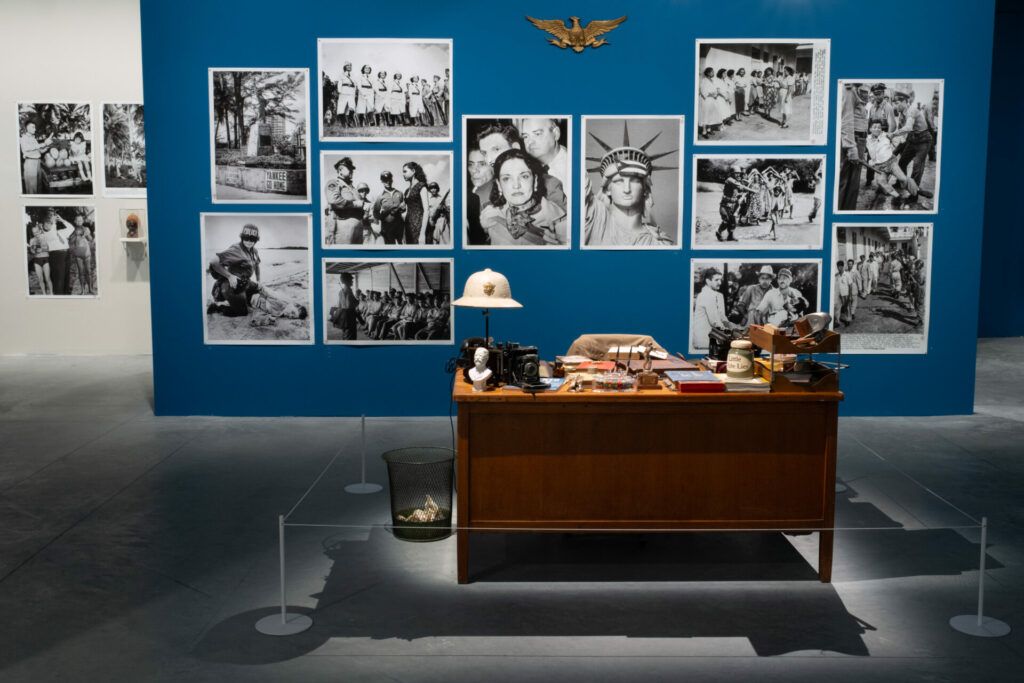
A considerable portion of the installation is centered on photography and its role in justifying US imperialism. The images included in books and military reports are appropriated by Delano through scans and reproductions to expose the racist and paternalistic ideology behind US rule over Puerto Rico. The artist questions the role photography has in othering the subjects that are portrayed.9 He focuses mostly on anonymous works that don’t inherently have artistic merit but were visual registers of US colonialism.10 It is a profound reflection made by an artist who practices this medium. In a similar exercise as in his photography, Delano employs juxtaposition, in this case, between objects and images that show the underlying contradictions of Puerto Rico’s colonial status.11
Many of the photos are extremely racist. One jarring image from 1899, shows five white Americans drinking coconut water and a young naked black Puerto Rican on top of a palm tree. The original caption of the photo states that the “native” cut the coconuts for the colonizers.12 It is a staged image that has no bearing on the real lived experience of the boy but rather focuses on the American’s enjoyment of the tropical fruit. At the Duke Hall Gallery of Fine Arts, near these photos there was a grouping of objects, Platos y Cocos (Plates and Coconuts): a table with coconuts and souvenir plates with Puerto Rican maps,13 that make a broader comment on American tourist consumption of the island. The installation usually has a desk filled with books and publications of US colonial propaganda. Near them, a jar with a label that reads: Little White Lies, alluding to the propaganda disseminated in those texts as well as the racist foundations of colonialism.14 This desk is the workspace of an imaginary archivist. By the uniform coat that rests on the seat, it would suggest to be an American military that’s examining and collecting these books, photos and souvenirs. (Rodriguez-González, 2024)
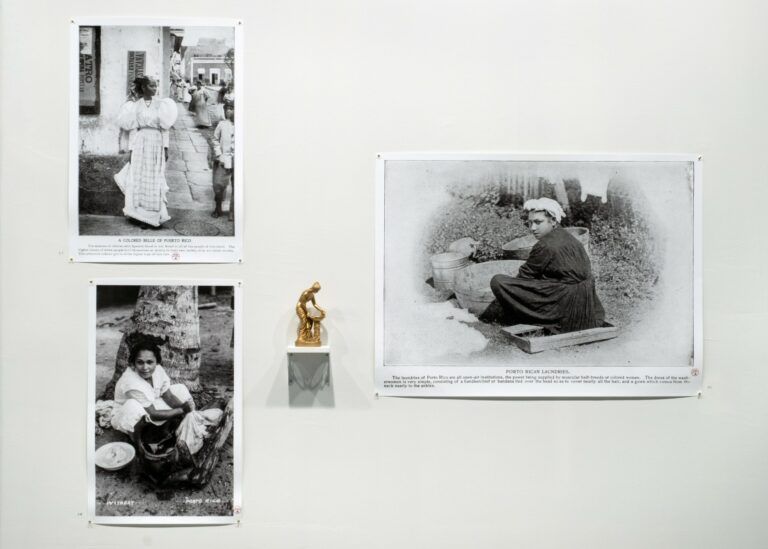
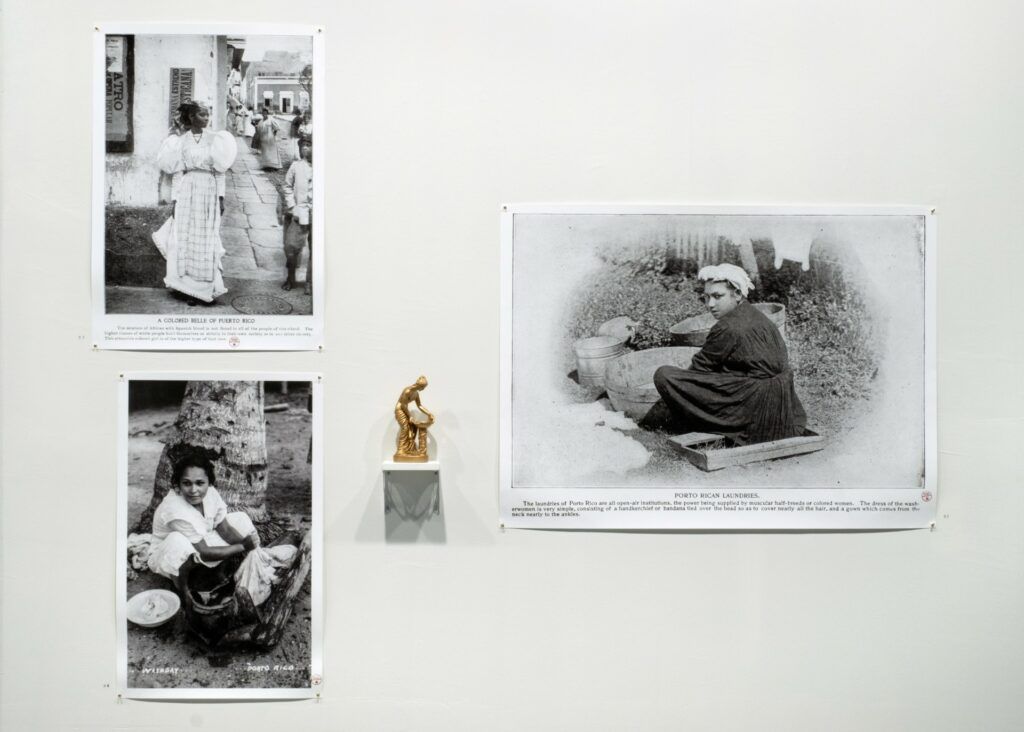
The Museum of the Old Colony is not meant for Puerto Rican audiences only and challenges the viewers to think of their particular context and what part they play in racist, imperialistic structures (Berger 2020, 7). It is also a harsh critique of the idea of the modern museum that reiterates European ideologies and often houses pieces that were stolen during military occupations. Delano’s appropriation of objects under the guise of a Museum posits art institutions as complicit to imperialistic and racist ideologies.15 There is a curatorial aspect to the work,16 reminiscent of Fred Wilson’s famous installation Mining the Museum, 1992. Delano carefully selects and groups the objects and photographs to create interconnections that also reflect art historical biases. For example, at the Biennale, there was series of photographs of Puerto Rican women, such as Colored Belle of Puerto Rico,17 displayed near a kitschy statuette of a bathing Venus. (Rivera 2024). The artist is dismantling art historical conventions of the ideal female nude that reiterate white European notions of beauty. Delano also thinks of the place where his Museum will be exhibited and its relationship with the themes explored in the piece. The central pavilion of the Biennale was originally a garden created by Napoleon Bonaparte.18 By occupying a space rooted in European imperialism, Delano’s installation further problematizes traditional art spaces.19
There is also an autobiographical element to this piece. The ongoing examination of Puerto Rican history is born out of Delano’s implacable love to his native land: “My entire output as an artist has been shaped by my upbringing and my love for Puerto Rico, but in the last years I’ve felt an urgency to address the plight of the island more directly in my work, to address it head-on”. (Berger 2020, 4). For over two decades, Delano has been thinking about the political and social problems of the island and making a very personal reflection through this ever shifting conceptual artwork. It’s a poetic and artistic interpretation of Puerto Rican history which he feels inexorably his. Of this personal aspect of his work, Delano stated: “It’s not meant to be authoritative in any sense, or to represent anything but my own take on the past and present of the place I was born and raised, the one place in the world where to this day, even after living away from the island for so many years, I most feel that I belong.” (Berger 2020, 7). It is precisely this never waning connection to the island what makes this art project so deeply moving. It is an artist’s reclaiming of his homeland’s history. It is also an affirmation of a Puerto Rican identity that continues to flourish despite every attempt to erase it. When reviewing the piece at the Biennale, Anabelle Rodríguez-González noted that many Puerto Ricans who saw the installation were moved to tears and speculated what could’ve triggered this response: “Me parece que [las lágrimas] se deben al reconocimiento de que ante este asalto hemos logrado seguir existiendo. Seguimos luchando y hasta riendo y gozando. No nos han quitado eso…la instalación, aunque sea difícil o dolorosa, nos afirma y afirma nuestro derecho a existir…” (Rodríguez-González, 2024).20 The installation gives visibility to the Puerto Rican experience and in doing so, proclaims our right to exist. Pablo Delano’s Museum points to what lies outside of those images: the real place and people that cannot be reduced to colonial propaganda. By exposing the ugly and painful truth of colonialism, the artist allows us to better understand our history. Puerto Rico does, in fact, exist beyond the painful narratives that have failed to define us.
Footnotes
- Pedrosa had seen the installation when he visited the exhibition (Re)conocer el Futuro in Museo de Arte Contemporáneo (MAC) of Santurce held between 2022 y 2023. See Rodríguez-González (2024).
- “Where does Puerto Rico fit into the register of world nations, or into the Biennale for that matter? Not recognized as an independent country by Italy or any other country, it ‘belongs to but is not a part of the United States’ according to U.S. law. Therefore, it does not qualify for a national pavilion at the Biennale.” Delano (2025).
- See Irrizary, 2019, 8.
- For example, Pablo Delano’s photograph East 5th St. betwen Avenue C and Avenue D, from a series of photos of Loisaida, taken between 1981-1984. See Artist’s website < http://www.pablodelano.com/project/oisaida-1980-1984/>. Accessed April 20, 2025.
- These images can be seen at the artist’s website: <http://www.pablodelano.com/hartford/intro–scenes–civic/>. Accessed April 20, 2025. The series of photos of Hartford began shortly after he started working in Trinity College, 1996, and was exhibited in 2014. The works were published in the book Hartford, Seen in 2020 by Wesleyan University Press.
- About this logo, Delano wrote: “In essence, it is a striking metaphor in the world’s oldest continuous colony, now ravaged by diabetes, onerous debt to Wall Street and cruel austerity measures imposed under imperial subjugation.” Delano (2025).
- Images of this section of The Museum of the Old Colony exhibited at Duke Hall Gallery of Fine Art in 2022 can be seen in Mirabal, 2023: https://www.latinxproject.nyu.edu/intervenxions/estrangement-restlessness-and-rupture-pablo-delano-and-the-rethinking-of-puerto-rico
- Pablo Delano is continuing his examination of Caribbean identities with his most recent project cuestiones caribeñas/caribbean matters first exhibited at the Austin Arts Center at Trinity in 2023, curated by Dr. Amanda J. Guzmán and a new version will be exhibited August 2025 at the Chazen Museum of Art and curated by Jorell A. Meléndez-Badillo, Ph.D. and Aurora Santiago Ortiz, Ph.D. See: https://chazen.wisc.edu/exhibitions/caribbean-matters-cuestiones-caribenas-assemblage-and-sculpture-by-pablo-delano/ . It seems to be a continuation of The Museum of The Old Colony but examining the Caribbean at large and not just focusing on Puerto Rico. His exhibition My Paradise is Hell, that opened in October 2025 in Embajada, Puerto Rico, included a section of found objects of different Caribbean islands, continuing his interest in exploring a shared colonial history of so many countries in the region.
- In an interview with curator Amy Halliday, Pablo Delano remarked that the US brought photographers along with the military troops. The photos that were taken were reproduced in books, news articles and magazines and served to reinforce the notion that US colonial rule was beneficial to the people who lived on the island. They reinforced a paternalistic and often racist view of Puerto Ricans and the idea of the American colonizers as saviors of the native population. He also comments on the ability of photography to perpetuate lies that are necessary in the justification of colonial rule. See Amherst Media (2018). A fascinating parallel could be drawn between these photos and the woodcuts and engravings that illustrated European accounts of the Americas during the XV and XVII century that also served to justify imperialism and reiterated racist imagery.
- It should be noted that his father, Jack Delano, was first sent to Puerto Rico by the Farm Security Administration (FSA), with a number of photographers, to document Puerto Rico’s poverty for the Federal government. When questioned by the Italian press why he didn’t include some of the images taken by his father in The Museum of the Old Colony, he stated that he was excluding photos taken by established artists and focusing on anonymous images, see De Leonardis, 2024. Surely the images captured by the trained artists sent by the FSA present much more formal complexities than others taken purely as propaganda. However, there is also a different sensibility in these images. We cannot discount the fact that the Delanos and the Rosskams were so moved by what they saw that they felt the need to return to the island and actively help Puerto Rican people in many ways. Instead of othering, the photographic exercise seemed to spark a deep connection, something that might be behind Pablo Delano’s own artistic practice.
- Nelson Rivera also noted the similarities between Delano’s photographic eye and how he organized The Museum of the Old Colony. See Rivera (2024).
- The original caption read: “The above shows the American enjoying himself in the tropics. After walking two or three miles in the hot sun, nothing can quite refresh one as to drink the water from one or two cocoanuts. The native lad has just been up the tree and cut down as many as the ‘Americanos’ wanted. The cocoanuts are also sold on the streets of the Capital every morning and are a pleasant and healthy drink.” Berger (2020, 5).
- Images of this grouping can be seen in Mirabal (2023).
- See images included in Rodríguez-González (2024).
- “Obviously it’s not a brick-and-mortar museum, it’s an exhibit that’s named after the idea, it’s more the concept of the museum. And so I created the whole …concept of the piece based also on the notion of the role that museums have had in our society. Museums haven’t been around that long, really, when you think about it, a few centuries perhaps. And museums have always had an agenda, a curatorial point of view, a purpose. In fact there are many museums which in the past have served to justify empire, to justify the dominance of some people by other people. And that also plays into your question…”- Pablo Delano in Amherst Media (2018).
- Anabelle Rodríguez-González comments that the desk in the installation belongs to an imaginary curator, because of the military coat placed on the chair, it could be a US general browsing the archives of the Old Colony. See Rodríguez-González (2024).
- The photograph was originally published in White, Trumbull. (1898). Our new possessions.A graphic account, descriptive and historical, of the tropic islands of the sea which have fallen under our sway. Book I. The Philippine Islands. Book II. Puerto Rico. Book III. Cuba. Book IV. The Hawaiian Islands.Chicago, Ill.: National educational union, 357. A digital copy of the edition held at The University of Michigan library is available in the Hathi Trust Digital Library: <https://babel.hathitrust.org/cgi/pt?id=miun.ajl3653.0001.001&seq=1> Accessed October 24, 2025.
- The official website of the Biennale mentions the fact under the information of the Giardini, the location of the main pavilion. See: <https://www.labiennale.org/en/venues/giardini-della-biennale >. Accessed May 8, 2025.
- Delano also explores the similar problems Venice and Puerto Rico have with tourism. See Rodríguez-González (2024).
- My translation: “I feel that it is due to the recognition that despite this assault, we have been able to continue to exist. We continue fighting and even laughing and enjoying ourselves. They haven’t taken that from us. In other words, the installation, even though it’s difficult and painful, affirms us and affirms our right to exist (and in the context of the biennial, to exist in the world with the other nations).”
References
- Amherst Media. 2018. “The Museum of the Old Colony with artist Pablo Delano”, interview
with Amy Halliday, Director and curator of Hampshire College Art Gallery.
<https://www.youtube.com/watch?v=ZK0VDxOfMzU>. Accessed April 8, 2025 - Berger, Maurice.2020. Evidence of things not seen: Pablo Delano’s The Museum of the Old
Colony in The Museum of The Old Colony An Art Installation by Pablo Delano (Exh.
Cat.). Baltimore: Center for Art, Design and Visual Culture: 3-7.
<https://cadvc.umbc.edu/wp-content/uploads/sites/247/2020/02/Museum-of-The-Old-
Colony-2.pdf> . Accessed April 12, 2025. - Biennale di Venezia. Giardini della Biennale. <https://www.labiennale.org/en/venues/giardini-
della-biennale>. Accessed May 8, 2025. - Comerford, Simon C. 1996. “Medicinal Plants of Two Mayan Healers from San Andrés, Petén,
Guatemala.” Economic Botany 50, 3: 327–36. <http://www.jstor.org/stable/4255852>.
Accessed May 19, 2025. - De Leonardis, Manuela. 2024. Un archivio decoloniale di Porto Rico. L’opera di Pablo Delano
alla Biennale published in Artribune, May 25. < https://www.artribune.com/arti-visive/
fotografia/2024/05/pablo-delano-interviste-colonialismo/?fbclid=IwY2xjawKhYqhleH
RuA2FlbQIxMABicmlkETFlaWFvVkROcENsWERub0w3AR5ASgkM7HZlMpgBX_
Q-ss-f19rAUkJ-_n0oBDFRoSrfXpnKF1tn4rKpxZ33VQ_aem_xih2PxkR2dZS2CMmo
TA-PA>. Accessed May 10, 2025. - Delano, Pablo. 2025. The Museum of the Old Colony in La forma del caos/The Shape of Chaos-
Rivista La Biennale di Venezia,1: 192. - Pablo Delano official website.< http:// www.pablodelano.com>. Accessed April 20, 2025.
- Delgado, José A. 2022. Desde el lente del colonizador: El fotógrafo Pablo Delano lleva su
instalación “The Museum of the Old Colony” a la Universidad de James Madison de
Virgina in El Nuevo Día, February 23: 22,23. < https://www.pressreader.com/puerto-
rico/el-nuevo-dia1/20220223/281689733254646?srsltid=AfmBOooHvhgK4aQTOX2Iy
JPLJS03RAFr4uXFsC9wNXwUY9yP5jAScXeh>. Accessed March 24, 2025. - Irizarry, Guillermo B. 2019. A Specific Beauty: Pablo Delano’s Photography in New York City,
Hartford, and Santurce in Centro Journal 31 (1): 4-25. <http://biblioteca.uprc.edu:2048/
login?url=https://www.proquest.com/scholarly-journals/specific-beauty-pablo-delanos-
photography-new/docview/2230818284/se-2.>. Accessed April 20, 2025. - Mirabal, Elizabeth. 2023. Estrangement, Restlessness, and Rupture: Pablo Delano and the
Rethinking of Puerto Rico in The Latinx Project at New York University, Mar 28.
<https://www.latinxproject.nyu.edu/intervenxions/estrangement-restlessness-and-
rupture-pablo-delano-and-the-rethinking-of-puerto-rico>. Accessed April 8, 2025. - Noticel. 2013. ‘Historia, Legado, Imagen’, un recorrido por la carrera fotográfica de Pablo
Delano in Noticel, 22 de agosto. <https://www.noticel.com/vida/20130822/historia-
legado-imagen-un-recorrido-por-la-carrera-fotografica-de-pabl/>. Accessed May 15, 2025. - Rivera, Nelson. 2024. Pablo Delano, la Biennale de Venecia y Puerto Rico en 80 grados, July 10.
<https://www.80grados.net/pablo-delano-la-biennale-de-venecia-y-puerto-rico/ ?fbclid=
IwY2xjawKhYsFleHRuA2FlbQIxMABicmlkETFlaWFvVkROcENsWERub0w3AR5EP
BasGOUTS86kadNhx5gd6ntGynxkB-aLyFO0aUm4HfYzdjT2-QRlYKzX6A_aem_om
MkbZtGN0U0AGefopInoA>. Accessed May 2, 2025. - Rodríguez-Gonzáles, Anabelle. 2024. Pablo Delano planta bandera en la Bienal de Venecia con
“The Museum of the Old Colony.” Plástica: Revista de la Liga de Arte de San Juan,
June 16. <https://www.revistaplasticapr.org/post/pablo-delano-planta-bandera-en-la-
bienal-de-venecia>. Accessed April 10, 2025. - White, Trumbull. (1898). Our new possessions. A graphic account, descriptive and historical,
of the tropic islands of the sea which have fallen under our sway. Book I. The
Philippine Islands. Book II. Puerto Rico. Book III. Cuba. Book IV. The Hawaiian
Islands.Chicago, Ill. The Hathi Trust Digital Library: <https://babel.hathitrust.org/
cgi/pt?id=miun.ajl3653.0001.001&seq=1> .Accessed October 24, 2025.