

In the 2017 Netflix reboot of One Day at a Time, Puerto Rican cultural icon Rita Moreno plays Lydia Riera, a first-generation Cuban immigrant and grandmother living in Los Angeles. Except for occasional errands, most of her scenes unfold inside the apartment shared by three generations of her family: the kitchen, the living room, and her bedroom, partitioned off by a golden, floral curtain in lieu of a proper wall. Although the sitcom narrates a Cuban diasporic story, many Puerto Rican viewers recognize in it a familiar intimacy, one that exceeds shared immigration histories or Moreno’s own iconicity as a Nuyorican figure. More often, that recognition surfaces through a material sensorium anchored in the most ordinary objects and routines of everyday life: the moka pot on the stovetop; kitchen cabinets crowded with cereal boxes and spice jars, yet arranged with quiet precision; a crucifix and papal portrait affixed to the refrigerator door; bright fruit gathered in a no less bright ceramic bowl; the oversized wooden spoon standing upright in a clay pot; and breakfast patiently prepared in the early morning hours. Running through all of it are the accumulated traces of the abuelita and of so many other working-class Latina women’s bodies moving and bustling through space: the sediment of labor performed daily, invisibly, across years.
The same domestic familiarity pulses through Nuyorican artist Melissa Misla’s mixed-media canvases. Raised and based in Queens, Misla works with paint alongside collage and found materials. Returning persistently to the corners and surfaces of domestic interiors, her art takes shape through an intimate engagement with household labor and the people who perform it, enacting the racialized and gendered work of care that shapes Nuyorican life. These concerns extend to her aesthetic choices. In an interview, Misla described her relationship to materials in terms of access and improvisation: “I really am trying to use what I have next to me in that moment or what I can be creative with” (Ramos Delgado 2025). In her work, domestic labor is not simply represented as a subject matter. Misla’s own artistic labor—the patience required to meticulously render every ordinary object—resonates with the constant work of care and adaptation that maintaining a home demands.

In works such as La cocinita (2018), Misla seizes the intimacy of the Spanish diminutive to depict a small kitchen that appears long used, tended to, and repeatedly mended. Food still seems to simmer inside a dented tin pot, while a bunch of bananas rests on the windowsill ledge, as though left there in passing. On top of the refrigerator, a jar of Bustelo instant coffee sits hastily atop a tin of Keebler Export Sodas; alongside it, a Goya can—likely emptied of beans and repurposed for household miscellany—joins the assembly, each object serving as a small monument to improvisation. Elsewhere, as in Cuarto (2019), Misla turns to more private spaces—the bedroom and the bathroom—rendered with an almost devotional precision: sheets folded and layered without a crease, two shoe boxes and two pairs of slippers aligned impeccably at the foot of an ornate dresser, figurines and trinkets arranged on top, each appearing measured into its exact position. Human figures are almost absent in these images, yet each scene bears the residue of care. Someone has just left, and someone will soon return. The Spanish verb dibujar—to draw—traces back to a root meaning to give outline to form. Domestic labor, too, gives form to a home. Misla draws the contour that care leaves behind.

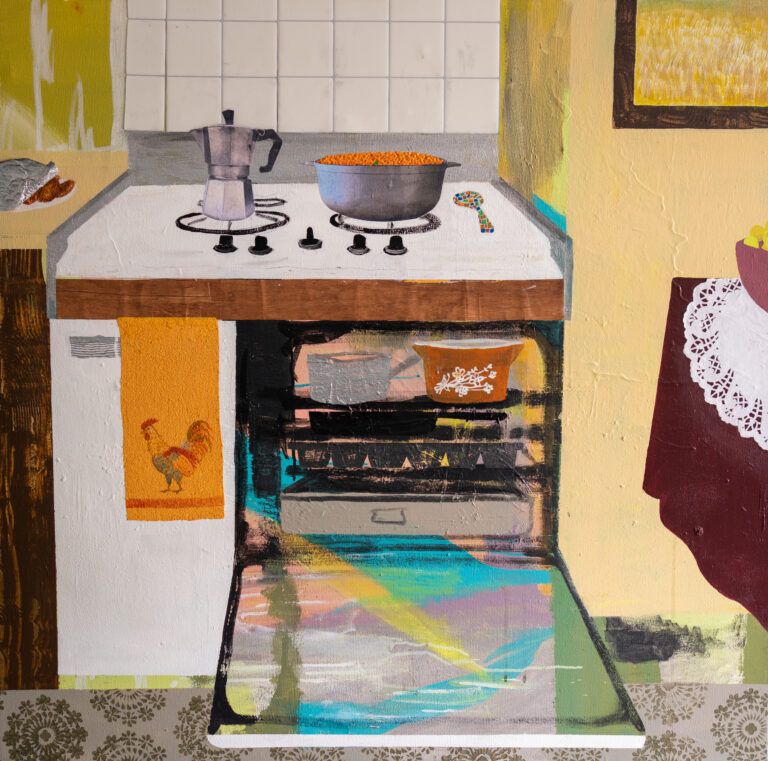
Misla’s compositions are frequently flat. This sets them apart from the nineteenth-century European tradition of interior painting, where perspective typically stabilizes a vision of orderly, coherent, securely possessed bourgeois domesticity, with objects softening into background light and space receding toward reassuring depth. Misla collapses that depth, pressing tables, cabinets, cookware, and walls into a single compressed plane. Objects look as if they have been scraped into place, their edges retained with an almost stubborn clarity. Some objects swell slightly beyond the scale that strict representation would permit, enlarged by the emotional weight accumulated through years of use and attachment. Others seem to verge on overflowing the boundaries of the canvas altogether, as with the running faucets that recur across several works.
Color also plays a key role in Misla’s search for her own language in relation to the domestic genre tradition. Her palette alternates between the exhausted brightness of immigrant working-class interiors and the lush sensuality often associated with Caribbean color. In La cocinita, creamy yellow, faded pink, and muted green create a warmth that nevertheless feels worn down by steam, touch, cooking oil, and humidity. Patches of darkened pigment spread unevenly across the canvas, producing a texture that feels handled, weathered, and lived with. In El comedor (2019), a dining room dense with flowers glows in electric lemon and coral pink—vivid, yet free of the polished smoothness of commercial imagery. Through these fluctuations of color, scale, and space, Misla pushes the domestic genre beyond a stable site of nostalgia and comfort, toward a more layered and materially saturated sentimental world, an ongoing field of negotiation shaped by feminized labor and working-class diasporic life.
Misla’s paintings ultimately ask viewers to reconsider what counts as “material” within the diasporic domestic genre itself. Materiality here extends beyond objects alone. It includes labor, maintenance, bodily presence, commodity culture, paint, memory, and artistic process. The canvas becomes a site where these different material conditions converge and rub against one another. Mass-produced commodities occupy a salient place within this world: canned food, soda packaging, Yankees caps, figurines, and devotional magnets. Misla treats these objects with attentiveness and care, investing them with emotional density through the patient act of rendering. She reveals that such objects accrue a significance exceeding their exchange value to become the most portable yet tenacious carriers of diasporic experience lived between worlds.

Several of Misla’s pieces were included in the DOMESTICANX exhibition (2022-–2023) at El Museo del Barrio, which placed them into explicit conversation with Chicana artist and theorist Amalia Mesa-Bains’s concept of domesticana, articulated in her essay “‘Domesticana’: The Sensibility of Chicana Rasquache.” Mesa-Bains’s framework traces the intersection of the domestic sphere and the cultural experience of working-class Chicana women, with an emphasis on spirituality, healing practices, and feminine aesthetics (Mesa-Bains 1999). Her own practice—renowned for elaborately constructed altars—works toward monumentalizing the religious rituals performed by Chicana and Latinx women at home, reclaiming domestic space as a site of resistance, emancipation, and cultural survival too easily overlooked. Misla, by contrast, stays with the ordinariness of the domestic. Her paintings remain embedded within the material conditions from which domesticana first emerged: limited means, inherited habits of care, and the creative entanglement of artistic labor with the ongoing work of everyday survival. Moments of quiet transcendence nevertheless surface unexpectedly. In Rice and Riches (2022), iridescent turquoise, lemon, and lavender light spill mysteriously across the oven door, as though the kitchen itself had briefly slipped into reverie, exposing the fleeting dreaminess latent within even the most mundane moments.
Misla’s two-dimensional planes also open onto other media. She has remade several works into cinemagraphs, capturing barely perceptible moments of change: a flame flickering on a stovetop, potted plants on a dining table slowly flourishing over time. More compelling still is the presence of a different medium within the paintings themselves: the family photograph. Both Cuarto and La cocinita, for example, incorporate framed group portraits—in Cuarto, what appears to be a young couple cradling a newborn; in La cocinita, older siblings holding an infant. These images activate what Marianne Hirsch calls the “affiliative look,” which the author defines as a relational form of identification: “Recognizing an image as familial elicits … a specific kind of readerly or spectatorial look, an affiliative look through which we are sutured into the image and through which we adopt the image into our own familial narrative” (Hirsch 1997, 93). By transposing private photographs into publicly exhibited painted surfaces, Misla enacts this affective economy of recognition and relation, drawing viewers themselves into the familial circuits of attachment the paintings construct. At the same time, the particular family structures chosen for these family frames pose a quiet comment on the heterosexual forms of inheritance and kinship that continue to organize dominant Puerto Rican and Latino imaginaries, just as they obscure the multiplicity of lives and intimacies that exist within them.
Misla’s mixed-media canvases remain attached to the sentimental without surrendering to sentimentality. The Nuyorican interiors she depicts remember not only the feeling of home, but also the dense material networks—above all, of gendered labor, maintenance, improvisation, and care—that make such feeling possible in the first place.
References
- Hirsch, Marianne. 1997. Family Frames: Photography, Narrative, and Postmemory. Harvard University Press.
- Mesa-Bains, Amalia. 1999. “‘Domesticana’: The Sensibility of Chicana Rasquache.” Aztlán: A Journal of Chicano Studies 24 (2): 157–167.
- Ramos Delgado, Coral. 2025. “Misla.” Center for Puerto Rican Studies, Hunter College.
- Accessed 10 May, 2026. <centropr.hunter.cuny.edu/publications/misla>.