

To encounter is to surrender distance and dare to venture inward. This leap places us within the thicket, that shared space that frightens and enlivens, as Nature’s unruly presence extends its roots to envelop and embrace us. Such an experience may seem difficult to imagine emerging from a two-dimensional surface, yet this phenomenological intensity is precisely what the electric brushstrokes and thick impasto of José Jun Martínez’s paintings provoke.
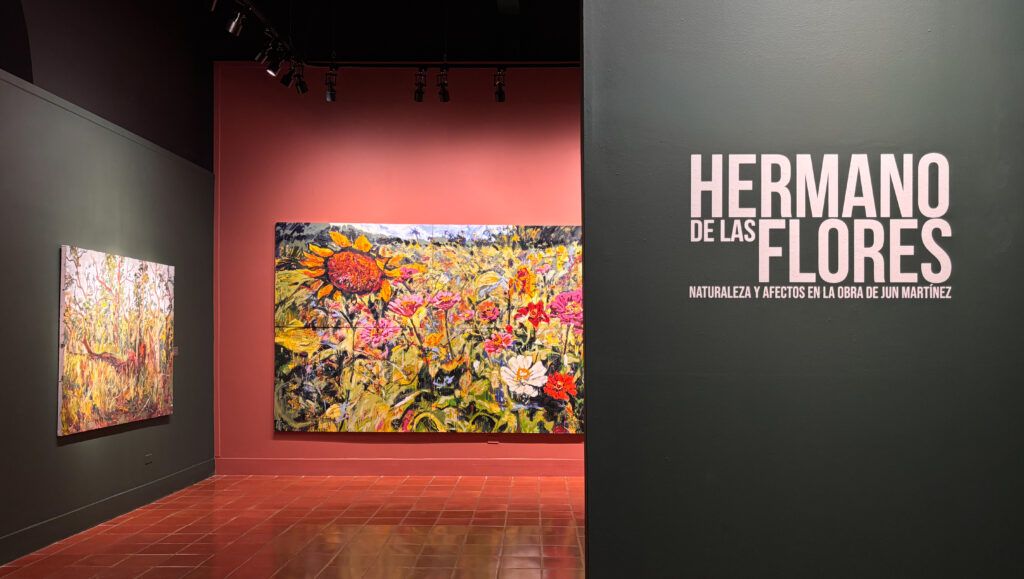
Born in the archipelago of Puerto Rico, José Jun Martínez is what some may call an anthophile, a lover of flowers. However, the artist relinquishes the position of distant admirer to assume the familial role of Hermano de las flores, title of his solo exhibition at the Museo de San Juan, presented from August 2025 through January 2026. The exhibition surveyed the last decade of his artistic career, tracing works made in Puerto Rico alongside recent paintings produced following his relocation to London.
Though it may come as a surprise to some, Martínez has remarked that he does not consider himself a landscape painter, insisting instead that he paints places of encounter. As he stated in an interview with Jackson’s Art (2025): “I paint places of encounter because…this is where you have the reflection about all this other stuff that we’re living and that we’re thinking and that we’re being affected by. I bring all of that with me. I cannot leave it out there.” This calls into question the ubiquity of the term “landscape” and its colonial and romanticized modes of representation that render Nature as passive and possessable. How might this shift in language and framing allow us to move beyond an acquiescent reading of the landscape genre? And might such a venture bring to the fore the critical histories, mystical encounters, and interspecies relations that tie us to the place of a painting?
As the Puerto Rican art historian Liliana Ramos Collado remarked, “the landscape overflows;” (Ramos 2014) its unfathomable extension cannot be contained within the surface of the canvas. Martínez paints from this understanding, working with what exceeds the frame, a world the margins cannot enclose. Such an encounter is accompanied by a phenomenological experience of time and place, as he explained (2025): “I need to be able to feel that things are happening outside of the canvas. The edges point me to the continuity of what’s coming next or what’s outside that I’m not seeing…” Throughout the exhibition, we glimpse at Martínez’s telluric journey as he navigates the perennial paroxysm that permeates our relationship to place and representations of Nature. (The title is a reference to José Jun Martínez’s solo exhibition, Perennial Paroxysm at Ordovas, London, United Kingdom, September 2025.)
Martínez began with painting en plein air. By arriving at a site and traversing it for hours, he sought an intimate understanding of place, engaging in a dialogue of exchange with the air, temperature, light, and humidity. This embodied experience situates the viewer in what Donna Harraway (2016) terms a “thick present,” a dense entanglement of past, present, and future relationships. Made familiar through the shared visual ground of a painting, Martinez’s works depict a place shaped by past experiences, held in the land and the artist, that meet the viewer in a present moment of encounter. As Harraway argues, “Good stories reach into rich pasts to sustain thick presents to keep the story going for those who come after.” Such perceptual placing occurs through an acknowledgment of kinship, a connection between beings close and far, past and future. As the artist describes it: “I am absorbed by it, because I am part of it, I am a child of it” (Martínez 2025).
To provoke this awareness, the viewer must be engulfed in a sensation akin to being a small creature moving through the living terrain of the canvas, which required a shift in scale and process. Martínez eventually transitioned his practice into the studio, projecting photographs taken across Puerto Rico onto joined large-scale canvases. This process led to many of his monumental multi-panel paintings, such as El abrazo de las fieras (2022).
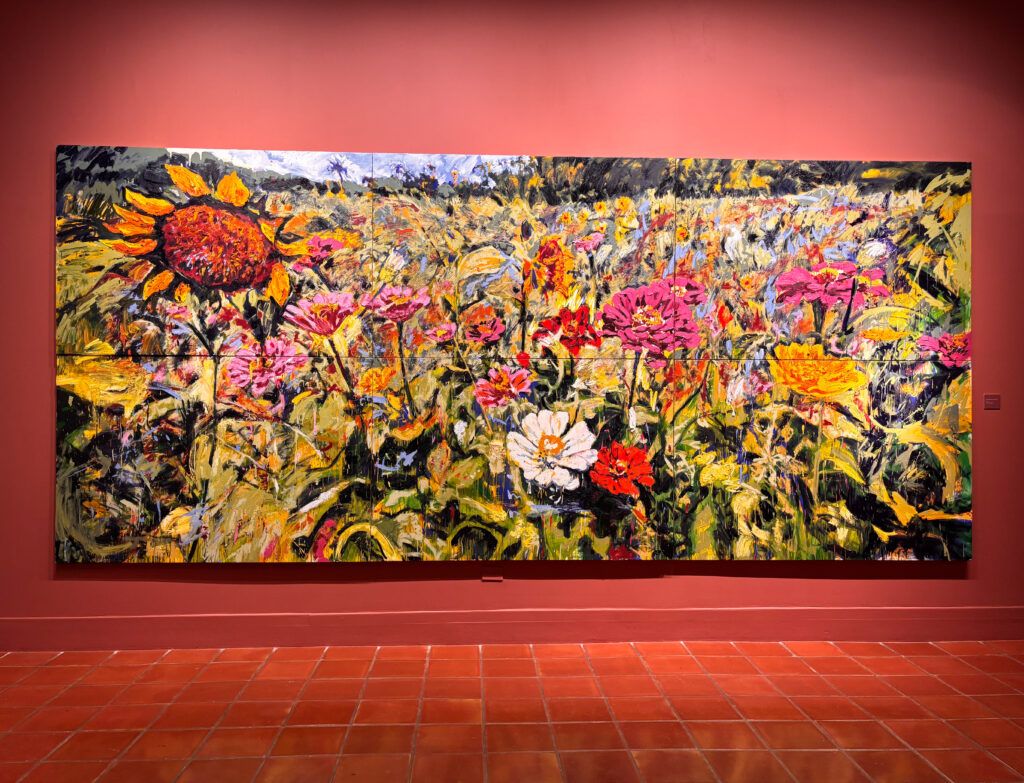
El abrazo de las fieras greets the viewer with a rush of wind moving in unruly currents through a thick grassland of flowers. The vegetation dissolves into impressionistic brushstrokes as the gaze moves deeper into the painting, while palm trees emerging through the distant haze remind us that we remain grounded in Puerto Rico.
The work initially recalls Romantic sublime landscape traditions, which both revel the gaze and distance the viewer through fear of what lies beyond their control. As Burno Latour argues (2011), “To feel powerless, overwhelmed, and totally dominated by the spectacle of ‘nature’ is a large part of what we have come to appreciate, since at least the 19th century, as the sublime.” This sensation is heightened by the keystone effect that mobilizes the plants upward as if sprouting from the ground of the canvas. However, the sublimity of the image works concavely here, drawing us inward with courage. This is further pointed to by the spiritual canticle from which the title takes its inspiration:
“Buscando mis amores, iré por esos montes y riberas; ni cogeré las flores, ni temeré las fieras.” (John of the Cross 1577)
[In search of my Love, I will traverse mountains and strands; I will gather no flowers, I will fear no wild beasts.]
The wild beasts do not terrify; they welcome us into an enveloping embrace, reminding us to contemplate our own smallness without fear. Through this shift in scale and perspective, one might ask whether anthropocentric hierarchies begin to soften, as we no longer dominate the flowers, but dare to entangle among them.
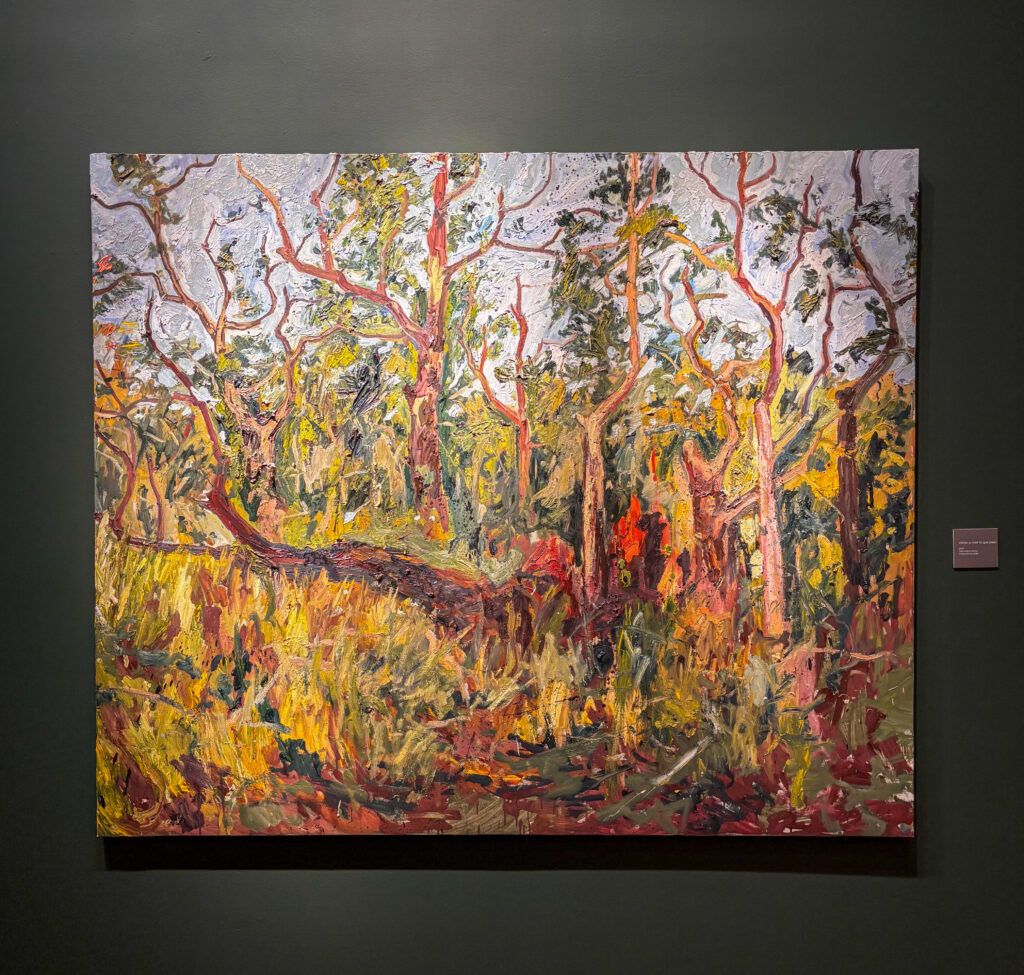
Another memorable work encountered in the exhibition is Volver a traer lo que pasó (2018). Martínez worked on this painting while recalling the aftermath of the catastrophic event that impacted the Puerto Rican archipelago in 2017: Hurricane María. Blurring figurative marks, aqueous brushstrokes flow like rainfall into the tree trunks and branches that intertwine in search of solidity within an unstable landscape. Fragmented by the frailty of memory, the work calls upon a contemplative imagination to intervene in its commemorative gesture. What remains after such a phenomenon, and how does the land retain this memory?
The historical event embedded in the painting highlights the restorative capacities of Nature, as well as the resilience of the Puerto Rican people, signaling a parallel response between the earth and the people. As José Jun Martínez stated in a conversation with the author, “El grito de la tierra es el grito del pueblo.” The picture departs from the vibrant palette that characterizes both Martínez’s practice and the colors that emerge in the tropics, offering a somber tonal register that marks the poignant reality of loss. In stark contrast to the vibrant liveliness of its gallery companion El abrazo de las fieras, the work reveals the dialectics of landscape and the power of encountering place, where beauty remains inextricable from the histories and violences that traverse the land. As Martínez (2025) remarked in an interview, “When I am painting a place, it is not just what I can perceive through light, colour, and texture; the place has a history, and painting is about that tension.”
In the exhibition’s final gallery, we encounter works produced following Martínez’s completion of a master’s degree at the Royal College of Art and the establishment of his artistic practice in London. While the chromatic intensity of his paintings remains, the gestural treatment of Puerto Rico’s insular terrains moves further toward an expressionist abstraction, emerging through a mystical and otherworldly palette.
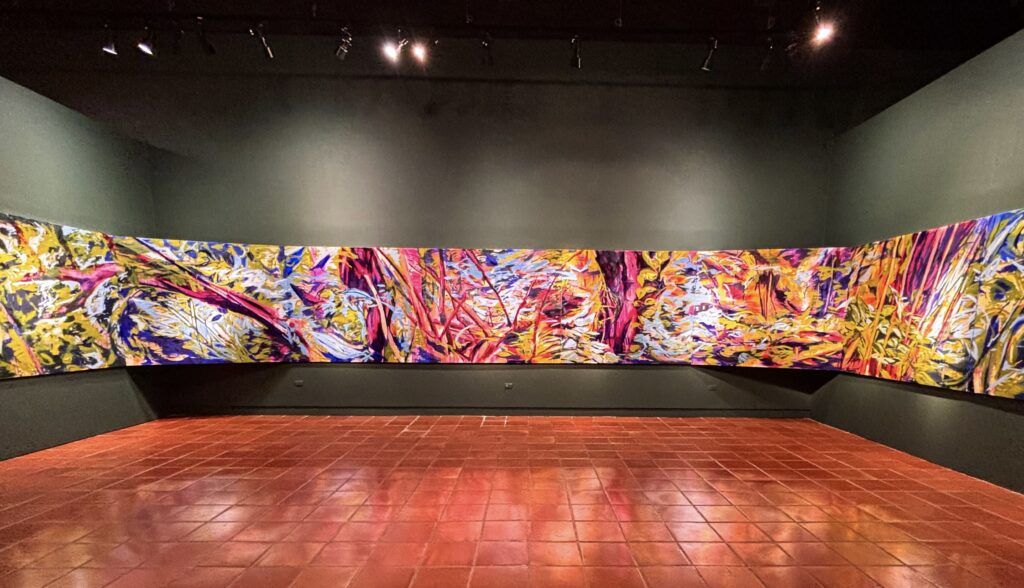
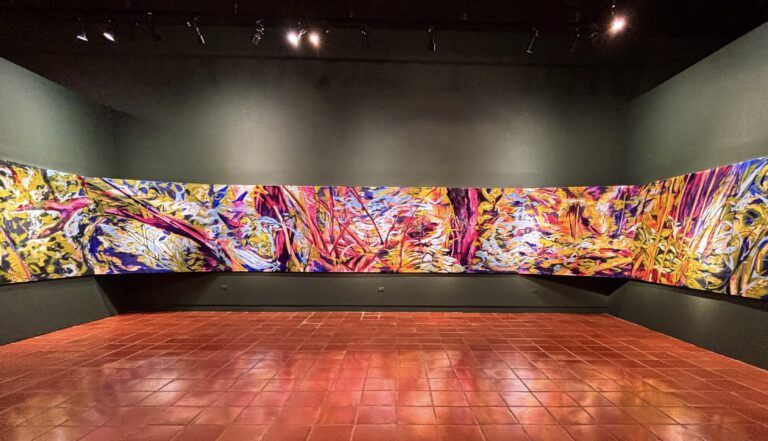
This pictorial character arrives in El bosque de la búsqueda (2025), a forty-eight-foot-long, multi-panel painting made in Puerto Rico specifically for the exhibition. Inspired by fragments of the Río Piedras Botanical Garden ecosystem, the work transforms the forest into a poetic passage of cerulean brushstrokes that bidirectionally flow across the surface, as magenta tree trunks anchor the canvases within shafts of warm light that slip through the foliage and extend the landscape into the gallery space. Here, Martínez not only immerses viewers in this place, but invites them to linger and explore it with the curiosity of a child, the affection of kin, and the closeness of home. The elongated scale of the work, shaped through enveloping canvases that fill the room, marks a recent development in the artist’s practice, in which he understands works to be physically and imaginatively traversed.
Hermano de las flores is a journey of telluric encounters that urges us to position ourselves as active inhabitants of place. José Jun Martínez expands the landscape genre in a gesture that is both anachronistic, following the lineage of landscape painting, and idiosyncratic, shaping his work through a contemporary visual poetics of relation. He enacts this from the specificity of his homeland of Puerto Rico, which imbues his practice with an unmistakably political force: painting a place shaped by ongoing colonial dispossession. Painting here exceeds representation; to paint is to reclaim the land. Martínez renders the characteristic unruliness of the Puerto Rican ecosystem in ways that resist the systems seeking to control, extract, and occupy the archipelago and its inhabitants. His paintings depict a natural world that exceeds containment, allowing us to see these histories break through imposed grids and flourish beyond the limits of the frame.
References
- Haraway, Donna J. Haraway. 2016. Staying with the Trouble: Making Kin in the Chthulucene. Duke University Press.
- Jackson’s Art. 2025. “Artist Insights: José Jun Martínez.” Jackson’s Art Blog, Interview with José Jun Martínez. November 25. <https://www.jacksonsart.com/blog/2025/11/25/artist-insights-jose-jun-martinez/>. Accessed January 2026.
- Jackson’s Art. 2025. “‘You Have to Paint Without Fear’ Artist Insights – José Jun Martínez.” Interview with José Jun Martínez. November 25. YouTube. 2025. <https://www.youtube.com/watch?v=87hdFFoQUx8>. Accessed January 2026.
- John of the Cross, Saint. [1577–1586?]. “Cántico espiritual.” In “Canciones entre el alma y el esposo.” in Obras de San Juan de la Cruz, vol. 3, (Burgos: Editorial Monte Carmelo, 1930), 7.
- John of the Cross, “Dialogue Between the Soul and Christ,” in The Complete Works of Saint John of the Cross, of the Order of Our Lady of Mount Carmel, vol. 2, trans. David Lewis (London: Longmans, Green, Longman, Roberts & Green, 1864), 4.
- Latour, Bruno. 2011. “Waiting for Gaia: Composing the Common World through Arts and Politics,” Lecture at the French Institute, November, London.
- Martínez, José Jun. 2025. Perennial Paroxysm solo exhibition at Ordovas, London, United Kingdom, September.
- Ramos Collado, Liliana. 2014. “Puerto Rico: puerta al paisaje.” In Puerto Rico: puerta al paisaje, edited by Museo de Arte Contemporáneo de Puerto Rico and Museo de Historia, Antropología y Arte, 15. Museo de Arte Contemporáneo de Puerto Rico.