!["[This] painting is a symbol of US-American colonialism. The house in the painting is emblematic of my Great-Grandmother's house in Patillas, Puerto Rico." - Saint Electric. The painting depicts a pink skeleton looming over a small orange house.](https://centropr.hunter.cuny.edu/app/uploads/2023/12/VallejoSantiago-Estefania_Asi-Vienen_2020-768x786.jpg)


Her childhood memories are the raw material Estefanía Vallejo Santiago uses in her artistic production. To be consistent with this intangible materiality, the artist resorts to the means and compositional strategies of children. But her themes are far from being those that a child would choose. Although most of the subjects of her paintings are set in outdoor scenes, these island spaces are settings in which her memories are accommodated and combined with adult experiences, both her own and those of others. These compositions include pink wooden houses, fluffy clouds, and rounded mountains, but they challenge the typical pictorial genres of childhood, as they are neither proper landscapes nor familiar genre scenes. The result is a work in which childhood and adulthood constitute a sort of verbal tenses in a decolonial visual language.
!["[This] painting is a symbol of US-American colonialism. The house in the painting is emblematic of my Great-Grandmother's house in Patillas, Puerto Rico." - Saint Electric. The painting depicts a pink skeleton looming over a small orange house.](https://centropr.hunter.cuny.edu/app/uploads/2023/12/VallejoSantiago-Estefania_Asi-Vienen_2020-1001x1024.jpg)
Vallejo Santiago was born in Puerto Rico and moved to Atlanta with her family when she was too young to have a clear idea of what it meant to migrate. That is how her great-grandmother’s wooden house with a gable roof became her main reference to her homeland; in her memories, Puerto Rico is a house and a woman’s body. It is from this metonymy that the artist addresses the relationships between the topics of migration, displacement, colonialism, racism, and gender violence. While migration was part of her human development, it would be through her scholar formation that Vallejo Santiago would understand this movement as a result of displacement. This academic experience has also been marked by emigration, though this time with an awareness of what she was seeking when she moved to Tallahassee to pursue a graduate degree focused on Caribbean art. In this way, her relationship between lived experience, memory and how she would later understand these phenomena in the context of her Puerto Ricanness, is the basis of her artistic process.
There is not a single line drawn with a ruler in Vallejo Santiago’s paintings and each stroke reveals the material with which it was made. Crayons, colored pencils, markers, acrylic, or oil paint are all materials that can be found in a school supply store, which implies that the pictorial media selection goes beyond a reference to childhood; it also becomes an economic commentary. This is further accentuated by the dimensions of the works, which never exceed a medium size. The artist does not need large canvases to deal with monumental themes, nor expensive materials to deal with precariousness; resorting to so-called professional materials would be, perhaps, counterproductive. However, although her training in art history has led her to know well the approaches of Arte Povera, or the concepts behind naïf art, art brut, vernacular or folk art, Vallejo Santiago does not propose to revive any of these concepts through her artistic practice. Instead, she operates from the material limitations of a working-class family trying to provide their children with the best possible resources, a core experience among families who migrate in search of a better future.
At first glance, the iconography used by Vallejo Santiago may remind the paintings of Puerto Rican artist, Luis Germán Cajigas because they have been so widely reproduced. But a second glance reveals that the only thing these two artists share is the reference to the working class of Puerto Rico, especially those who live outside the urban centers. However, unlike Cajigas, Vallejo Santiago romanticizes neither the past nor poverty. This difference is mediated by the focus of the Diasporican academic research: the history of architecture and its relationship to large-scale art in Puerto Rico. From this understanding of the relationships of scale between the human body and its environment, the artist treats space as an important character in her paintings, although it is never the protagonist. In her written work she looks at how art and design shape and transform spaces, while in her pictorial work, the represented space is nothing more than a proscenium in the service of Caribbean drama. In this sense, instead of referring to particular artists, styles, or artistic movements, Vallejo Santiago paints from art historical ideas. Her immediate referents are not Francisco Oller, the 1950s Generation of Puerto Rican printmakers, or the Association of Women Artists of Puerto Rico. For her paintings, she goes to oral sources from Puerto Rican working women, primary written and drawn sources, such as documents, plans, maps, and spatial theories, such as those of Henri Lefebvre. This does not mean, however, that Vallejo Santiago is completely alienated from the artistic production of Puerto Rico or that she ignores all visual references.
In addition to the obvious borrowings from the iconography of 20th-century Puerto Rican art, the artist sometimes includes the written word in her compositions, in the form of captions with footnotes that guide the viewer. Through this relationship between image and word, Vallejo Santiago channels the imposing presence of posters and prints in Puerto Rican art since the 1950s. The Puerto Rican school of poster art was initiated by American artist Irene Delano after moving to Puerto Rico in the 1940s. Which is why this history of Puerto Rican posters is intersected by gender, migration, and precariousness. The last part is because Delano and her husband, Jack, were invited to Puerto Rico to produce posters and film as a method of mass education, given the lack of resources to build schools and the lack of teachers.
Unlike graphic posters, which had to include specific and clear information and were disseminated as much as possible, the words Vallejo Santiago notes in her unique paintings tend to be more poetic than declarative. In …pero yo estaba hecho de presentes… the artist quotes directly from the poem Yo misma fui mi ruta by Julia de Burgos, a poet whose migration became tragic when she died in New York and was buried in an unmarked grave and was only able to return to her beloved Puerto Rico after her death. On the other hand, in the painting desde 1493, a hand with red painted fingernails relates macho violence to colonialism (since it was on Columbus’ second voyage, in the year that appears in the title when the Spaniards first sighted Borikén). In this way Vallejo Santiago ties her personal memories to the memories of millions of Puerto Rican women, to create not a history of art but an art of national history, from the body of a black woman. It must be noted the lack of capitalization in her texts, is a way of epistemic disobedience, following bell hooks.
A recurring element in Vallejo Santiago’s works is the mask, which is presented as a unifying resource. Sometimes it takes the clear shape of a vejigante mask, that carries a whole history of religious syncretism among Black and Afro-descendant communities in Puerto Rico. But also drags the connotation of a folkloric element (a pre-modern type of art) crystallized in the logo of the Institute of Puerto Rican Culture, designed by Lorenzo Homar in 1956, by petition of Ricardo Alegría, archeologist and founder of the Institute of Puerto Rican Culture. In this logo, the Spaniard, at the center of the composition and supported by the large ships representing the Christian faith with their crosses on the sails, contributes a book to Puerto Rican culture symbolizing language and knowledge. The Taino contributes a gastronomic and agricultural heritage, symbolized by the corn plant, and a cemí as a remnant of an indigenous culture that was thought to have disappeared. The African contributes the brute force of his labor, music, and folklore, symbolized by a machete, a drum and a vejigante mask. This conception of Puerto Ricanness as the “mix of three races” limited the knowledge of our African ancestors to unintelligible sounds, a music that for years was considered improper. In addition, this Puerto Ricanness does not recognize the contribution of women, as the three figures in the logo are men.
Responding to this patriarchal and racially problematic conception of our cultural construct, Vallejo Santiago makes black women the protagonists of her paintings, highlighting oral sources as a legitimate source of knowledge thanks to which we have received wisdom that the official history has not recorded. It is also for this reason that masks included by this artist in her work are configured in multiple ways that do not necessarily respond to the recognized typologies of the vejigante masks of Loíza, Hatillo, or Ponce. This is how she unifies her interests in gender, coloniality, migration, and racism through one element, the mask, since the covered faces of the black women allude to the erasure of those who have given birth and raised the men who are recognized as the founders of Puerto Ricanness.
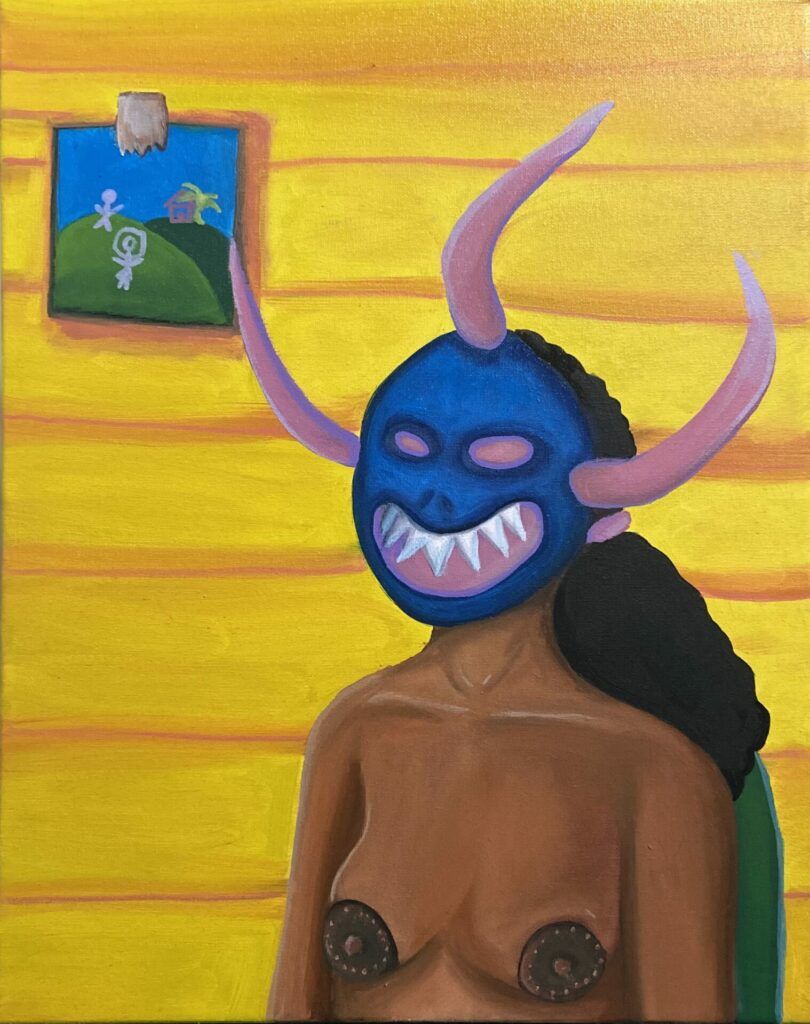
From the diaspora, the heterochronic visual language that this artist has developed literally draws lines that connect those themes that for too long have remained disconnected in the Puerto Rican idiosyncrasy. She achieves this undertaking by looking at herself, from her lived experience, channeling the stories her mother and grandmothers have told her, and combining them with those of others. Through a decidedly Afro-Caribbean aesthetic that recalls the Vodou Drapós of Haiti and the paintings of the Intuitive artists of Jamaica, Estefanía Vallejo Santiago articulates the memories of a people divided between two lands.