


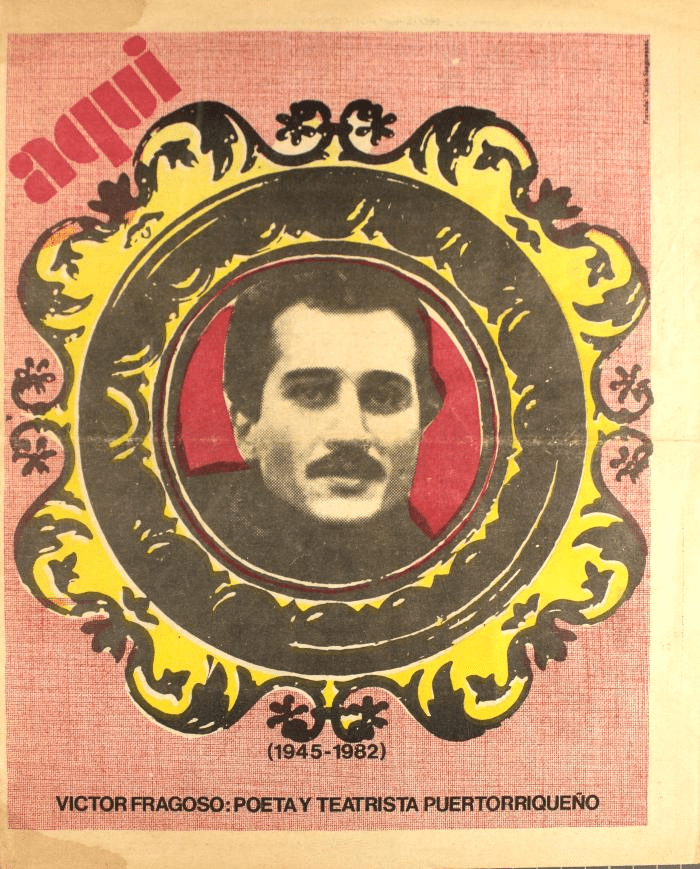
Victor Fernández Fragoso Papers. Special Edition of “Aquí”: ViFr_b01_f10_0001_pg01. Center for Puerto Rican Studies Library & Archives, Hunter College, CUNY. Web. 09 Apr 2026.
Editor’s note: “Archiving the Intangible” opens with the line, “When you interact with an individual’s archive, you engage with fragments of calcified memory.” In the following excerpt, Durán lingers on this idea, reflecting on his archival process and his encounter with Víctor Fragoso’s materials.
As an archivist, there is always an endless queue of unprocessed materials and not enough staff to get them done, so it’s rare to have the opportunity to delve further into a collection after you finish processing. The push to move on to the next collection feels persistently unnatural; after all, you spend so much time researching someone’s life, touching, interpreting, and describing their things, which leads to a parasocial communion. Feeling more experienced as an archivist, I decided to scrutinize the finding aid I created and I still could not get over the missing letters. So, I dug around again, relied on the documentation I already had, and leaned on institutional memory by asking my co-worker, who had been at Centro for a decade, to fill in the blanks. She recalled there being a hard drive, donated to Centro in 2017, which contained scans of physical material that the family was not ready to part with. And so I logged onto our server and found a folder I had missed before. Lo and behold, Fragoso’s personal material.
The letters act as a connective tissue, weaving together the fragments of Fragoso’s professional and personal life. Several letters between Fragoso and Pedro Mir depict a budding mentor/mentee relationship, where they discuss Mir’s work, Fragoso’s dissertation, and coordinate trips to meet in person. After their first meeting in Santo Domingo, Fragoso wrote, “crecí mucho de ese contacto de dos días [.] me traje nuevas fuerzas para trabajar.” In that same letter, he shares a poem he wrote during his visit, inspired by Mir’s braiding of themes in his writing, like the Dominican Republic’s history of colonization, slavery, and dictatorship and championing the working class. Fragoso writes, “Para aquel que no pudo/ enterrar el dolor en la palabra/ un día llegará en que de momento/ el mundo escuche el trueno de su ira.” There are letters from Fragoso to his mother, Concepción. He usually wrote to update her about the classes he taught, the projects he was working on, who he was collaborating with, and whenever he moved to a new apartment. This was an immense departure from what I initially thought when I only had access to his physical archive. Contrary to what I feared, his papers were not sanitized by feelings of shame or homophobia; they were being preserved and protected under the auspice of love. His personal letters and photographs, the final remnants of him, his memory, his soul, in tangible form were not something the family would be willing to part with physically.
In the last two years of his life, Fragoso expressed to his mother a desire to come home. In a letter written on October 15, 1980, he wrote, “¡Dieciséis años por acá! Ya es hora de considerar el regreso, ¿no crees?” A chilling foreshadowing of his return to the island but only after his death. In that same letter, he laments over the state of things, claiming it will likely get worse before it gets better. Through this, in a stream of consciousness, he reflects on how much he has grown and how his priorities have shifted as he slouches toward his 40s:
Nos esperan años sumamente difíciles, lo sé. Tanto allá como acá las cosas van a empeorar antes de mejorarse. En cuanto a mi sobrevivencia y mi vida en general, mi punto de referencia más importante eres tú. He aprendido a disfrutar de la soledad y a valerme solo. Y ahora que estoy técnicamente desempleado, espero poder aprender, de una vez y por todas, a economizar–sí, me lo has dicho millones de veces– y a planear mis finanzas con cuidado. Por ahí vienen los 40’s, de eso estoy consciente.
My favorite line is when he concedes to his mother’s tutelage about budgeting, further emphasizing a relationship built on love, respect, and candidness. There are also letters from Puerto Rican nationalist Rafael Cancel Miranda while he was imprisoned, a letter from René Marqués giving Fragoso feedback on his poetry, a letter from Fragoso to Miriam Colón Valle thanking her for the asopao de gandules and letting her know that, due to his health, he would not be able to work with the Puerto Rican Traveling Theatre that year, a picture of himself he sent to his sister Delia shortly after moving to New York City so that she wouldn’t forget what he looked like, signed ‘Junior’, and a ton of letters and memos from his time as Assistant Professor at Rutgers University.
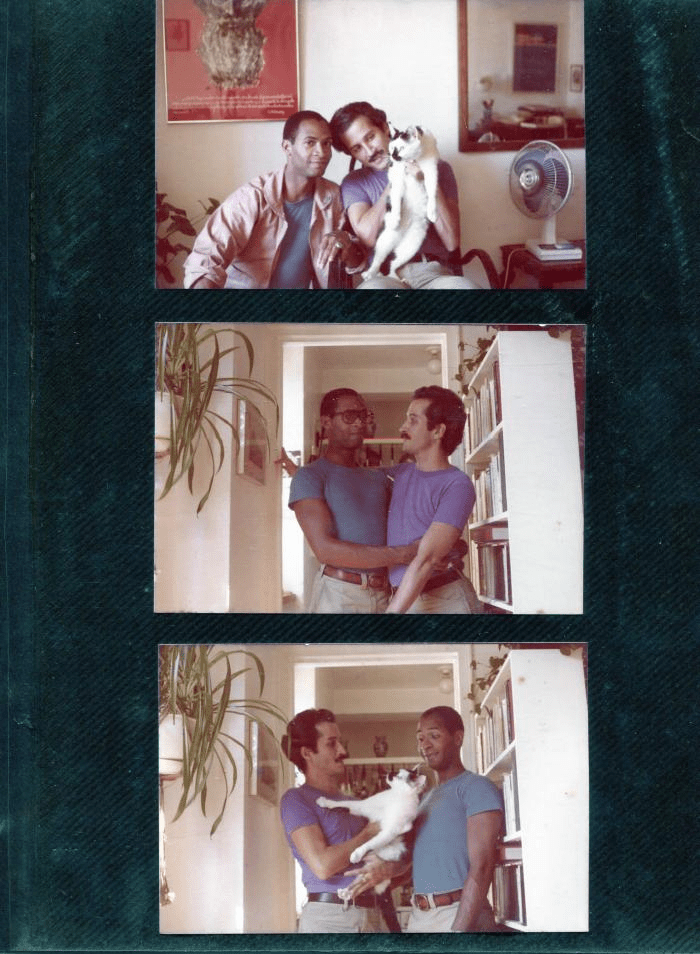
Victor Fernández Fragoso Papers. Photo from a Scrapbook Belonging to Victor Fragoso.: ViFr_0078. Center for Puerto Rican Studies Library & Archives, Hunter College, CUNY. Web. 09 Apr 2026.
If the letters are the connective tissue, then the pictures are the blood that pumps through this archive, giving it color and vitality. The pictures, scanned images from a scrapbook his family put together, help fill in the blanks of Víctor, not only as a writer who died but as a person who lived. Photos of his mother with his two sisters Delia and Zaida, photos of his friend and frequent collaborator Ilka Tanya Payán, photos of him and a man hugging with a cat in an apartment, and photos of him with friends at a picnic, at the beach, and at readings. There are also photos of Fragoso as young as 18 in school, photos of him in the hospital connected to IVs, photos of him in front of a cuchifrito spot, and a portrait he took of Pedro Mir. Additionally, there are several pictures of his funeral. I reached out to Dr. María Josefa Canino again over e-mail and asked if she would be able to help identify some of the people in these photos. She agreed and wrote back to me, “I have recalled so many memories and relived moments of joy, but also sadness, that I am indebted to you for the task which has felt more like a labor of love.” I was naive enough to think that seeing personal pictures of him happy would absolve the reality of his untimely death. A man, full of creative fire, dying of a disease that in the coming years would take out a whole generation and affect many more.
Recently, we sent his cassette tapes to be digitized. While I was listening to some of the tapes for quality control, I heard recordings of discussions and lectures from people like Luis Rafael Sánchez, a.k.a. “Wico Sánchez,” and Clemente Soto Vélez. There were recordings of an improv session, stage readings of his play The First Night Out (1981), and several poetry readings––one of them being a bilingual reading of Ser islas/Being Islands, with the book’s translator Paul Orbuch. The tape “Víctor y Rolando” was a recording of him and another man having what feels like an intimate conversation about their relationship. Later in that tape, he recites a poem from El reino de la espiga, and there’s also a segment of him singing acappella. I played the tape for the archives team at one of our meetings, all of us huddled around the tape deck, silent, as Víctor’s voice filled the room. Fragoso delivers each word with so much diction and consideration. It felt like a séance, the way his voice returned to this plane after decades of silence. Hearing his voice rewarded me with a sense of completion, and the assurance that his life would exist beyond the written word.
To follow Durán’s archival journey in its entirety and encounter more of Fragoso’s work, seek out Ser Islas / Being Islands at La Bodega.
ser islas/being islands by Víctor Fragoso translated by Paul Orbuch