


It is clear that the world is purely parodic, in other words, that each thing seen is the parody of another, or is the same thing in a deceptive form. -Georges Bataille, The Solar Anus, 1931
Todo el mundo es igual, depende por el roto que lo mires (2016) by Bayamón raised, Tampa based artist Roberto Márquez Jorge was originally exhibited at the group show, Air conditioned by Satan (2016), curated by artist Héctor Madera. Márquez Jorge’s contribution consisted of eleven vertical ceramic rectangles hung in a straight horizontal line. Upon close examination, the viewer notices that each panel differs slightly in color with various shades of pink and features an asterisk shaped orifice —very reminiscent of the Holsum donitas’ inner circle shape— whose position shifts from piece to the next. Each panel is individually titled with the first names of the artists who were participating in the exhibition: Omar, Bobby, Martina, Roberto, Anais, Jomar, Heryk, Jonathan, Cristina, Ahmed and Héctor.1 As viewers begin to connect the titles and repeated formal elements, it becomes clear that the work functions as a group portrait —a quirky, contemporary interpretation of the collective portraits popularized during the Dutch Golden Era (ca.1575-1675), when civic and social groups frequently commission likenesses. Yet, in stark contrast to the traditional aims of portraiture –to capture the sitter’s likeness, social identity or psychological essence— Marquez Jorge’s polyptych stuns viewers with something unexpected: a likeness of the person’s most private of areas… their anus. If, as art historian Stephen Perkinson suggests, “the relationship between body and identity can help us understand why the naturalistic depiction of the body could have become a means of representing an individual,” then what might the presentation of the anus as a means of representing an individual reveal? (Perkinson 2007, 136)

Portraiture in Puerto Rico, as elsewhere, has long been linked to the politics of power. The genre’s genesis on the island is attributed to José Campeche, the renowned 18th-century painter who created portraits of Puerto Rico’s colonial elite—including governors and their wives, military leaders, and church officials, each with attributes that help identify each sitter. For these subjects, portraiture was a symbol of prestige and authority; having one’s likeness painted in oil echoed the practices of European aristocracy and aligned them with colonial centers of power.
Contemporary Puerto Rican artists, however, transgress this tradition, challenging the authority and ideologies embedded in the history of portraiture. Artists such as Aaron Salabarrías and Rogelio Báez Vega subvert the genre by intervening in official portraits of Spanish and U.S. military figures—often defacing them. These acts undermine the visual authority of the empire and question the myths that frame colonizers as saviors.
Roberto Márquez Jorge’s approach diverges further. Rather than confront power directly through defacement or aggression, he employs humor and irreverence to disarm and destabilize hierarchies of art history. Working across media—including drawing, painting, mixed-media sculpture, and, more recently, ceramics—Márquez Jorge draws upon Puerto Rico’s rich folklore, traditions, popular art, colloquialisms, and music to inform his practice. Humor, in this context, is not merely a stylistic device, it is a culturally embedded strategy of survival.
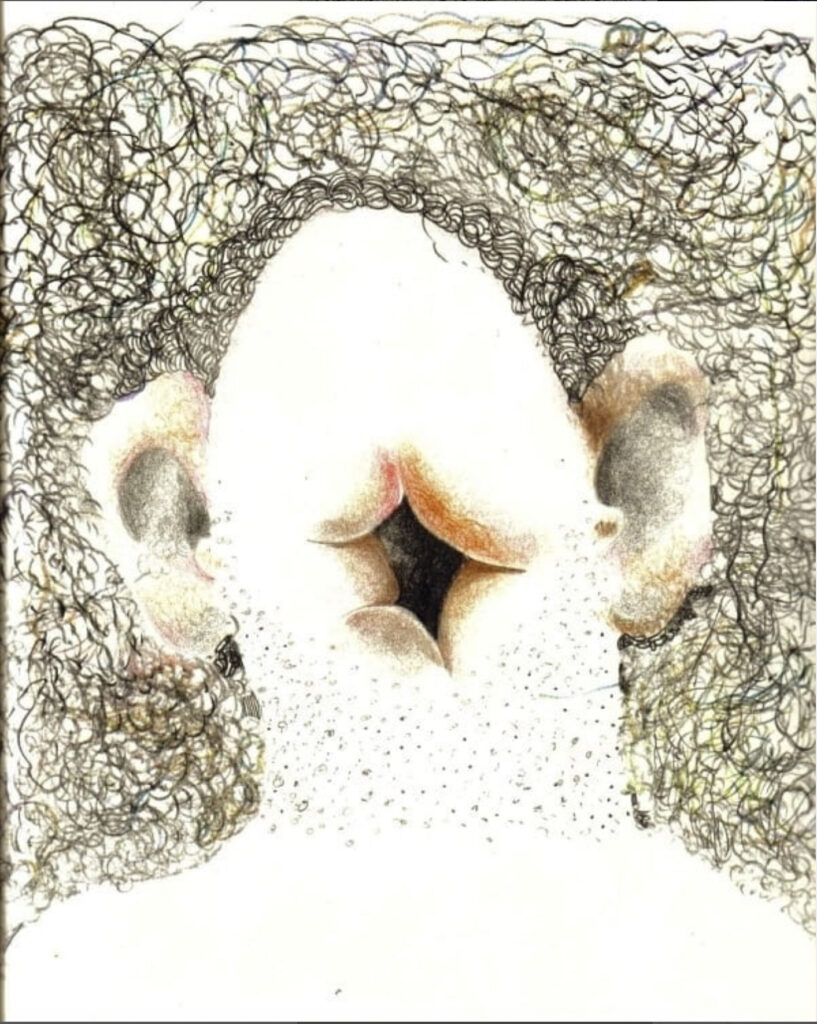
A graduate of the Escuela de Artes Plásticas de Puerto Rico, Márquez Jorge studied under artists like José Lerma, which provided him the necessary references to develop a playful, irreverent voice that simultaneously engages with and critiques art historical tropes. His close relationship with artist José Rosa (1939-2025), known for his iconic wit and irreverence, further shaped Márquez Jorge’s practice, embedding humor as both a formal strategy and a form of cultural resistance. Márquez Jorge’s humor operates as a distinctly Puerto Rican coping mechanism—a way of processing and surviving the traumas of over 500 years of colonial repression. His work is not merely a critique but a cathartic and culturally embedded response to historical violence and ongoing marginalization. His work becomes a space where trauma and absurdity coexist, blurring the lines between serious and playful. Take, for example, Cara e cu (2008), a frontal bust portrait drawn on paper. The sitter is centered on the page, their hair rendered as an amorphous cloud of thin, swirling black lines that dominates the composition. The ears are disproportionately large in relation to the head. Márquez Jorge removes all elements typically associated with a human face and replaces them with a drawing of a slightly opened anus. The title, Cara e cu—loosely translated as “butt face”—is drawn from Puerto Rican slang, used to describe someone in a foul mood, whose expression reflects their irritability or unpleasantness. Through this work, Márquez Jorge literalizes the expression while destabilizing traditional portraiture, combining parody, discomfort, and cultural specificity in a single image.
Todo el mundo es igual, depende por el roto que lo mires operates on multiple levels. First, it boldly displays what is typically concealed—the orifice rarely seen in public and almost never depicted in highbrow art. Viewers are immediately confronted with a sense of impropriety: if portraiture is meant to depict a ‘real’ likeness of the sitter, is the artist, then, exposing something deeply intimate about his colleagues—perhaps even without their consent?
On the other hand, if the concept of self is traditionally rooted in the recognition of the face—our most socially legible and personally familiar feature—then Márquez Jorge’s work raises a different kind of question: what happens when we are represented through a part of the body that most of us have never even seen of ourselves? If identity is tied to visibility, recognition, and control over one’s image, what kind of self is being portrayed when the subject is reduced to—or reimagined as—an anonymous orifice? Márquez Jorge’s work subtly challenges the assumptions that underlie portraiture and selfhood, replacing visual familiarity with embodied estrangement.

Second, the choice of material—ceramic—is significant. Ceramics evoke the processes of casting and imprinting, which in turn prompt viewers to consider the work’s material intimacy. As art historian Marcia Pointon notes, casts and imprints bear “the immediacy of their contact with the body they re-present […] its function as an attempt to hold on to the person.” (Pointon 2014, 170-172). This connection invites reflection: how were these portraits made? Are they actual casts or impressions of the artists’ bodies? If so, the questions multiply: How did Márquez Jorge convince his colleagues to participate? How was the idea received? What were their reactions? What did the casting process entail? How did the artists pose? And how topographically accurate are the results?
Although it is known that these works are not literal anatomical impressions, this ambiguity is precisely the brilliance of the piece—it invites speculation. The strength of the work lies not in factual accuracy, but in its power to provoke curiosity, discomfort, and reflection. One is reminded of the work of American artist Cynthia Dorothy Albritton, better known as Cynthia Plaster Caster, who gained notoriety in the 1960s – 1970s for creating plaster casts of rock musicians’ penises. Her work fascinated the public not only for what it represented, but for the performative and participatory process behind it. In both cases, the intrigue lies as much in the method as in the object, exposing the dynamics of intimacy, consent, and representation.
Third, the title alludes to the well-known Spanish proverb: “todo es según el color del cristal con que se mira”. Originally penned by Ramón de Campoamor in his 1846 poem Las dos linternas, and later popularized in song by Rubén Blades in 1977, the phrase speaks to the subjectivity and relativism that shape our everyday perceptions. Roberto Márquez Jorge reimagines this expression by adding “todo el mundo es igual” and concluding with “depende por el roto que lo mires.” By replacing cristal with roto —a word that is not only an anagram of orto but also a Puerto Rican slang term for it— the artist guides the viewer’s interpretation from the metaphorical to the visceral. He invites us to look through that aperture, often overlooked, and even taboo, and recognize that from this perspective, everyone is essentially the same. The result is an egalitarian portrait stripped of social and economic markers, presenting an abstracted, nude body that emphasizes a universal physical trait—one tied to our most basic physiological needs. As Tarō Gomi famously put it, everybody poops.
Hence, the roto becomes a site of both commonality and individuality, since like bellybuttons, we all have one, and like snowflakes, each is unique. Márquez Jorge reclaims this space not as vulgar or obscene, but as deeply human, challenging conventional norms of portraiture and perception. Through linguistic and visual play, the work invites us to reflect on how every point of view—every roto—reveals something specific and personal, while still grounded in our shared human experience.
Roberto Márquez Jorge’s work engages the tradition of portraiture not to honor it, but to invert it, using parody and irreverence to challenge its conventions. His pieces echo the formality of traditional portraits, only to subvert their authority and hierarchy by replacing the expected with the most private part of the body. Through this humorous distortion of the genre, Márquez Jorge exposes how constructs of power and selfhood are visually encoded and culturally reinforced.
Footnote
- These artists were: Omar Velázquez, Bobby Cruz, Martina Franchini, Anais Melere, Jomar Rodríguez, Heryk Tomassini, Jonathan Torres, and Cristina Tufiño. As mentioned, Héctor Madera was the curator, and Ahmed Echevarría was ArtLab’s director, gallery space where the exhibition took place.
References
- Pointon, Marcia. “Casts, Imprints, and the Deathliness of Things: Artifacts at the Edge.”The Art Bulletin 96, no. 2 (June 2014): 170-195. Accessed April 15, 2025. https://www.jstor.org/stable/43188871
- Perkinson, Stephen. “Rethinking the Origins of Portraiture.” Gesta 46, no. 2, (2007):135-157. Accessed April 15, 2025. https://www.jstor.org/stable/20648950