

Editor’s note: All images included in this text are screenshots from the Apple Music Super Bowl Halftime Show, as made available on YouTube. They are used under fair use for academic analysis and educational purposes.

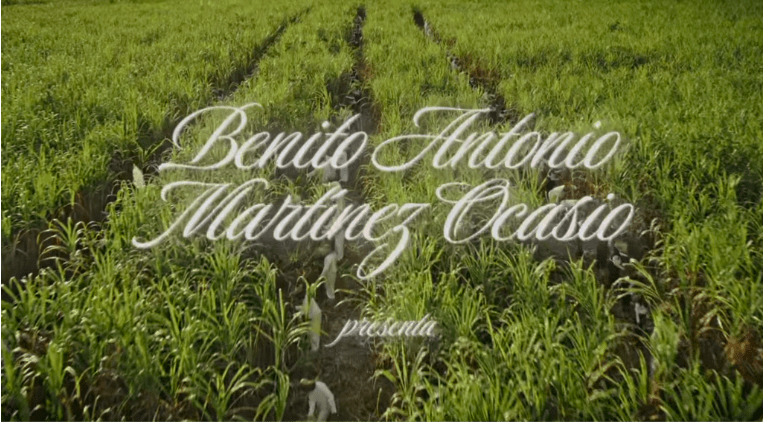
Bad Bunny opens with his full name. Benito Antonio Ocasio Martínez appears in white cursive letters, followed by the Spanish announcement El espectáculo de medio tiempo del Súper Tazón; the white letters sharply contrasting the earth tones below (00:00:25, 00:00:30). Viewers are momentarily suspended into the sugarcane fields of Puerto Rico (and the greater Caribbean) that symbolically represent the multilayered story of empire and modernity. Workers cut the cane with machetes, dressed in pavas against the land. Before Bad Bunny sings his first song, the image lingers. It is a fifty-six-second immersion into Puerto Rico’s past, suggesting we must look back in order to move forward today to the world’s oldest colony: Puerto Rico.

We can interpret this wait as a symbolic homage to the agricultural labor integral to the archipelago’s economy in the past, and to the Caribbean history embedded in both (1). The Puerto Rican aesthetics and Caribbean symbols in this performance remind me of the importance of seeing and naming—how entertaining performances have the opportunity to convey political messages through silences, scenery, optics and imagery, allowing the viewer to consume something more than a spectacle (2). Perhaps, behind it all, the viewer is tasked with investigating Puerto Rico’s colonial history. An example is the performance of workers on a sugar cane field and the opportunity it gives for discussing the history of labor through both the plantation system and the libreta system—which kept Puerto Ricans in cyclical debt and poverty while also developing a regime of surveillance.
These layered histories are visually narrated throughout the performance across different eras of Bad Bunny’s discography, imbuing in the performance storytelling iconography of Puerto Rico (3). For example, the replica of Toñita’s Caribbean Social Club in the setting of this performance. Bad Bunny’s Puerto Rican aesthetic also pays homage to the iconic imagery of the jíbaro, which was used throughout his DeBÍ TiRAR MáS FOToS (2025) album campaign and concert residency. This includes photos of plantain clusters and machetes while he wears a pava and linen clothing of white, beige and light-brown hues, a visual language he continued for the Super Bowl Halftime Show performance.
Bad Bunny narrates a Puerto Rican story through the precise usage of Puerto Rican aesthetics and his music. This is evoked when Bad Bunny sings “Nueva Yol” with both ubiquitous and specific places in Manhattan, Brooklyn, and the Bronx that have been and continue to be home to Puerto Ricans who have been migrating since the late nineteenth century (4). The incorporation of a salsa band—dressed in suits that reflect the ‘70s salsero aesthetic—provides an additional sonic and optical layer of the Puerto Rican sound and aesthetic. The sample of El Gran Combo’s “Un Verano en Nueva York” is an audible piece of a story rooted in nostalgia. It honors the salseros of the 1960s and 1970s, signaling Puerto Rican cultural and vibrant past that traverses national borders and includes the diaspora in his definition of Puerto Rican identity.

Bad Bunny recreates the atmosphere of Puerto Ricans in New York City, echoing spaces like Toñita’s Caribbean Social Club, offering a small but vivid example of how NYC functions as a multicultural and diverse hub shaped by Caribbean and Latino communities (00:07:39-00:08:011). This performance disrupts the racist and anti-Black logics of mestizaje and Hispanismo that have proliferated in the myth making of the nation-building project of Puerto Rico (and the Caribbean) during the nineteenth and twentieth centuries. The barrio set shows how Bad Bunny and the performers, as Puerto Ricans and Latinos, are symbolically reclaiming their space, and thus belonging, in New York City. In an amalgamation of quotidian moments and symbols, including men playing dominoes and the piragua and coco frío carts, Bad Bunny subtly names these experiences as those of diaspora and represents these experiences as a part of the fabric of this multicultural American city.

Puerto Ricans and Latinos were pushed out of New York City to make way for investors and outsiders. Similarly, displacement and gentrification affects Puerto Ricans in Puerto Rico today (5). Therefore, it was almost required to include an analysis of the performance of “LO QUE LE PASÓ A HAWAii,” performed by Ricky Martin. Bad Bunny’s lyrics showcase he doesn’t want to lose his home, but the threat is already a reality as we see the neoliberal and colonial policies forced, for example, on Puerto Ricans versus beneficiaries of Ley 60: “Quieren quitarme el río y también la playa/ Quieren al barrio mío y que abuelita se vaya/ No, no suelte’ la bandera ni olvide’ el lelolai/ Que no quiero que hagan contigo lo que le pasó a Hawaii” (Martínez Ocasio) (6). This shifts the momentum from a fast, party like paced atmosphere with perreo to a slower cadence focused on the Puerto Rican cuatro (Puerto Rican guitar).
The lyrics address the threat of loss from an imperial and colonial power that is ever-present as it affects multiple generations. Bad Bunny alludes to multiple forms of loss, including land, culture, identity, and nationality, as he urges his Puerto Rican listeners to maintain a firm grip on their national flag. The song can be interpreted as a decolonial and anti-imperial stance against American colonization and privatization practices as it alludes to the 20th century history of Hawaiian Kingdom and eventual annexation of Hawaii to become the 50th state. It is also a position against statehood as a viable choice for Puerto Rico’s sovereign future. Separated by continents and oceans but with our shared experiences as US territories, this song situates us to think about Hawaii and Puerto Rico together, or “in relation,” as Édouard Glissant offers in his seminal work Poetics of Relation (7).
The beat for “El Apagón” begins as the camera shifts to another set. I gasped when I saw the lampposts on the fritz and lighting changes signaling a blackout, which evokes the lived experiences of Puerto Ricans post-María navigating an unreliable and outdated electrical grid (00:10:08). As the beat continues, suspended performers climb and work their way around the lampposts, even as the poles themselves become useless. This on-the-air performance is a metaphor for Puerto Rican resilience—finding creative ways to live, work, and provide care as they survive their current colonial conditions.

Bad Bunny climbs the lamppost and eventually sings and dances in it, too. I link both the sugarcane performance and the electric unstable lampposts by its common thread through time: colonialism. Bad Bunny in his modern take on the jíbaro holds the Puerto Rican flag with its azul clarito, signaling his pride and resilience for Puerto Rican people to self-determination (00:10:23-00:10:41). In both songs “LO QUE LE PASÓ A HAWAii” and “El Apagón”, Bad Bunny entertains while signaling to the critical eye the various issues hindering Puerto Rico.

Naming is significant because that’s the first step on tackling and solving the collective problems that ache our souls. As the cameras follow Bad Bunny, he does so by reminding the public of all the countries that encompass America alongside a parade of each country’s flags. Clearly engaging with political commentary, Bad Bunny strips the imperial power of the United States by asking his viewers to reconsider what “America” is and who is included as American. This is especially important at a time when the country is deeply divided both politically and culturally. The MAGA movement and conservative interests fuel divisive rhetoric—amplified by influencers and major media figures—that promotes hostility toward immigrants, along with racial, class, and gender discrimination, for example by funding agencies like ICE, which was created after 9/11 and has since been responsible for family separations and unconstitutional acts of extreme, fatal violence. Bad Bunny concludes this part of the performance by challenging our ingrained ideas of separation; echoing Glissant’s call for relationality, encouraging us to rethink belonging as something rooted in connection and togetherness (8).
The closing note of the performance is on the jumbotron: “no hate just love,” a clear rejection of ongoing state-sponsored hate. While there was an online campaign to cancel Bad Bunny’s show due to a language barrier, the naming of each country that comprises America and the rejection of hate with love needs no translation. Despite having no fluency in Spanish, the viewer knows we cannot feed the hate machine with more hate and divisiveness. The quintessential representation of love within the performance is the live-wedding. The one that took place throughout the performance forced viewers to focus on love as actions, affirming the need for love to combat hate (00:05:11-00:05:19).
Before the wedding Bad Bunny sings lyrics from “Monaco:” “esto es lo que tú querías.” Could he mean Lady Gaga’s performance? These lyrics can be quickly dismissed as a reference to the song’s melody played on strings, but as Lady Gaga is revealed right after the wedding ceremony, the viewer is left wondering if he means it as a white woman singing in English in the frame center of the Super Bowl. Maybe this is Bad Bunny addressing the expectations and cries from some of the American public that are rooted in xenophobia, linguistic imperialism, anti-Blackness, and racism. Lady Gaga sings and dances to “Die with a Smile,” a duet that features Bruno Mars and is overlaid on a salsa beat.
As previous Super Bowl Halftime Show headliners have demonstrated, this global stage is an immense opportunity to engage with important matters within the parameters of the fourteen minutes allotted for the performance. Last year in Kendrick’s performance, the dancers came together to form the American flag, which is not only a symbol but a metaphor of how Black Americans are essential to the country’s labor history and cultural production since before its founding (10). The performance, rooted in Hip-Hop sound and symbolism, resonated with many and it tasked us with thinking about belonging, citizenship, and race in the U.S. Bad Bunny capitalizes on this opportunity to entertain and to also celebrate and pay homage to Puerto Rican history and culture as well as the people and nations that are America.
Footnotes:
(1) Meléndez Badillo, Jorell A. Puerto Rico: A National History. Princeton University Press, 2025.
(2) Multiple neighborhoods in New York City have been historically Puerto Rican, including Williamsburg in Brooklyn and the Lower East Side and Spanish Harlem in Manhattan. By including Villa’s Tacos, a famous taco truck from Los Angeles, Bad Bunny also asks viewers to consider migration and diaspora histories and communities in LA (and the West Coast). This showcases the breadth and range of Latino communities and populations throughout the entire country at a time when belonging and immigration are under attack.
(3) Dávila, Arlene. Barrio Dreams: Puerto Ricans, Latinos, and the Neoliberal City, 2004. University of California Press, 2004.
(4) Sánchez Korrol, Virginia. From Colonia to Community: The History of Puerto Ricans in New York City. University of California Press, 1983.
(5) Gentrification and displacement have been preoccupations in Bad Bunny’s work as he portrays their histories and current form in Puerto Rico through the El Apagón mini-documentary and the short film Debí Tirar Más Fotos. I write about them in my forthcoming book Boricua Projects: Intimately Archiving Puerto Rican Memory (2027).
(6) Puerto Rico has been an unincorporated territory of the United States of America since 1898 and stands in political limbo as a commonwealth.
(7) These frameworks are leading the current fellowship model and initiative at Centro spearheaded by its director Dr. Yomaira C. Figueroa-Vasquez. I was a part of the inaugural Rooted and Relational Fellowship (2024-2025). More information can be found here: centropr.hunter.cuny.edu/projects/rooted-relational/
(8) Relationality is not solely a theory as it is applied throughout this performance. Bad Bunny sings the lyric “Si no me voy a RD, saludos a mis vecinos” from “El Apagón” and points to a historical and contemporary relationship between Puerto Rico and the Dominican Republic (00:11:10-00:11:13). In fact, the opening video of the show was recorded in the cane fields of the Dominican Republic, highlighting the shared violent histories of colonialism and slavery across the Caribbean.
(9) Bad Bunny’s rise as a figure of Puerto Rican culture and resistance is contextualized and written about extensively by the co-creators of The Bad Bunny Syllabus Project, Vanessa Díaz and Petra R. Rivera-Rideau. P FKN R: How Bad Bunny Became the Global Voice of Puerto Rican Resistance. (Duke University Press, 2026).
(10) Madden, Sidney. “Kendrick Lamar brought West Coast hip hop, Uncle Sam and Serena Williams to the Super Bowl,”NPR, 8 Feb 2025. https://www.npr.org/2025/02/09/nx-s1-5288004/super-bowl-half-time-kendrick-lamar-sza
Works Cited:
National Football League, “Bad Bunny’s Apple Music Super Bowl Halftime Show,” YouTube, 9 Feb 2026. https://www.youtube.com/watch?v=G6FuWd4wNd8&list=RDG6FuWd4wNd8&start_radio=1 v=G6FuWd4wNd8&list=RDG6FuWd4wNd8&start_radio=1
Credit and thanks for this post’s promotional images go to Hanna Fraguada.