


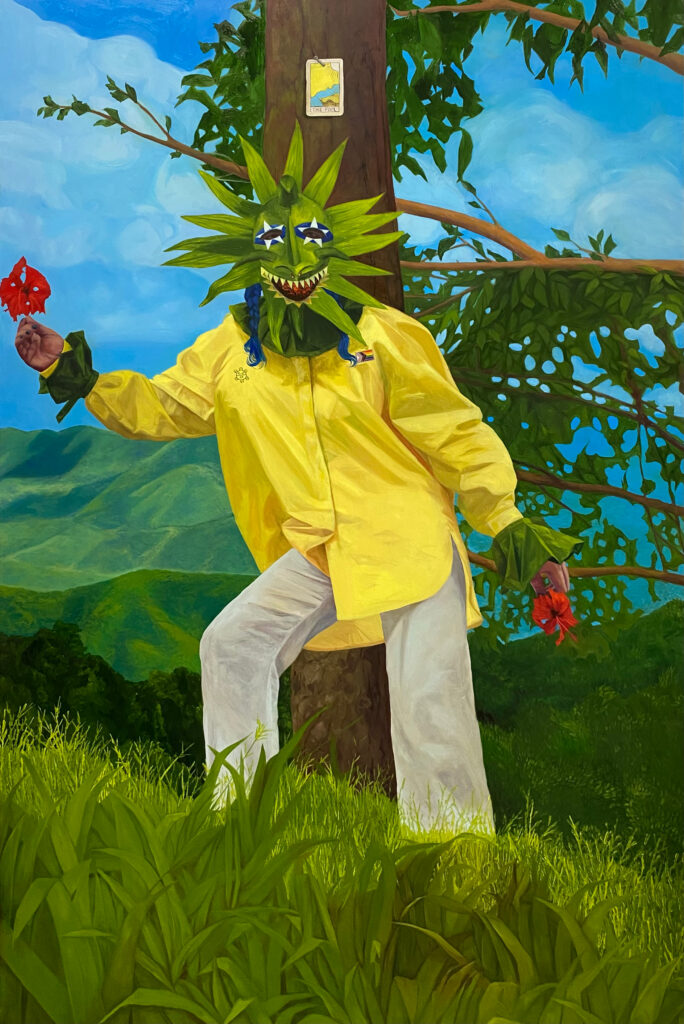
The Fool (2024) by the Puerto Rican artist, Isabella Mellado, is a large format oil painting featuring a human figure wearing blue hair pulled back in two braids, a loose yellow shirt, and baggy white pants. On the upper part of the shirt there are two symbols, on the right side is the LGBTQIA+ flag and on the left side is the Jayuya sun, a popular symbol of the Taíno culture in Puerto Rico. However, what stands out most about the attire of the figure is the green mask that she wears over her face, which is composed of multiple horns and a big mouth with pointed teeth. The mask is reminiscent of the one used during the Carnivals of Vejigantes in the town of Ponce, Puerto Rico. The carnival is traditionally celebrated days before the beginning of Lent and represents a Christian origin dramatization between good and evil, where evil is embodied by the vejigantes and good by King Momo. The vejigantes are masked characters with wide and colorful costumes that oversee mischief during the festivity. Using devil and demon masks during Carnival is a tradition that dates to 17th century Spain, when they were intended to scare people into going to church (Timothy S. Y. Lam Museum of Anthropology n.d.). In the painting, the figure looks directly at the viewer while her body is in an exaggerated contrapposto. The right arm is raised while the left arm is extended at her side, but both are holding a red flower with pistils, known as flor de maga (hibiscus). The character is located on a hill that opens onto a mountainous landscape, where the shades of green contrast with the bright blue of the sky with translucent clouds. Right in the middle of the composition and behind the main figure, a tree rises with its branches laden with leaves. At the top of the trunk is a tarot card bearing the name of the title of the artwork.
The Tarot is a divinatory deck of Italian origin, consisting of seventy-eight cards that depict various characters with universal meanings, though their interpretation may vary depending on the questions being asked. However, twenty-two of those cards are known as the Major Arcana because they symbolize fundamental concepts of the human being’s spiritual and personal journey. The Fool is considered as the zero card, a number of infinite potentials, and is the first major arcana of the tarot. The Fool usually represents a cheerful young man wearing frilly clothes with colorful prints. He has a bundle tied to a long stick while in his left hand holds a white rose. To the left of the character, there is a white dog barking to warn him that he is heading towards a cliff. However, the young man is so unconcerned and distracted that he ignores the barking of the dog accompanying him. In the background, a mountainous landscape is shown under the overhead sun. The Fool is a card that typically tends to predict the beginning of new journeys that should be approached with optimism, but always with caution. In this way, through painting, Mellado transforms the character of The Fool into a vejigante, fusing arcane tradition with Puerto Rican cultural heritage.
Isabella Mellado uses a figurative style with mystical characters in her works that alludes to the literary movement known as magical realism, in which supernatural elements or creatures are part of daily life. The work consists of oil on canvas, a pictorial technique that stands out for its vibrant colors and rich tonalities. The palette, of The Fool (2024), is warm and full of vitality, as the colors that stand out visually in the composition are the primary ones: blue, yellow and red. Those colors predominate in the traditional tarot deck because of their symbolism and relationship with the card’s message. Although green is the most abundant in the landscape of the composition, where the finish of lights and shadows is soft, it is rich in textures due to the brushstrokes. In this way, these colors give the work a strange atmosphere, as they are too bright and almost unreal to be part of nature. Compared to Mellado’s other paintings, such as The Magician (2024) and Four of Swords (2024), these do not share Mellado’s diverse color palette. Even when these works depict outdoor landscapes, their colors are opaque and the contrast between light and shadow is marked. In all the above paintings, regardless of the palette employed, the colors maintain the atmosphere of mystery. Although The Fool (2024) distinguishes itself by using colors that are associated with the striking nature of the Caribbean, especially the mountainous landscape of Puerto Rico’s interior. Therefore, Mellado intensifies the saturation of colors and complements the arrangement of the figures to turn the scene into a magical and disturbing encounter. The character on the top of a hill and in the middle of a pasture creates the illusion that the viewer has just stumbled upon the fantastic and powerful being by chance.
On the other hand, through The Fool (2024) the experience of the Puerto Rican diaspora is perceived, establishing a direct connection with Isabella Mellado, who was born in San Juan, Puerto Rico, but moved to Chicago, Illinois, where she settled as an artist. Both figures, The Fool and the vejigantes are associated with the journey: The Fool, for the symbolic meaning of his card and the vejigante for his free and mischievous spirit that keeps him in constant movement. They reflect the comings and goings, characteristic of those who emigrated to live in other countries but come to their natal land to visit. In the case of Puerto Rico, the country has been facing for many years an economic and social crisis that forced many Puerto Ricans to leave the island to improve their quality of life. The Fool (2024) refers to the beginning of that adventure full of optimism and dreams, but also of fears and nostalgia for his homeland. Merging the two figures alludes to a cultural identity that travels and transforms but never ceases to belong to its beloved place of origin. The character of The Fool (2024) embraces beloved cultural symbols, for example, the flor de maga, which is the national flower of Puerto Rico and is used by the island community as a symbol of pride. Also, it should be noted that the yellow shirt worn by the character in the painting could be the manifestation of the sun that usually appears in the sky of the chart, especially considering that the symbol of the Jayuya sun appears stamped on the piece of clothing. Mellado transfers the element and its symbolism, because now the light that guides the journey of The Fool is not in the cosmos, but in the interior of the protagonist. Representing the decisions and optimist feelings that drive each individual to venture far from their homeland for new opportunities.
On the other hand, The Fool (2024) exposes the artist’s personal narrative as a person from the LGBTQIA+ community. Isabella Mellado expresses that the experience of the diaspora is very similar to the experience of the queer community (Parrella-Aureli 2024), referring to the journey of sexual exploration and identity formation that they undergo. Queer people are forced to physically and emotionally displace themselves from certain groups or places because they are not welcome. Then, like immigrants, they find themselves lost in this new world with no one to guide and protect them. However, they gradually forge their own community, one in which they can share their experiences, insecurities, and dreams. Therefore, it is interesting that the main character in The Fool (2024) is played by a woman, when traditionally the vejigantes and The Fool in the Tarot are figures represented by men. Also, the style of clothing worn by the vejigante in the painting, the long-sleeved button-up shirt and baggy pants, present a subtle play between feminine and masculine, thus alluding to a non-binary identity. In addition, the LGBTQIA+ flag and the Jayuya sun on the main character’s shirt represent two aspects of different identities that coexist in the same person: queer identity and Puerto Rican cultural heritage. In this way, Mellado embraces the authenticity of the self, presenting it as something complex that continues an eternal journey.
To Isabella Mellado, the Tarot becomes more than a predictive tool, it is a vehicle that allows her to reflect and tell really clear narratives about herself through her artworks (Povos Gallery 2024). In The Fool (2024), Mellado manages to visually present the experience of belonging to the diaspora and queer community in a whole new light by fusing identity elements with Tarot iconography. This way, the central character of the painting becomes a symbol of power, resistance, and unity in the face of a hostile and conservative reality that seeks to eliminate all diversity. Mellado’s work boldly celebrates human diversity as something deeply worthy, beautiful, and magical, thus motivating viewers not to fear the beginning of their life’s journey.
References
- Parrella-Aureli, Ariel. 2024. ‘Liminal,’ A Humboldt Park Art Exhibit, Showcases LGBTQ+ Puerto Rican Artists. Block Club Chicago. Accessed 23 April. https://blockclubchicago.org/2024/06/26/liminal-a-humboldt-park-art-exhibit -showcases-lgbtq-puerto-rican-artists/
- Povos Gallery. 2024. “Isabella Mellado – Povos Gallery – Te Dire Quien Eres”. Posted June 20, 2024, by Povos Gallery. YouTube, 1:17. https://youtu.be/3nta-KxHpuI? si=hh3JdeJFaOUN2E9m
- Timothy S. Y. Lam Museum of Anthropology. n.d. Puerto Rican Carnival Mask. Wake Forest University. Accessed 18 April. https://lammuseum.wfu.edu/2023/02/puerto-rican-carnival-mask/