


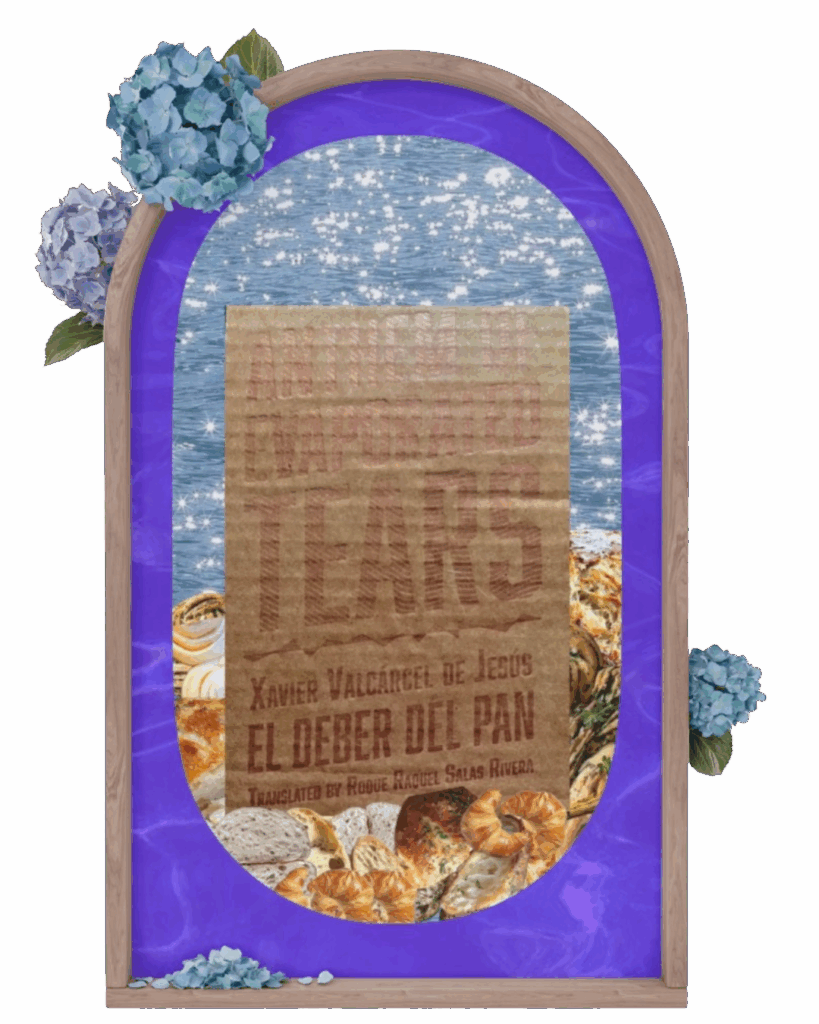
A review of the poetry collection by Xavier Valcárcel, translated by Roque Raquel Salas Rivera
When I think about bread, I think about its scent. The way it goes inundando cafeterías y mañanas. The smell that leads you home, that fills the guaguas, the living rooms, the dining rooms, your neighborhood and mine. It is the scent of warmth, of duty, of a day beginning.
Xavier Valcárcel’s Anthem of Evaporated Tears, originally published as El deber del pan in 2013 and translated with devastating clarity by Roque Raquel Salas Rivera, is a book that holds the scent of bread in one hand and a match in the other.
Consider it the perfect literary companion for your next heartbreak, or for those days when the thought of lighting his favorite sneakers on fire feels like a completely legitimate form of poetic justice. You can find it by clicking here at the Cardboard House Press online shop.
This is the central, blazing promise that arcs through the poems: a mother and her son will burn it all. “We’ll burn our men and their chairs, / mugs stained by envious kisses / sheets for having covered so much” (7). They will burn the six televisions, the cars, the clothes already frayed by beards. It is a pyre for the entire architecture of a life that has become a cage. And as they light the match, they hum, they do not scream, they hum “the anthem of evaporated tears” (7). This is the book’s central contradiction: it is a lullaby for an inferno.
The anthem is not a single note. It is a complex score of grief and liberation, played in the key of the Caribbean. The poems move like a mind pacing through a house it has decided to destroy. The structure is serial, fragmented; merely steps from an intimate confession; “I have made the bread. I have eaten. / I’ve been the bread, they have made me, and I’ve been eaten” (15) to the sprawling, desperate “ESCAPE PLAN,” where the world outside is collapsing into flood and protest, and the mother pleads, “come back home / come back home / come back home” (25).
Valcárcel excavates the home with the care of an archivist and the fury of an arsonist. He understands that the domestic is the first site of the colonial, the patriarchal, the place where the “burden of bread” (el deber del pan) (40-41) is kneaded into our muscle memory.
The house is not a single place, but a shifting landscape of refuge and reckoning. The aunt’s house is a hotel. The mother’s house is a site of returned memory, where “particles of dust float in silence / like glitter” (27). And the house they longed to burn is the ultimate act of love and liberation.
And what of the bread? It is the book’s obsessive, recurring dream. It is duty, it is debt, it is love, it is labor. In the phenomenal poem “BREAD” (31), the word becomes a mantra, chanted four hundred times in a dream. The poet braids a lineage of those who have written of bread, from Neruda to his own mother and aunt, asking if this repetition is “the anxiety of hunger / on a long, loverless night / or if something in me, I can’t comprehend / has something it keeps trying to say” (33). Bread is the ghost in the machine of this family, the recipe for survival that is also a chain.
This is a deeply Puerto Rican and Dominican queer text, a chronicle from “this side of customs” (19). It maps the internal borders of identity, the hunger that is both physical and existential. The speaker stores rations of bread in a jar “against hunger” (17), a poignant act of preservation for a lover, for a self, always thinking of the “way back” (17). Salas Rivera’s translation is a careful grafting of this specific world. The decision to change the title from the literal El deber del pan (The Burden of Bread) to Anthem of Evaporated Tears is a critical act of interpretation made alongside Valcárcel de Jesús. It lifts the focus from the weight of the labor to the music made from what that labor costs, the song of what has been cried out and then vanished, leaving only salt.
In the end, the truth is confessed: “I didn’t burn down any house / I never had a house of my own” (51). The grand, cinematic escape to Punta Cana is a fantasy, a lie the poet tells to survive the afternoon. The real, more difficult truth is that “the house is all that’s left / with me and her / inside” (53). The fire was not a literal one, but it was no less real. It was the internal conflagration required to see the mother not just as a pillar of suffering, but as a co-conspirator, a woman whose own tears were also evaporated by the heat of her heartbreaks and duties.
Anthem of Evaporated Tears is a contemporary classic because it understands that in our archipelagoes, the personal has always been political, and the political is felt in the body, in the kitchen, in the bed. It is a book for anyone who has ever been led by the scent of bread and understood it as both a comfort and a burden. It is for those who know the weight of the recipe and the seduction of the flame.
Let this book be the anthem you hum as you walk through the ashes of what you were told you had to be, the scent of burning bread a guide not to a lost home, but to a self you are finally ready to make.
Reference
Valcárcel, Xavier. Anthem of Evaporated Tears. Translated by Roque Raquel Salas Rivera. First Edition. Phoenix, AZ: Cardboard House Press, 2025.