


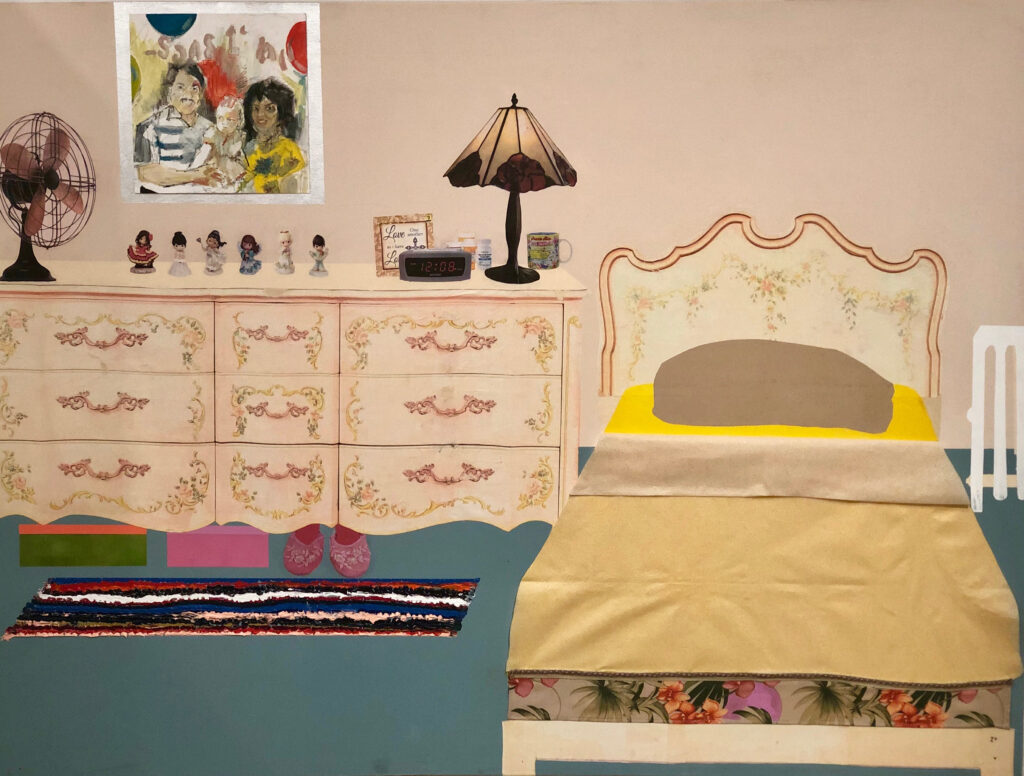
Upon encountering Misla’s work, one may well be getting a glimpse into a very personal, yet instantly relatable space. Her mixed-media works are decorated with distinct motifs that speak to her Nuyorican upbringing – from throne-like wicker chairs to bathroom cabinets full of VapoRub containers – Misla’s process of “furnishing” her artworks is an exercise of recalling memories of the homes she grew up in. Through this insistent exploration of the domestic space, she makes a place for herself in a city that is constantly undergoing change. Her work preserves the culture of everyday life in the Diaspora, threading between life in the Big Apple and her homeland in the Caribbean. Misla manages to record the memory of her home, all the while honoring her heritage and the people who inhabited these spaces. This subtle act of remembrance and resistance stands opposed to the policies of displacement and gentrification that favor capital over community.
Melissa Misla was born and raised in New York City, where she received a BFA from Hunter College and an MFA from Queens College. Her work has been exhibited in various galleries and cultural centers in and outside of the city. Her first solo show Bendita Casita in Praxis Gallery (NYC) featured artworks that captured the Nuyorican experience framed in a domestic setting. With the use of mixed media, Misla gives a new purpose to a variety of found items, be it photographs, artificial flowers, or clock hands, granting them a new home within the image of her home.
On April 16th Misla and I held a conversation where she delved into her creative process amidst a home that can be equal parts a haven and an unreliable place. The following is an edited version of this exchange.
CRD: What is the starting point for your artworks? Is it a photograph, or perhaps a specific memory that pops into your head?
Misla: I would say it’s a combination, but how it initially started was through photographs. I had taken a lot of photographs of my Titi’s apartment in the Lower East Side before she had passed away and it began from this idea that I couldn’t have access to that space anymore. I felt that her apartment meant something to me, like it really represented this idea of New York and what it meant to keep that island culture alive while she lived in the projects. It started from there, and then as I went on, I think I was trying to create those spaces myself. Sometimes it started with a photo, but sometimes it started with what I wanted a space to feel like. And so, I might start with a structure, a very simple construction, so that I can go from there and build. I go back and forth.
CRD: When you’re working on a piece, it’s almost like you are ‘furnishing’ a real space. Is this process instinctual or do you follow a model? How do you pick out what’s going to be in the final work?
Misla: It does feel a similar way. I actually have made jokes before that I can either do one or the other. Either I’m working on my paintings or I’m cleaning my house, there’s no in-between. There is a similar energy to going around decorating and finding the thing that will work. It doesn’t always make sense. The other thing that really draws my art practice is access to material. I really am trying to use what I have next to me in that moment or what I can be creative with. It started as a way of not letting the art stand still, because either I didn’t know how to do it, or I didn’t have the right material, or I couldn’t paint something realistically. Instead, I would ask myself, what do I have near me that I can do this with? After a while became an instinctual process that just comes from trying to feel things out – see what feels right.
CRD: You work mostly with mixed media, which is a fitting medium to represent those converging identities. When did you start working this way and how does it contribute to your vision?
Misla: I would say for me it started first with being a middle school scrapbooking kid, taking photos and cutting them up. I think I started liking that idea because I had always done art, but there was something about collaging where it felt like the pressure was off. Everyone wants you to draw a thing to look exactly like that thing, but collage doesn’t have that pressure. I think it’s why, when I came to a painting and I didn’t like the idea of painting mimetically, I found a way around it by using another material. And it felt right, because it really reminded me of the Puerto Rican will to make things work, to find a way.
CRD: Not only do you represent specific places in your work, but you also seem to depict specific memories from your childhood and from your time living in these spaces. Is this approach born out of a desire to document these memories within an everchanging landscape?
Misla: I think growing up in New York City, I constantly felt like the world around me was changing and that I had to hold on to it. I would see these places that I grew up with – the cuchifritos spot in the corner, the bodega I used to get sandwiches at – now they’re a Duane Reade and a Starbucks. I knew that I wanted to capture something, and I also knew that there was something very personal about a home that we don’t always have photos of. I learned that the hard way going through my old family albums – trying to find the places we lived in and not being able to. There is a sense of nostalgia and comfort in being able to access these spaces again. I think they are representative of an important time in our culture. Also, when it comes to the artworld specifically, we are in an interesting space where there has always been Latin American art and there’s American art, but where does Latinx art fit into that? I remember in college, people calling my work exotic and I was like “I’m from Queens!” But I get it. It was just an idea of understanding the whiteness that comes with American art and wanting to represent something different. Ironically, even though I make Latinx themed work, I’ve had conversations with Italians, Middle Eastern folks and people from all over who really relate to the combination of culture.
CRD: You treat your living space like a sanctuary through your work. The title of your first solo show, Bendita Casita, also plays into that idea. How do you view your own home? Is it always a safe space for you?
Misla: I think that over time, especially with my work, it has changed. Growing up, my home felt like a safe space, but it also didn’t. Like with all homes, there were complicated feelings, moody family, rules and things that had to be. I feel like I grew up feeling safe and comforted, but there was a balance there. The time that I was working on Bendita Casita was a transitional period in my life. I had a roommate that was moving out and the house was messy. Because it felt very chaotic, in some ways I was trying to channel the best parts of it into the artwork. I might have no control over my actual home space, but I have control over this artwork. Since then, it’s changed and now my house feels like one large painting. I think that I love the idea of a home being a safe space, but I do recognize that as a queer person, that’s a complicated thing. As a Latinx person, that’s a complicated thing. I know that life and the home are layered, it is a place of comfort and celebration, but if you pay attention there might be some other things going on… In some ways, there may be portraits of people, even though the person isn’t there. You can be the person in the painting because you’re standing in front of it, looking at it, and you’re reflecting off of the work.
CRD: Do you feel that your work changes as your home does? Does it embody what you see your home becoming?
Misla: Art is like a weird therapy at times. I think I got my home into a settled space, so I almost started imagining what was next. I still live in the same place I’ve lived in since I was a kid. I was supposed to move and then I didn’t, so I’m still in this place. But I think I have been coming to terms with this space, so I am anticipating my own future. I’m getting older, and part of that is imagining my own future. That comes with a lot of conversations I’m having with people my age or even younger. We’re all getting older and trying to imagine what our lives will be, and that parallels with the future of Latinx art and thinking about where we, artists, will be. I’m building on this visual language of representation. For example, I can keep using the Florecitas as a container, but you know that there’s no Florecitas cookies in that container. It’s holding something else. I like insider knowledge; like when people go talk about workshop and they shop talk and only they know what they’re talking about. I feel like I’m doing that with my audience.
And I think that leads to an interesting conversation. I’m sure that there’s so many paintings where we have no idea what was going on. So many art history classes where it has to be explained what’s going on because it wasn’t for me, but this is for you. It is for you to get it and for us to be included in this conversation.
