


Collage is derived from the French verb coller, meaning “to stick” (Nguyen, 2024).
Ephemeral evidence is rarely obvious because it needed to stand against the harsh lights of mainstream visibility and the potential tyranny of the fact. (Muñoz, 2009).
Memory, according to neuroscientists, is drawn from fact and feeling. These are several key components to memory: emotional salience (strong feelings that become ‘encoded’), semantic memory (names, dates, logistics), and episodic memory (anecdotes and important events) (Tyng, 2017) and (Raslau, 2014). What helps to spark a memory is often through association with a material. The material bridges the immaterial. Culture reveals itself if you parse through the layers of food, communication, art (visual and performance-based), and beliefs (religious and/or folkloric). What sticks and what doesn’t? Does that stickiness wear over time? Emily Rose, a Boston-based artist whose family hails from the island of Boriken, brings unconventional materials in conversation as cultural signifiers or even inanimate narrators of family memories. As elemental as show-and-tell but advanced as a collage and assemblage-based practice, every work blends Afro-Taíno culture as a tribute to her late father (d. 2005), vibrant kinship among her sisters and her mom, and methodology of memory-keeping. It fuses grief and celebration; nostalgia and estrangement—acknowledging that with time, your perceptions evolve, empathy or judgement abounds for what happened in the past, and those whom we mourn and glorify become more complex figures.
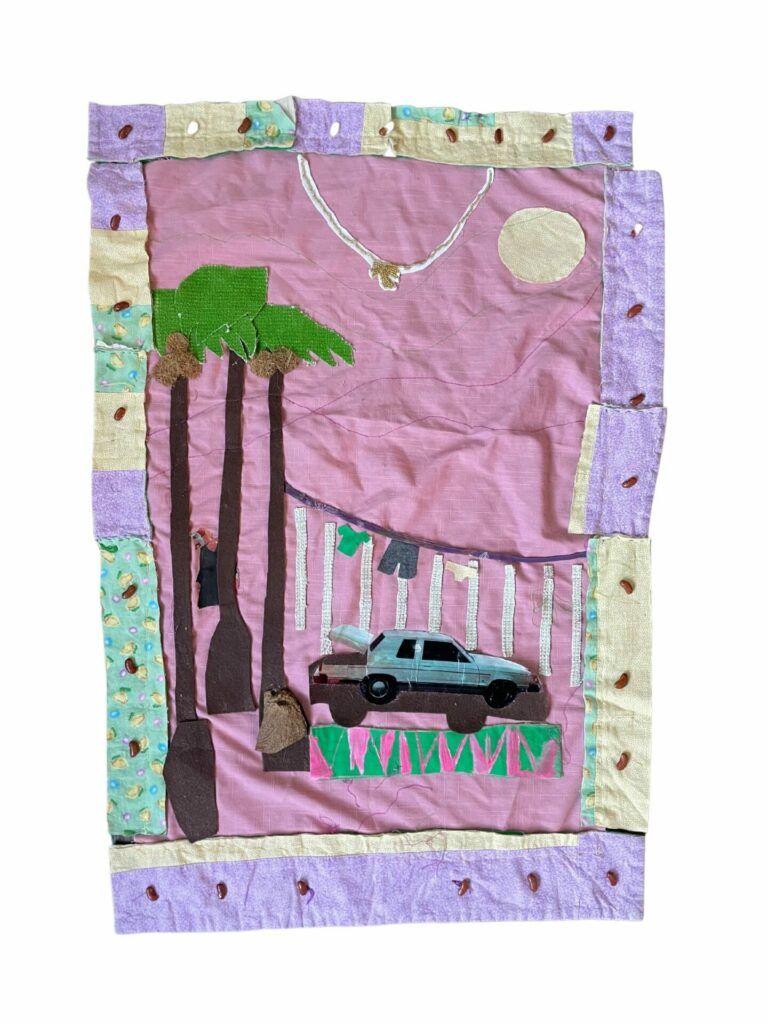
For example, Gold Chains, is a textile-based assemblage with coconut-bearing palm trees, a pastel background, an image transfer of a car, stitches suggesting Borikén’s mountainous terrain, a coconut husk, felted shadows, strips of rhinestones mimicking a white picket fence (perhaps The Boricua Dream instead of the “American Dream”), clothes on a clothesline to dry, a gold chain hung over everything like a constellation, and the patchwork border with dried frijoles. Gold chains can often be heirlooms or a way to express style and pride. In Emily Rose’s case, this is another tribute to her late father. She tells me, “Gold chains can serve as a symbol of personal success, prosperity, and or social status. My dad bought/owned a Gucci Chain in the 80s (his brother/uncle is the caretaker of the chain now). This piece was also inspired by his gold chains.” While each component of the work may feel piecemeal, each object jogs memories, and their complex relations to each other birth new meanings. Its arrangement suggests that these are the hidden stories contained and witnessed by the adornment of name plates and gold chains. They are merely a piece of the puzzle of daily life.
I did not understand the full magnitude of this work until the Unaccustomed Earth collage workshop, even though I curated the show. Emily Rose and I met in 2021 and have blossomed into collaborators, friends, and family. However, at this moment, I saw a different side of her. Rose imparted her process to participants in a new and unique way thinking through layers of memories through objects that access that intangible realm.
Memory became the adhesive for mundane, household objects. Magazine clippings came alive with hot glued rice, strips of fabric, and cowrie shells. Combining these materials made perfect sense in rebuilding familiarity and “domestic intimacy” according to the ShowUp blogpost by Jasper A. Sanchez in 2023. The omnipresence of rice and beans in the pantry, bold, colorful selvage my mother kept in a storage container for later use, and cowrie shells adorning anklets and earrings. She gave each object a new life and preciousness, more than they had before. They co-exist as permanent fixtures of the motherland, resourcefulness, and ritual.
Walking into the apartment that Emily Rose shares with her older sister Yazmine reveals the trace of family and two adults navigating the evoking relationships, histories, trauma (real or imagined) of their family while also building a home. Every time I’m there, they welcome me with hospitality. The longer I spend time there, the more stories I hear about how the pots that we used were from the 90s. The lid doesn’t have a handle anymore but it belonged to whom the Navarro sisters affectionately call Mamí (their mom). A simple quip about a pot leads to an excavation of how Mamí had to be strong because she raised five kids after her husband died, how she deflects through laughter, and how she loves her girls fiercely. She did pray for all girls afterall.
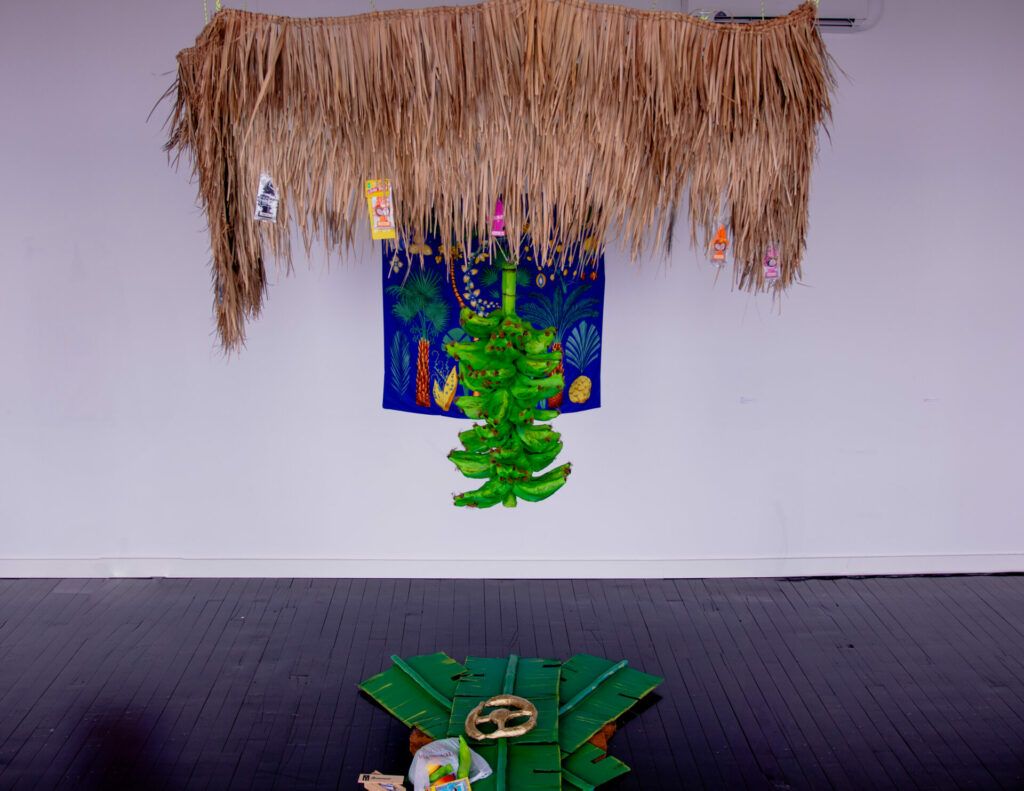
Emily Rose’s newest work (in its first phase), created in Rixy’s Artist Bootcamp at Elevated Thought, is Entra/Spirit Car (2024). She re-envisions her father’s past time as a backyard mechanic since coming to the US in the 80s. One of his proudest achievements once arriving in the States was purchasing property, his very first car: Toyota Corolla SR 5. From then on, he loved and cared for cars up until his passing. One of the hardest things to do after someone passes is to parse through their things that they left on this earth. It may evoke memories or feel possessed with their spirit. Rose remembers one of his cars resided under a tarp after his death that rusted and ended up at a scrapyard. Perhaps it was forgotten about, not prioritized in the attention-holders of raising children, or it was too painful to drive and pour into with the same level of care.
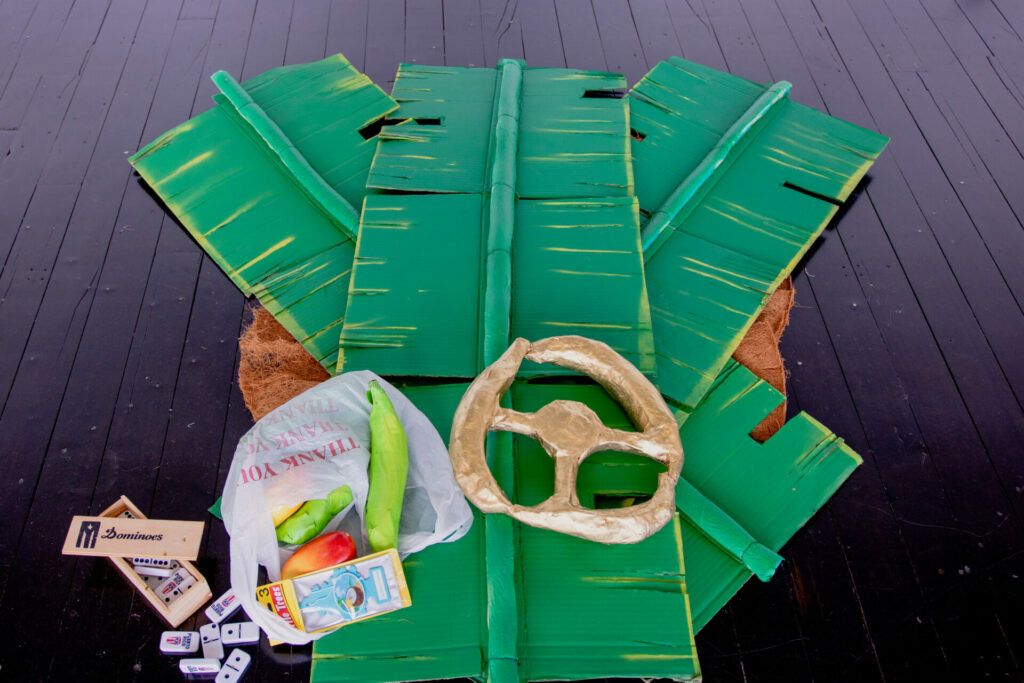
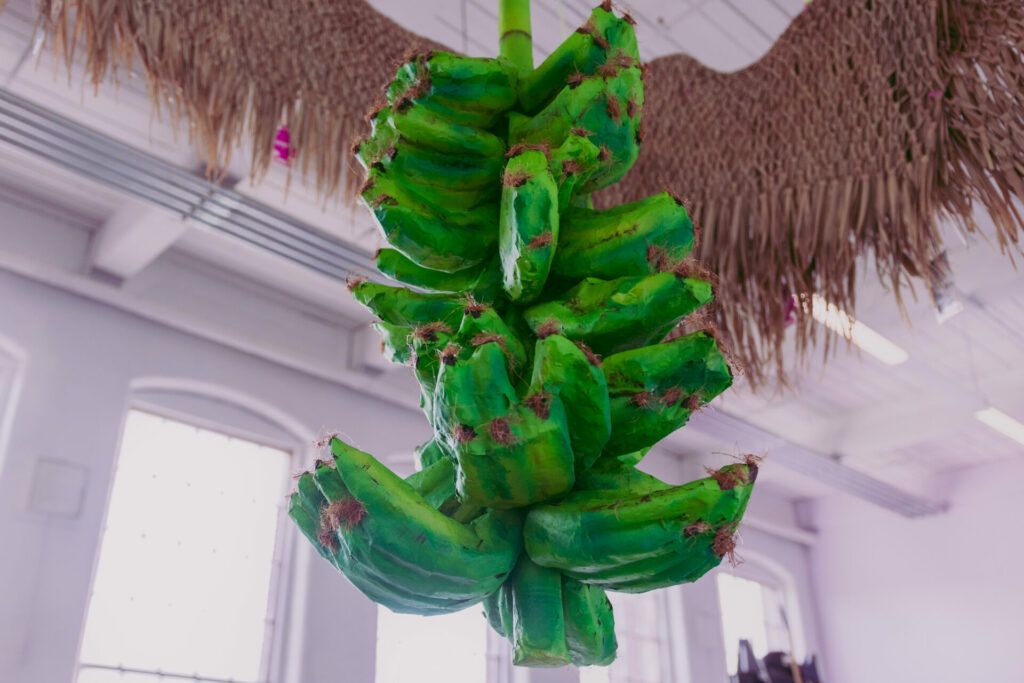
Therefore, what enlivened her father as a hobby, due to unforeseen circumstances, faded into detritus. Emily Rose takes up the mantle of his work and passion by rebuilding and stewarding the car. It’s like she picks up where he left off with his unfinished work. Rose revives this car and imbues it with preciousness once again. She talks about why she brings the car back to life and how she imagines its new purpose when says to me, “The Spirit Car drive[s] through the cosmos and bring[s] back loved ones while sitting inside. Once finished, the viewer can sit inside the car and remember forgotten versions of themselves, visit new places, and be with lost loved ones. My vision is plac[ing] the paper maché plátano vine in the car [and] drap[ing] the dried palm leaves [as] fender skirts.” The work, reportedly aromatic from dangling, tree-shaped car air fresheners, stimulates the senses to open up this memory portal.
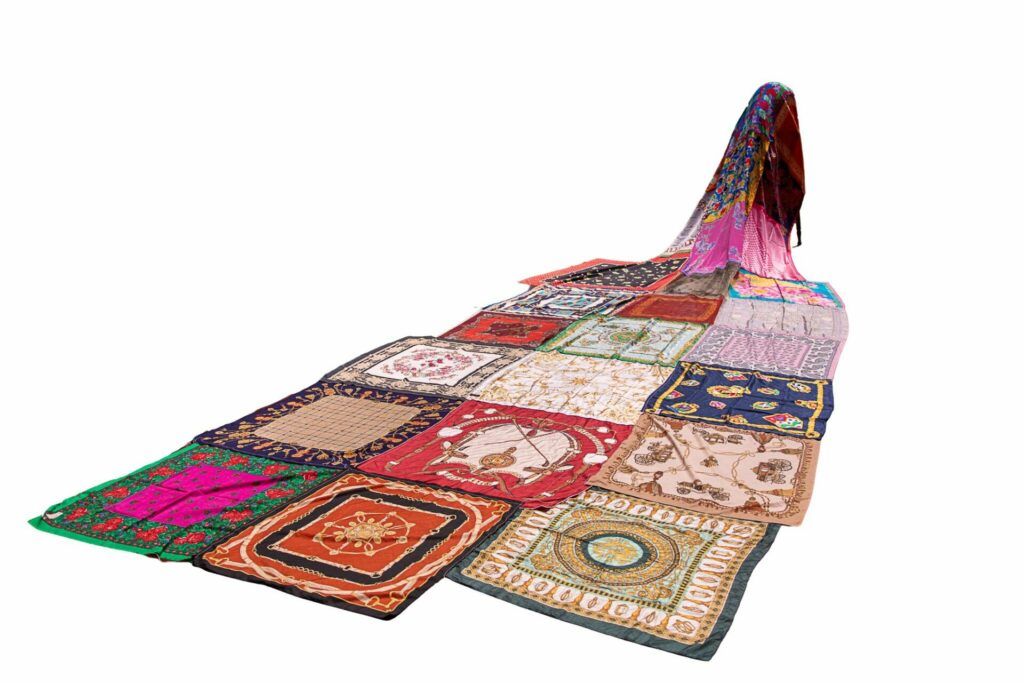
Most of Rose’s artworks are a tribute to her father and a particular work about hair really incorporates history and memory of both of her parents. La Doobie Doobie recalls how her parents fell in love. In El Salón, a multidimensional installation that included La Doobie Doobie, she writes in a blog post on her website, “My mother and father fell in love at beauty school in the early 80s. Her talent extended outside of beauty school and into the kitchen. Most of my early childhood was spent in the kitchen (presumably getting their hair done).” (Rose, 2023) La Doobie Doobie evokes the experience of protectively wrapping hair on flights only to be transformed into loose strands upon clapping at the plane’s arrival to San Juan. Or even the ritual of preparing for bed involving la doobie tucking in the curls and moments around the house of cleaning and lounging. But for Rose, she reiterates how, “This nighttime ritual was [her] favorite part, as it was rare one-on-one time with [her] mother.” (Rose, 2023)
artist.
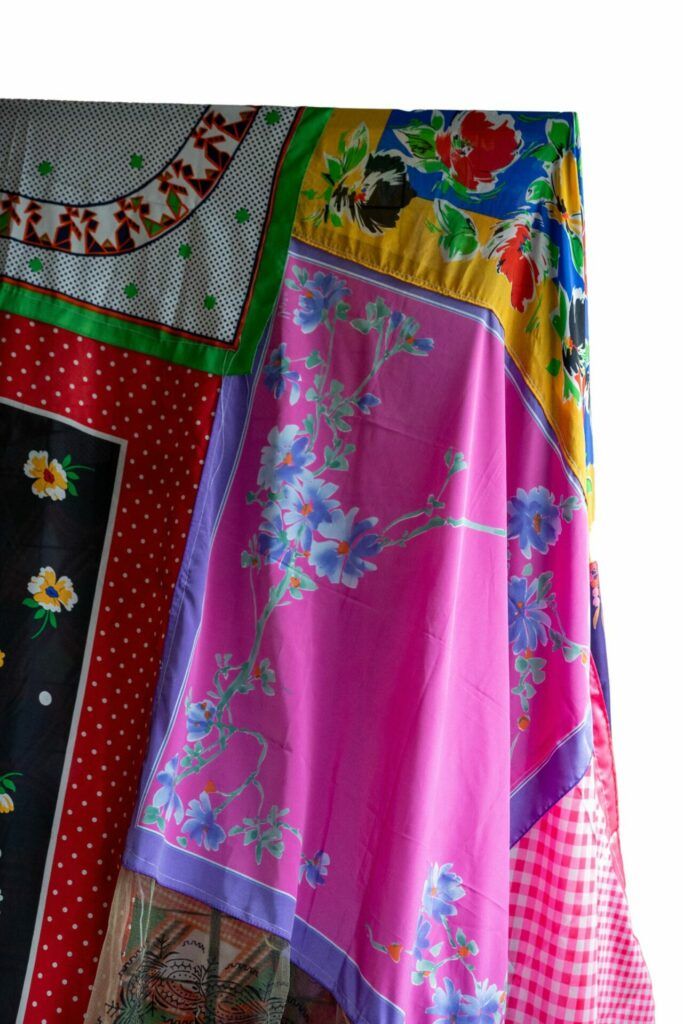
A doobie keeps flyways in check and hairstyling crisp. While I can imagine that a house of 6 women had many doobies even if they slipped into the crevices behind the bed during tossing and turning, like it grew legs and walked away, never to be seen again, that wasn’t a reality. In the 80s, their mom had only one that they shared. This is why Rose bought thirty of them and sewed them together to signal the approach of bedtime for the household like a unified symphony. She says, “Sewn together, I created a quilt of memories that can be worn, slept under, or hung from the ceiling to see the intricate shapes, patterns, and floral designs to create La Doobie Doobie.” (Rose, 2023)
artist.
However, Rose doesn’t just replay the function of the object, but through a larger scale brings a Dadaism to it where it becomes a cultural symbol; thus, recontextualizing a smaller object. In her installation, the headscarves become like a train of a dress or extra-long veil. Why is it so long, I thought. Rose talks about redeeming what she didn’t have as a kid. Since they all shared one doobie, she envisioned giving them to her younger self and sisters. Everything she creates encourages the cycle of gift economies and making due with the things that you have.
Each object tells a story. Rose gets viewers to notice and reflect on that because instead of trying to hold onto intangible memories that can fade into vapor, it is easier to carry them through objects as a medium. Plátanos, frijoles, and doobies are all approachable and accessible objects that are rearranged to reach the immaterial place of our memories embodying the assertion that “For us, these small artifacts are what most accurately map daily life—with all its friction, surprise, and wonder” (Bluedorn & Zhang 2023).
References
- Nguyen, T. (2024, February 24). On the Wor(l)d as Collage, or Intertextuality. Syllabus. https://syllabusprojOn the Wor(l)d as Collage, or Intertextualityect.org/on-the-world-as-collage-or-intertextuality/
- Muñoz, J. E. (2009). Cruising Utopia: The Then and There of Queer Futurity. NYU Press. http://www.jstor.org/stable/j.ctt9qg4nr
- Machado, C. M. (2019). In the Dream House: A Memoir. Graywolf Press. https://carmenmariamachado.com/in-the-dream-house
- Tyng, C. M., Amin, H. U., Saad, M. N. M., & Malik, A. S. (2017). The Influences of Emotion on Learning and Memory. Frontiers in psychology, 8, 1454. https://doi.org/10.3389/fpsyg.2017.01454
- Raslau, F. D., Klein, A. P., Ulmer, J. L., Mathews, V., & Mark, L. P. (2014). Memory part 1: overview. AJNR. American journal of neuroradiology, 35(11), 2058–2060. https://doi.org/10.3174/ajnr.A4059
- Sanchez, J. A. (2023, December 3). The Magic of Memory: Reimagining resilience in Diasporic Puerto Rican art — Show up. Show Up – Beacon Gallery. https://www.showupinc.org/blog/the-magic-of-memory-reimagining-resilience-in-diasporic-puerto-rican-art
- Rose, E. (2023, August 1). El Salón: Reimagining self-love, rituals, and healing in the kitchen. Art by Emily Rose. https://emilyroseart.substack.com/p/el-salon?r=22y6f3&utm_medium=ios&triedRedirect=true
- Bluedorn, E., Zhang, T., & Choo Choo Press. (2024, February 24). Personal Archives & Visual Memoir. Syllabus. https://syllabusproject.org/personal-archives-visual-memoir/