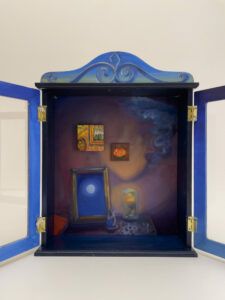


Raised in Boston, Massachusetts, twenty-six-year-old diasporic artist, Beatriz Whitehill carries Puerto Rico in every step she takes. She has been making art since childhood. Whitehill holds a BFA in painting from the Massachusetts College of Art and Design. She works as a studio mentor at Artists for Humanity and is a community artist liaison at the Museum of Fine Arts Boston. Her work ranges from painting to animation, even finding inspiration in streetwear design and collaging, to express different stories rooted in identity and culture.
Beatriz Whitehill deconstructs colonialism through her art, while building an identity rooted in her ancestral history. Whitehill is a multidisciplinary artist who weaves through art forms to confront and contextualize generational trauma, caused by colonization in displacement. Her practice grows from magical realism and draws from the symbolism of Puerto Rican folklore. Although utilizing art to heal and grow her sense of identity is deeply personal work, the artist looks to create a space for anyone to unburden themselves in her pieces.
Constantly welcoming with the warmest presence and a purpose in the arts, Beatriz Whitehill was generous enough to talk with me about her art and her practice. What follows is an edited version of that conversation.
GB: Do you remember the first time you made art and how it made you feel? How did it inspire you to pursue art as a career?
BW: I love thinking about that, I feel like I’ve always been doing art. My parents were really encouraging when I was younger. It was always second nature for me, painting with my sisters, or drawing from shows. Now I am stepping into it as my professional path because I can, and I don’t want to put my energy anywhere else. It feels like what I’m supposed to do. I’m still adjusting to it because it’s something I want to keep as an outlet. I want to hold on to that sense of my girlhood, and use it to express myself, while also realizing how it can connect with other people. Thinking about our emotions, about my family and identity, now I can recognize those things, but when I was younger, I was simply drawing and it was the only thing I felt I was good at, so I just continued. I’m lucky, I know not everyone has supportive parents when it comes to art. Sometimes I battle with guilt because it’s not a practical pathway. But I’m letting go of that guilt, because my family supports it, and wants me to continue.
I pursue it because it’s what I’m meant to do. Sometimes people say, “Trauma isn’t healed in a family or in a generation until someone does the work”, and I look at my art as that work. It’s just what I’m meant to do, and I find fulfillment in it.
What’s your style or technique? Do you connect it to the diaspora, or your community?
I look at a lot of Caribbean art, art from Puerto Rico, and art from other artists in the diaspora and I try to uplift art forms that aren’t always necessarily considered Fine Arts. I’m really inspired by folk art, I’m really inspired by even other areas you see art in, like advertising and just people combining different forms and making art more accessible. For me, I really like it when someone can look at something and see it out in the world, not necessarily in a museum or gallery, because not everyone has the time to go to a museum. But we can see art on billboards, we see art on the street, on posters or graffiti or folk art in our homes.
I think about ways that I can make my work more accessible, and sometimes that means I animate a part of my painting. Working in motion or on found objects and materials, because it doesn’t need to be on a linen canvas. This can be art too and it can be for my community that doesn’t spend their free time visiting museums. The world is far more digital, with social media right now; through animation my art can reach an audience beyond museums. It’s more accessible and out in the open, so public art is something that I’m working towards, whether it be through murals or other forms. It’s a goal of mine to be able to make my art in a public space.
Are you able to find a sense of identity by representing diasporas?
I’m creating my own sense of identity, it’s something I’ve struggled with while growing up here, my father is not Puerto Rican. It’s just on my mother’s side, so I need to find my own relationship to my culture and my family’s history. Doing that as a process has allowed me to find a sense of identity.
If you’re in a diaspora, you have a responsibility of taking pieces from where you come from, from your ancestors and recontextualizing them in a place that doesn’t have the groundwork for it. But a part of you needs it. Where I grew up there were no other Puerto Ricans, but my family became friends with a lot of other Latinx families. We found things in common and meshed. I still live with someone who I grew up with in that way. We built our traditions by borrowing aspects from Puerto Rico or Ecuador and remaking it here in Massachusetts. For me it was that sense of building, it’s a responsibility that you need to work for. I’ve made it my goal to go back to the island at least once a year. Whether it’s seeing my family or sharing the island with my friends from all over the world and share so many beautiful similarities. It’s just a dream of mine to be there, live there, go back, and preserve it, because I don’t want to lose it.
In my family, we don’t have a ton of connections because of traumas and tension that arose from colonialization. I blame colonization for this generational trauma that has broken relationships in my family.
Your animation tends to stem from your paintings, what’s your process in deciding what medium you’re going to work on? Does it affect your process going from painting with oil to working with animation and streetwear?
Sometimes my stories don’t have to be a painting, but it could be better represented if part of it is animated, or becomes a sculpture, or an installation piece. Just figuring out what the eventual feeling that I want to get across is. The last animation I did was on a whim, I was looking at this painting and thought “ What if I just animate a piece of it?” But with oil paint I find the process so precious and rooted in history. When I’m painting and erasing, to create an animation and wiping it away and painting again, making it less perfect to me, but it can just live in this in-between state. Which is something that I feel a lot in myself, and anyone in the diaspora feels that way. Your identity could be condensed to one thing, when you’re in one space and when you’re in another space you feel called to take on a different persona and tone yourself down. So, for me, that’s manifested as, when do I actually feel like me? When am I me? When am I not a reflection of what everyone else is expecting me to be? I can create my work in a way that’s not one thing, but multiple. It’s not just an oil painting or an installation, it’s up in the air, it’s a manifestation of how I feel.
My inspiration with streetwear has been a process of figuring out where it comes into my work. Sometimes it’s more the energy in streetwear that inspires me. It started when I was young, because my parents worked for an Activewear company, which was a huge inspiration for me. Part of the drawings that I did as a kid was on their throw-away design sketches. Ultimately, it’s about the way that people wear clothes and express themselves as a form of art. I look at that, revere it and put that on my own pedestal.
Earlier, you mentioned how you channel generational trauma through your art. In your piece Reminder to Call My Sisters, you write, ‘There’s a curse we promised each other we’d break. The kind of curse that creates a distance you can’t close with an airline ticket.’ Do you see your art as a way to connect with or represent your family?
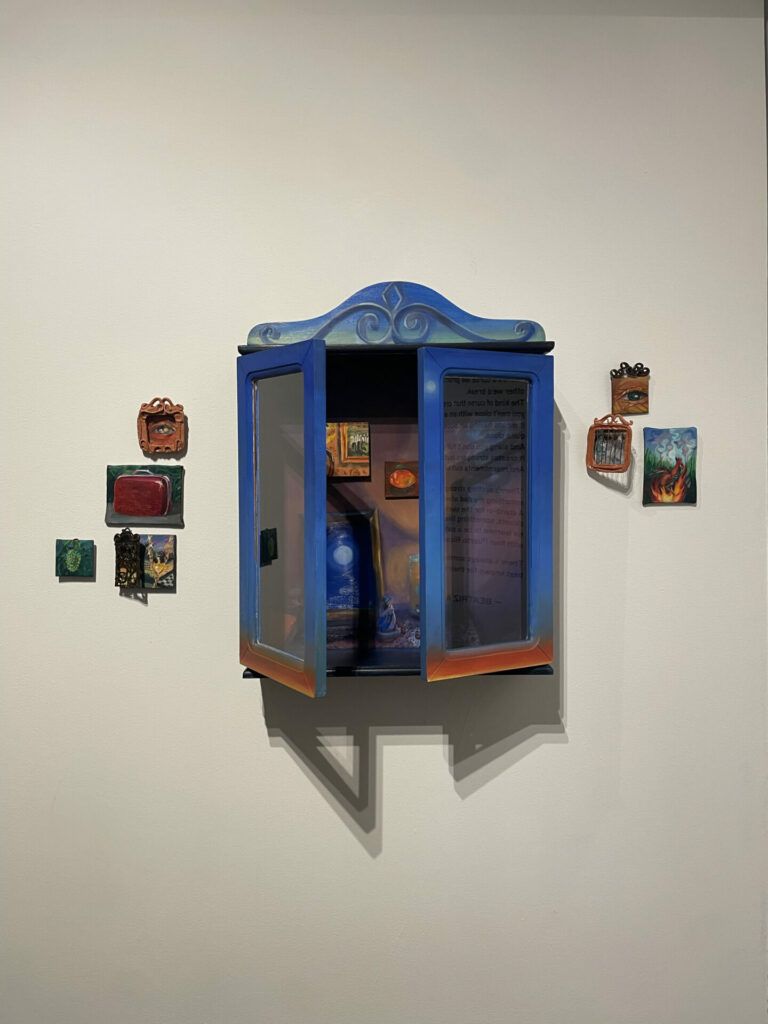
I’m learning how to, because there’s conversations that have yet to be had with my family about the work that I’m doing. Sometimes I feel like I’m walking delicately, we haven’t had conversations that I hope to in the future, but I’m learning how to ask questions. With that piece, Reminder to Call my Sisters, at the little gallery that I had, I was able to show it to my mom, which meant a lot to me. There are pieces of my work that I have made based off of the stories that she’s told me. I have a miniature painting series, and each miniature painting I tried to connect to her childhood stories. I’m trying to learn from their experiences and be curious about the things my ancestors and other people go through. Turning it into something that visually processes it for me and my family, or for anyone, because other people have these stories, and everyone goes through these things with their families. So, I don’t want it to be just for me and my family, but hopefully everyone sees themselves in my work.

I’ve seen that you’ve been to Puerto Rico numerous times, do you feel different when you’re in P.R than when you’re in the USA? Does it affect your inspiration?
Yes, I always feel so inspired every time I visit. Once the plane lands I feel it, it’s in the air, in the sunshine, in the humidity, just in nature, even on the streets. Everything about Puerto Rico inspires me. I don’t always feel like I belong there and that’s okay. I’m coming to a sense of peace with not belonging here nor there, because I can belong where I am. I create my own sense of belonging and I don’t allow other people to tell me where I do or do not belong. I enter every space with love, and love towards myself. I’m still learning how to do this. I don’t always feel like I belong there, but I always feel inspired when I’m there. I always feel more connected to myself and to the world. I don’t consider myself an extremely spiritual person, but I feel more spiritual when I’m in Puerto Rico.
What conversation are you trying to create for your audience? What are your goals?
I just want to create a space for people to reflect or just breathe when looking at my work. I don’t need anyone to tell me, “Your work is good, it’s valuable.” I just want people to feel seen. People tell me that they see ghosts or sadness in my work, and sometimes that’s true. I feel like we don’t have enough moments to simply feel what we need to. Everything is heavy; the world is extremely heavy right now and I know every generation has probably felt like they’re living through the craziest times, but I think this time is different. So, I hope that through my work people can just feel and reflect.
I want to make public art; murals on the street that anyone can easily find. I’m dreaming of having a residency, just being able to create and connect with other artists in Puerto Rico. Honestly just to continue right now, I’ve been struggling to really project into the future. I’m trying to make this career, so I should have goals; I should be dreaming of a show in whatever place. But my goal is to keep making art and find ways to love, because that’s what I need right now.
References
- Sanchez, Jasper. 2024. The Magic of Memory: Reimagining Resilience in Diasporic Puerto Rican Art. Boston MA 02118 Showupinc.org. Accessed April 8th. https://static1.squarespace.com/static/64c29dbfbe87be347908287e/t/656cb4a92459193db9e0a1fb/1701622955108/The+Magic+of+Memory+-+Jasper+Sanchez+Final+Version.pdf
- Whitehill, Beatriz. Beatriz Amelia Whitehill. Accessed April 7th. https://www.beatrizameliawhitehill.com/home