


The mirror often provokes profound and unsettling feelings of discomfort. Its reflective surface confronts us with rarely seen angles of our corporeality, compelling us to question not only how we are perceived, but also how we perceive ourselves within the larger fabric of society. In this meditative act of facing our image, a cascade of concerns and reflections often arises, extending beyond issues of physical appearance to probe deeper anxieties about identity, belonging, and recognition. Among these, perhaps the most persistent is the question of who we truly are, both in the intimacy of our homes and within a collective social body. It is precisely this tension between self-perception and the broader social framework that Gabriella Torres-Ferrer’s artistic series ‘Be Real’… encourages us to confront in dialogue with ourselves. To look in the mirror is to engage with the complexities of our existence—our vulnerabilities, contradictions, and the often-uncomfortable truths. Rather than evading these issues, this encounter invites us to embrace discomfort as a pathway towards accountability and communal growth. In a world where injustice and egocentrism are often improperly addressed despite being more visible than ever, Torres-Ferrer’s body of work prompts us to sustain engagement with conflict and to use it as a critical tool for continually examining the structures and failures of our society.
The issues of identity and collective belonging have gained special relevance in the contemporary context of the twenty-first-century wave of cybernetic spaces. Although to a great extent, we are more connected than ever, the absence of physical presence has often weakened the genuine conversations essential for true understanding and collective growth. Instead, we are encouraged to project, curate, and continuously perform our identities in public digital spaces, left to be constantly perceived, inspected, and monitored. Even the quality of authenticity is pressured to be performed and showcased under slogans like “be real” or “be yourself.” However, these imperatives are deeply entangled with cultural norms, market logic, and social expectations that shape, police, and ultimately constrain the ways authenticity can be performed and recognized. Rather than embracing the fluid and shifting nature of human identity, the digital sphere often compels us to present ourselves in fixed motion, as something that can be captured and consumed in a single selfie. In addition, social media frequently fosters a false sense of community, where isolation and superficial interactions replace the materialized act of critical dialogue.
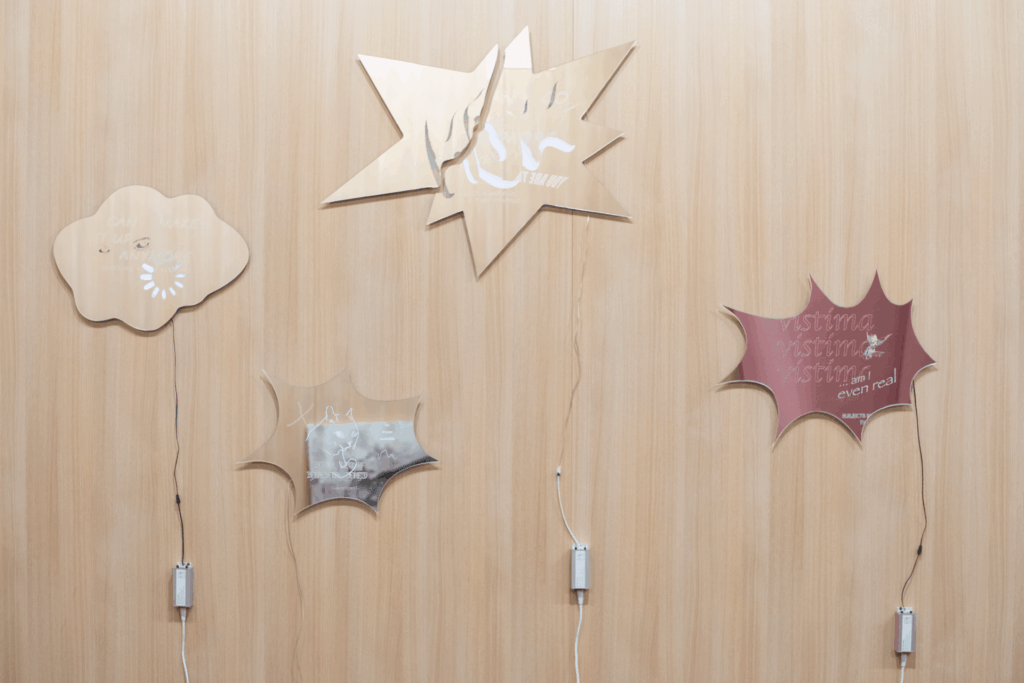
Confronting this tension, Gabriella Torres-Ferrer challenges the static gaze of the digital self through their latest work ‘Be Real’… (see figure 1). Face-to-face with our image, their work invites us to reflect on what it truly means to “be authentic” through their intervention of five mirrors. In this series, the materiality of the mirror becomes both the support and the subject matter of the creative act, directly intervening on the surface of the glass. Intentionally, when standing before the mirror, the viewer is not only accompanied by their reflection, but also by a series of meditative phrases and wordplays, laser engraved onto the surface, such as: “CAN MAKE IT UP ANYMORE (nothing wrong with me),” “vistima vistima vistima,” and “YOU ARE THE MEME.” The irony embedded in these phrases reaches its full potential through the inclusion of scattered images and sudden flashes of light, adding a much more alarming and chaotic dimension to the process of personal introspection. Furthermore, all the mirrors, except for one, feature irregular edges. These forms are thoughtfully designed to reference exclamation bubbles, which in pop culture and comic books have become iconic symbols of agitation or heightened emotion; alongside thought clouds, used to represent either dialogue between characters or internal monologues, often serving as distinctive visual representations of the spoken word.
Unlike the mirror, the digital camera not only allows us to look at ourselves, but also to control how we want to be seen. Through strategic angles and filters, idealized versions of the self are constructed, stripped of pores, movement, or temporality. This everyday practice of self-orchestration authenticity thus becomes a paradox, not so much an exercise of honesty or empowerment. Torres-Ferrer’s proposal directly challenges that logic, using the mirror not as a tool of vanity but to reflect on our need to control and frame a falsely “real” identity and appearance. Unlike a photograph, which captures a brief moment, the mirror reflects the body in constant transformation, following it in real time and revealing its shifting and often vulnerable sides. Gabriella Torres-Ferrer leverages this element to challenge the way the viewer sees themselves, without the control offered by the photographic lens of our mobile devices.
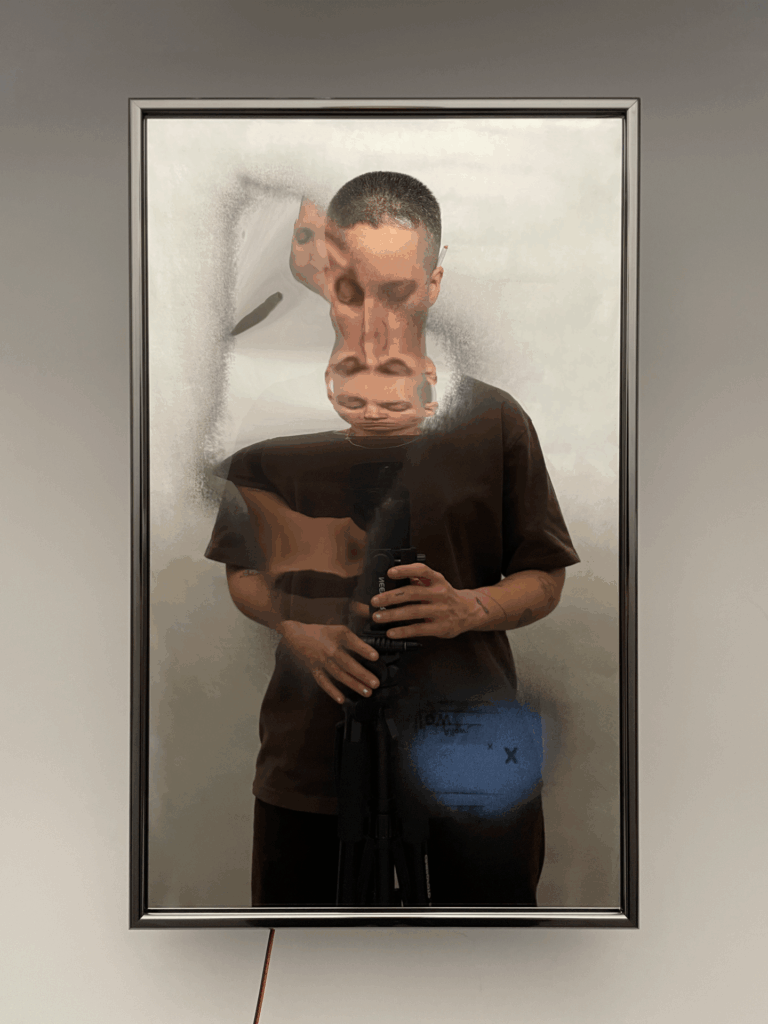
One of the most challenging works in the series is perhaps its most minimal. As the artist describes, the work I (see figure 2) consists of a subtle intervention on the glass to produce an effect comparable to that of distorting mirrors found at circuses or amusement parks. Through the simple act of misshaping the viewer’s face, the piece directly subverts the idea of the self-image as something immutable. Instead, by offering the viewer a series of unstable forms while contemplating their altered reflection, the work suggests that identity is fluid, malleable, and profoundly shaped by surrounding conditions and perception. The presence of the viewer thus becomes indispensable for activating the artistic gesture. Its reflective surface demands a bodily dialogue, positioning the viewer as a co-conspirator in the artwork’s action by mirroring their image, making them aware of their body, their position in space, and the passage of time.
In this sense, the mirror is presented as an active, unstable surface whose existence depends on direct interaction. In the work of blin blin blin blam (far right in Figure 1) for instance, the satirical yet critical textual fragments such as “…am I even real,” “(Laughter),” and “vistima vistima vistima,” perfectly capture the inherently discordant nature of human contemplation. The play on the word “vistima” appears to allude to the viral interview clip, later popularized as a meme across Latin America, featuring the phrase “yo la veo que ella se está haciendo la vístima” (“I see her as playing the victim”). This reference, loaded with irony, underscores the idea of performative victimhood.
Here, Torres-Ferrer’s central proposal comes into play by placing the viewer in friction with their being as a mechanism for self-interrogation, taking as a point of reference Sarah Schulman’s book Conflict Is Not Abuse. As its title suggests, in her book, Schulman argues that people often escape accountability by overstating harm, framing ordinary conflicts as abuse to avoid self-reflection or justify misconduct. Instead of receiving the complexity of conflict as something negative, the author prompts us to hold each other accountable and intervene to repair relationships and grow in community. Shulman further warns that by choosing to avoid discomfort, whether through silence or by weaponizing our experiences, we also evade the possibility of change. This has especially been perceived in the past years, where violence and abuse of power have been plastered across our devices, yet manifestations of outrage are often insufficient. ‘Be Real’… further follows Schulman’s critique of victimhood, as the author theorizes that it may be used to defend real abuse, as she exemplifies with the reign of fascism, police brutality, and the mass genocide of Palestinians under Zionism.
As demonstrated in this body of work, Torres-Ferrer’s artistic research stands out for its critical inquiry into power structures framed within processes of futurability and globalization. The ‘Be Real’… series points to the need to rethink how we relate to our surroundings, especially through the dynamics that unfold in digital spaces. Through minimal gestures—the distortion of a reflection, the inscription of ironic phrases, the allusion to recognizable visual languages—the artist subverts traditional mechanisms of self-representation, proposing instead a space where our place in society it’s in constant interrogation. Faced with a world saturated with images and carefully edited performances, ‘Be Real’… returns us to an experience of the real that does not lie in the coherence of an image but in the tension between who we are, what we display, and what is expected of us. In dialogue with our reflection, the series confronts us with the reality that no human being exists in isolation. We are part of a larger whole that depends on the continual revaluation of the systems and beliefs designed to serve us. In this uncomfortable act, Torres-Ferrer does not offer answers, but an invitation to look, and to look at ourselves, with a kind of honesty that escapes the filters of our electronic devices. Only through this ongoing process can we truly transform and evolve collectively.