

The idea of place—a space where we belong—is a constant subject for many of us. For Afro-Puerto Ricans, feeling at home is a complex issue that arises whenever someone asks, “Where are you from?” Again and again, I am reminded of how many—including myself—feel lost, bereft of a sense of place. Born in Carolina, Puerto Rico, and later transplanted to Dallas, Georgia, my identity often blurs, defying clear boundaries. The question, “Where are you really from?” becomes a refrain, a way for others to make sense of me within their limited framework. This reduction process divides us, rendering us a singular thing—an exotic “other,” something fixed and digestible within hegemonic terms. Whether within Borikén or in its diasporas, Afro-Puerto Ricans often feel like strangers, even in Puerto Rican spaces. This everyday anguish that shapes our sense of belonging affects us all. As an artist and art historian, seeing people like me and my family excluded from the discourse feels familiar within the unfamiliarity. However, despite what others think, Puerto Rico is my home. It is my place of memories and substance, where Blackness is as Puerto Rican as the structures that build our homes.

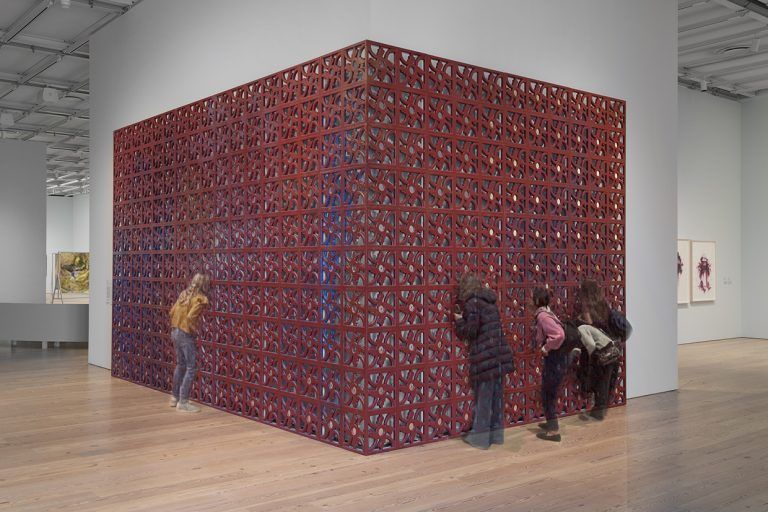
Edra Soto’s ongoing GRAFT (2022) echoes these feelings of displacement, belonging, and being that “thing.” GRAFT acknowledges the history of vernacular design in Puerto Rico and its diasporic communities through the motifs of rejas (wrought-iron bars and gates) and quiebrasoles (concrete fences). Rejas typically serve as security measures, demarcating boundaries between the private and public, the inside and outside. This distinction is one that those who were born, lived, or are outside of the archipelago know all too well—caught between worlds, trying to find a place where we truly belong. The rejas, delicate yet confining, evoke beauty and containment. They are whisperings of boundaries: private and public, inclusion and exclusion. These motifs, etched precisely, recall the colonial desire to divide, categorize, and claim. Through these apertures, what could have been decorative transforms into something more profound—a reminder of how colonial frameworks fracture, label, and consume.
Césaire tells us that under colonialism, we are reduced to “things,” stripped of complexity, of agency, our identities molded to fit someone else’s vision (Césaire 2000, 42). In GRAFT, I see this process mirrored but also resisted. The rejas, once symbols of home and safety, are here fragmented, their patterns repeating like the rhythm of loss in diasporic lives. For many of us, the rejas become a barrier and bridge metaphor, holding the weight of belonging and estrangement. The grid’s symmetry and repetition evoke a sense of order and structure, while the embedded slide viewers introduce moments of interruption, inviting close inspection. Through these breakings, viewers glimpse photographic images of Puerto Rican landscapes devastated by hurricanes, creating a poignant dialogue between the aestheticized structure and the lived realities of destruction and resilience. The juxtaposition between the solid, ornamental exterior and the fragmented, evocative imagery within mirrors the diasporic experience of holding onto fragments of home while navigating dislocation. They are familiar, yet in this space, they stand stripped of context, asking us to confront what has been taken, what has been erased.
Place, as scholars like Yi-Fu Tuan describe it, is not just a static point on a map but a living entity infused with history, memory, and emotion. Tuan describes a “sense of place” as a bond forged between land and life, where attachment or alienation seeps into the soul. Tuan reminds us that such a sense of place is not inherently kind or comforting; it may whisper warmth and belonging but also bristle with fear or exclusion (Tuan 1977, 684–96). For Afro-Puerto Ricans, home is both cradle and crucible, the anchor of identity and the stage of continual displacement. This sense of place is not stillness but motion—a dialogue between what was, what is, and what we hope to be.
Soto’s work pushes back against this erasure, refusing the simple narratives that colonial gazes impose. Instead, GRAFT embraces the multiplicity of Puerto Rican identity: fractured yet whole, beautiful yet bruised. The intricate designs of the rejas, steeped in West African influence, echo the histories of enslaved ancestors who wove their aesthetics into Puerto Rican life. Here, their presence refuses to be ornamental; it demands to be seen as essential. Memory, in particular, plays a central role in shaping the sense of place. For diasporic communities, memory is both a solace and a struggle—a tether to a home that is often out of reach. Soto’s rejas become vessels of memory, their patterns and apertures holding the weight of ancestral histories and personal longings. The images of hurricanes within the rejas evoke the fragility of home, while the rejas stand as symbols of resilience. Soto’s use of these patterns becomes a reclamation, a counter-narrative to the colonial project that would turn culture into artifacts, people into exhibits, and lives into lessons for others to consume. This tension between fragmentation and wholeness, between the imposed and the reclaimed, feels deeply personal. In the rejas, I see the lines of my identity, the ways we are broken apart, reshaped, and asked to fit into frames that do not hold us. But through Soto’s apertures, through these portals into memory and loss, we are reminded of the complexity that cannot be erased. Like the images within GRAFT, we are layered—a patchwork of longing, survival, and reclamation. In GRAFT, however, Soto complicates these boundaries. The slide viewers embedded in the structure allow us to see “out” into landscapes of Puerto Rico ravaged by Hurricanes Irma and Maria (Soto 2020). Through these apertures, we are reminded of the fragmented and fragile connection to home, much like the one many feel—a yearning for something familiar yet distant.
For the past decade, Soto’s project has investigated Puerto Rican cultural memory, often highlighting the Black heritage of the archipelago, which has been relegated to folklore. Like GRAFT, our diasporic experiences underscore the erasure of Afro-descendant identities from the mainstream narrative of Puerto Rican culture. There, visual culture is memorialized. Soto challenges the idealization of whiteness as the essence of Puerto Rican architecture, reminding us that Blackness is an integral part of this cultural oeuvre. Her rejas point to West African influences, particularly from the Yoruba communities, and illustrate how enslaved Africans brought their aesthetics of collective beauty into the everyday spaces of Puerto Rican life (Soto 2020).
Similarly, identity in Soto’s work defies reduction to a singular narrative. The structures embody vulnerability, resilience, and strength. They suggest a connection to something deeper—an essence untouched by colonial definitions. The term ‘liminal,’ derived from the Latin word limens, meaning ‘threshold,’ signifies a transition space marked by waiting and uncertainty. It describes the existing experience between two worlds: one familiar and the other yet to be discovered. It is a title meant to encapsulate how they examine the notion of homeland as fixed and unfixed, a constantly shifting idea or memory, and a physical place and psychic space. To be liminal also underscores how people trouble and redefine concepts of migrant, immigrant, and citizen. To belong is to hold a tether to something larger than ourselves. Some directly engage with present global migration debates while avoiding the vitriol in which those debates are steeped. Others challenge the labels of alien, foreigner, and outlier. Many poignantly and apolitically illuminate the universal themes of departure, arrival, loss, uprootedness, persistence, and faith. In this structural matrix, the hidden, almost intimate faces between the bars become a symbol of identity and ancestral memory, a reminder of the richness and complexity that survive beneath the surface. Soto’s work invites us to see identity as a process of reclamation, a dialogue between the imposed image and the reclaimed self—a theme that echoes Césaire’s call for decolonization as a return to human dignity and complexity.
GRAFT’s symmetry, texture, and geometric motifs resonate deeply with its meaning and echo the structures from Puerto Rico. But more than that, these designs speak to the fragmented and multifaceted identities many of us in the diaspora carry. Like the rejas of GRAFT, which separate yet connect, we feel the tension of belonging and alienation. Soto’s work reflects this duality—of being part of and apart from a place––navigating the complex emotions of home, identity, and memory. By stripping away the architectural framework, Soto leaves behind echoes of these design elements, just as many of us try to hold onto the fragments of our memories and Puerto Rican identity. The images in the center of GRAFT’s rustic petals attempt to visualize the fragmentation and loss experienced by many migrants, illustrating how place remains tied to one’s identity, even as we build new lives elsewhere.
This act of remaining finds its roots in decolonial work, work that has emphasized that colonialism disrupts Indigenous relationships with place, separating “space” from “place” through processes of forced migration, cultural erasure, and linguistic imposition. For Afro-Puerto Ricans, these disruptions are deeply felt as colonial narratives continue to obscure the contributions and presence of Blackness within Puerto Rican identity. Soto’s rejas, steeped in West African design traditions, become a counter-narrative—a reclamation of the cultural and architectural aesthetics that were dismissed or erased by colonial powers. Yet, even as the rejas speak of heritage, they also evoke the tensions of liminality for diasporic populations, a means by which place is a fluid negotiation, not fixed. Scholars like Homi Bhabha describe this as the “third space,” where hybrid identities take shape (Bhabha 1994, 57). In Soto’s work, this hybridity is evident in the interplay between the rejas’ geometric precision and the fragmented images embedded within. These apertures create a dialogue between the seen and the unseen, the remembered and the forgotten, the rooted and the displaced. They ask us to consider how home can exist simultaneously as a memory, a longing, and a reality. This existence resonates with the truth, the understanding that the feeling of place is never neutral.
As Césaire highlights how colonial powers constructed reductive narratives about the “other,” it strips away the complexity and agency of colonized peoples (Césaire 2000, 34). For Afro-Puerto Ricans, this erasure manifests in the constant negotiation of identity within both Puerto Rican and diasporic spaces. The question “Where are you from?” becomes a reminder of how place is often weaponized to define and constrain. Yet, resistance can occur. In Soto’s artwork, she illustrates marginalized communities taking back narratives of their space, asserting their histories and existence in opposition to prevailing discourses. Soto creates a layered narrative that resists simplification by embedding these patterns with images of Puerto Rican landscapes. Her work reminds us that place, like identity, is not singular but multifaceted, shaped by history, memory, and lived experience.
As I reflect on Soto’s work, I am reminded of my own relationship with place. Growing up in Puerto Rico, I knew early on what home was—where my memories and sense of belonging united. But now, home is the place I long for, not necessarily where I live. This tension between belonging and alienation is a constant theme in the diasporic experience. Like Soto’s rejas, I feel both connected and confined, rooted and uprooted. Yet, within this tension, there is also a possibility—a chance to reclaim and redefine what home means. Soto’s GRAFT is a testament to this reclamation. She offers a new way of seeing and understanding place by transforming the rejas into apertures of memory and resistance. Her work challenges us to move beyond simplistic narratives to embrace the complexity and multiplicity of identity. For Afro-Puerto Ricans, this is not just an artistic or academic exercise but a profoundly personal act—a way of asserting presence and belonging in a world that often seeks to erase or diminish.
References
- Bhabha, Homi K. 1994. The Location of Culture. London: Routledge
- Césaire, Aime. 2000. Discourse on Colonialism. New York, NY: Monthly Review Press
- Soto, Edra. 2020. Graft: Whitney Museum. Edra Soto. Accessed December 3, 2024. https://edrasoto.com/section/517597-Graft%20%7C%20Whitney%20Museum.html.
- Tuan, Yi-Fu. 1977. Space and Place: The Perspective of Experience. Minneapolis: University of Minnesota Press.