

Anyone who has traveled by airplane has seen the seatback screens that provide on-board entertainment. These have a map feature, which shows you the path you are traveling. Some people choose to watch the interactive map throughout their flight. André Marcel Pagán, a Puerto Rican Diasporic artist, captures this typical scene in his piece Untitled (2022) and gives it a whole new meaning through the representation of the space, the symbolism it carries, and what it reveals about the emotional complexities of the experience of returning home. This piece, which was first exhibited in the group show TAMO AQUÍ / WE HERE in 2023 combines, like many of André Marcel Pagán’s work, the use of dark acrylic colors, common spaces, and topics to evoke a feeling deeply rooted in the Puerto Rican collective mind while highlighting the tension between familiarity and the displacement that defines the diasporic experience.
Pagán grew up in San Juan, Puerto Rico. He received his B.F.A from the Escuela de Artes Plásticas de Puerto Rico in 2008. After graduating, he moved to New York and joined the still-growing Puerto Rican community. Throughout his career, he has presented his pieces in solo and group exhibitions in museums and galleries in Puerto Rico and New York. For these exhibitions, he has developed different series, like the Portrait series, where he takes photos with social media filters and paints them on canvas and other mediums. The Dronestesia series, where he paints deformed traffic barrels in acrylic. The Cars & places series consists of works in which he captures familiar places rooted in the mind of the Puerto Rican community in a photorealistic manner. In contrast, the El Cuco/The Boogeyman series represents dark-filled landscapes which result in almost abstract, but very recognizable scenery that enables the subconscious mind of the Puerto Rican popular consciousness and collective worldview.
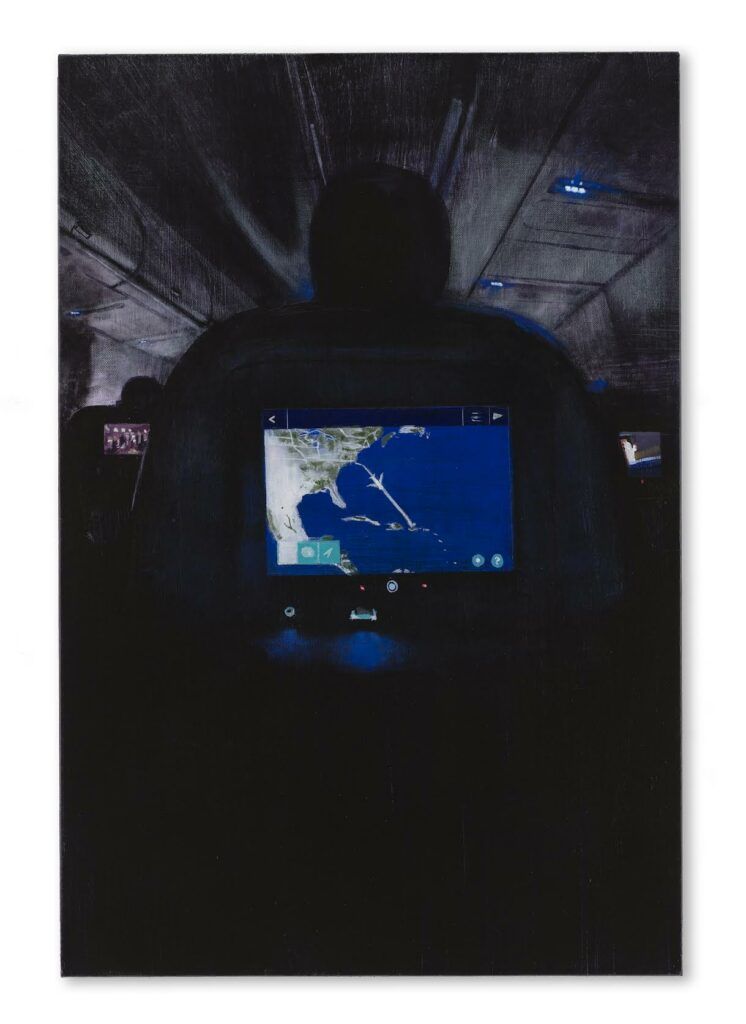
His piece Untitled (2022) is part of the Cars & places series. The piece presents a seatback screen in the middle of the composition through a first-person point of view. If you look closely, you can see the flight departed from New York, or somewhere in the Northeast of the United States, while on its way to Puerto Rico. Although the screen is the piece’s focal point, the rest of the space is also important, as it lets us understand the literal and symbolic sense of the scenery. The perspective is presented through a person’s eyes, and with depth in the piece, Pagán gives a glimpse of the space surrounding the screen. On the right and left of the frame, we can see other seats with bright screens that reduce the darkness, along with the minimal lights at the top. The only lights in the painting come from artificial sources: the screen, the overhead cabin lights, and other glowing rectangles in the distance. These elements emphasize how modern life, especially for migrants, is mediated through technology and how often these technologies fail to capture the human experience of being at home. Even though Pagán presents other seats and screens through the composition, he does not capture any other passengers as they are consumed by the looming darkness that appears. In this way, he creates a sense of intimacy and captures a profoundly personal journey. This is supported by the fact that the only screen looking at the flight path is the one in front of us.
To make the scene more palpable, Pagán follows the photorealistic style developed by Richard Estes and Chuck Close in the 1960s. This style enforces a feeling of awe, intrigue, and curiosity while staying connected to reality. Through this connection to reality, Pagán alludes to a feeling of detachment, coolness, and the artificiality of the contemporary world. The artist has also presented this artificiality in pieces like Selfie 0 (2020), in which he presents a photorealistic portrait copied from a photo with a face filter on. In both works, Pagán explores how modern technologies distort and mediate our sense of self. The filtered face and the flight screen represent realities in flattened, depersonalized versions of intimate experiences. By replicating them in painstaking detail through this style, Pagán elevates our reality and critiques how such representations can obscure more profound emotional truths. This tension between hyperrealism and emotional distance allows his work to simultaneously evoke connection and alienation, mirroring the diasporic experience of living between cultures and filtered through digital, political, or social systems that fail to contain the complexities of identity and belonging fully.
While appearing uneventful at first glance, Untitled (2022) carries more profound implications about migration, displacement, and the complexities of Puerto Rican identity. The perspective is placed in the traveler’s position. While at the same time, they appear anonymous and surrounded by darkness. The only clear anchor is the map, a symbol of movement and transition that represents a feeling deeply rooted in the Puerto Rican community. Pagán’s use of dark colors evokes the isolation and solitude of a nostalgic moment of a person who left their homeland searching for new opportunities and gets to return. The screen glowing in the center of the composition is both a literal and metaphorical window. This route is familiar to many Puerto Ricans living in the diaspora and on the island, who often move back and forth between these two places.
However, this clearly presented path on the screen masks such a journey’s emotional and historical weight. The plane moves, but the issues of colonial status, economic hardship, and identity crisis remain unresolved. Nevertheless, this flight to Puerto Rico represents the future, what could be, and the desire of the people on the island and the diaspora to have a better Puerto Rico for the next generations. This way, even a Puerto Rican living on the island can feel represented in the piece. It is a journey in which we all, as Puerto Ricans, participate.
Pagán suggests the existence of a space rooted in clarity and hope, but that is limited by portraying the screen as nearly swallowed by darkness. The screen might show a flight path, but Pagán’s piece transcends the canvas to make us understand the protagonist’s journey through the universal feeling of the return to home. The darkness around it can be interpreted as representing the uncertainty of migration, a liminal space where one is neither here nor there, not quite belonging to either land. The decision to leave the figure of the passenger invisible further universalizes the experience. Anyone could be sitting in that seat. Many have. The image is a shared memory among members of the Puerto Rican diaspora and other migrant communities: the quiet, reflective moment of watching your path on a map, measuring the time it will take to reach what is home or what used to be home. Pagán’s stylized photorealistic techniques add a dreamlike quality to the piece. The blurred edges, rough textures, and muted tones prevent the viewer from fully grasping the scene. It is familiar but distant, just like the feeling of returning to a place that has changed or that you have changed too much to re-enter. This haziness mirrors how memory functions for diasporic individuals: emotional, powerful, and never fully sharp.
From a political standpoint, Untitled (2022) also invites reflection on Puerto Rico’s colonial status and how it has affected its population. The political relationship between Puerto Rico and the United States facilitates the route depicted. This relationship makes Puerto Ricans U.S. citizens, yet denies them full democratic representation. The artwork captures the ease of movement across this imperial corridor, while subtly pointing to the power structures that underlie it. Its relevance gets stronger every day as more people leave the island, more foreigners take up our space, and the sense that this art piece gives becomes universal to every Puerto Rican.In conclusion, André Marcel Pagán’s Untitled (2022) is a rich, sentimental, and layered artwork that transforms a quiet moment of travel into a profound reflection on identity, memory, and migration. Through his use of dark colors, impressionistic techniques, and a familiar visual setting, Pagán captures the psychological weight of being caught between two places, a condition many Puerto Ricans share. The piece is not just about a flight; it is about the longing, uncertainty, and unresolved tension accompanying the act of leaving and returning to the place you used to call home. In doing so, Pagán gives voice to an experience that is deeply personal and widely shared, a moment suspended in time, hovering between homes with a nostalgic feeling of staying in the one that saw you grow.