


On April 10th, 2025, I sat down via video call with artist Andina Marie Osorio and talked about her process as a photographer, as well as how identity and memory inform the creative process. This conversation will not only include parts that were discussed in our talk, but will also give a broader perspective of Osorio’s dialogue with other creators in the Puerto Rican diaspora(s) and in the archipelago. I will be engaging Andina Marie Osorio’s work in ongoing dialogue with artists that have inspired and informed her practice. The pieces I will be analyzing in this text are “All These White Angels Around All These Black Babies” (2019), “Untitled (Namesake)” (2024), and “Titi y yo” (2019).
Andina Marie Osorio is an Afro-Caribbean photographer born and raised in the Bronx, New York. Her interest in photography stems from what she describes as, “capturing the mundane yet decisive moments, while also observing and engaging with my community.” She completed her bachelor’s degree at the Fashion Institute of Technology, New York, where she studied photography and related media. In 2024, she completed her master’s degree in photography at Yale School of Art, New Haven Connecticut.
For many Puerto Ricans and Diasporicans, the archive is an important space of memory, remembrance and longing. It facilitates us and the ability to reconnect with our ancestors, our lineage, and to imagine other possible futures. For me, as an art historian and artist, the archive serves as an umbilical cord. It provides inspiration and is a source of longing and information through affects. Osorio’s works invite us to rethink our approach to the archive, with regard to identity and family history as sources of truth, both communal and personal.
In the text “Historical Metadata Debt: Confronting Colonial and Racist Legacies Through a Post Custodial Metadata Praxis,” author Itza A. Carbajal proposes an interesting question that confronts the legacy of colonial archives and the difficulties that post custodial practices and institutional responsibility pose in regard to the care and time that is put into the material. Carbajal and other authors propose the concept of “slowing down the work”. They describe the practice as:
“By insisting on an anti-colonial framework, the use of my time even if repetitive or slow allows me to refocus our attention on what best meets our partner’s needs even at an institution’s expense. This brings me the mind of Kimberly Christen and Jane Anderson (2019) call slow archives, meaning from the temporal sense the slowing down of work in order to focus differently, listen carefully, and act ethically (p. 90).” – (Carbajal, 2021)
Therefore, I proposed a certain type of “slowing down” when perceiving Osorio’s work. The goal of “slowing down” is to seek within the personal and intimate experience of her compositions, a more careful reading of her work through ethical engagement. “All These White Angels Around All These Black Babies,” a 40 in. x 40 in. archival pigment print, is part of the photographic series “A Collection of a Life” created in 2019. Osorio illustrates how tension is present in domestic spaces by denoting, in the title, the imagery of white angels that are visible in the piece alongside the faces and lives of black people who are systematically erased. This is the first image in which Osorio captures a sort of shrine or “altar” in her great aunt’s home. Framed in warm orange tones, Osorio touches upon memory and nostalgia, as if in the exercise of photographing (as a verb) in itself conjures the lives of her ancestors and linkage. As discussed with Osorio, she does not change any part of the objects that she depicts, she loves them as they appear in front of her. All these elements are pieces of lived experience, the framed family pictures, cassettes, pictures of Puerto Rico, and heirlooms that are so commonly placed in Caribbean households.

40 in. x 40 in. Archival Pigment Print. Image courtesy of the artist.
Other works in this series have similar themes. “700 Nimes Road: An Indirect Portrait of Elizabeth Taylor,” created by artist Catherine Opie, is one of the main inspirations for this series in so far as it captures the intimate and quiet spaces that create a different reading of Elizabeth Taylor. In forging a similar imagery and eye, Osorio signifies the role of documentation and study of the personal and private space through an approach that goes beyond the spectacle and recognition that actors and public figures enjoy. Returning to, ” All These White Babies…” Osorio’s large format print invites us to immerse ourselves into personal spaces.
Jennifer Packer is another artist who inspires Osorio. Packer’s oil paintings present similar compositions, examining black experience and domesticity. The black experience and domesticity can be appreciated in, “A Lesson in Longing”, 2019. Additional artists who have inspired Osorio are Alice Neel, Carla Williams, and Elle Pérez. Pepón Osorio, a Puerto Rican artist, is especially important to her. Pepón Osorio constructs his art work and demonstrates an understanding of space, composition, and mise en scene as seen in his self-described formative work, “En la Barberia no se Llora,” 1994.
Andina Marie Osorio’s work has been informed by her identity as a Black Caribbean person and her relationship with her family; with her matriarchs and her relationship with home as a space of resistance, and care. Her connection with Puerto Rico was nurtured through her mother. During our conversations she mentioned how the spaces she chose to represent were part of her everyday life, of hearing her abuela, her tías, and mother talk, and how they interlaced care and kindness in her work. I was captivated by her piece “Untitled” (Namesake), 2024.
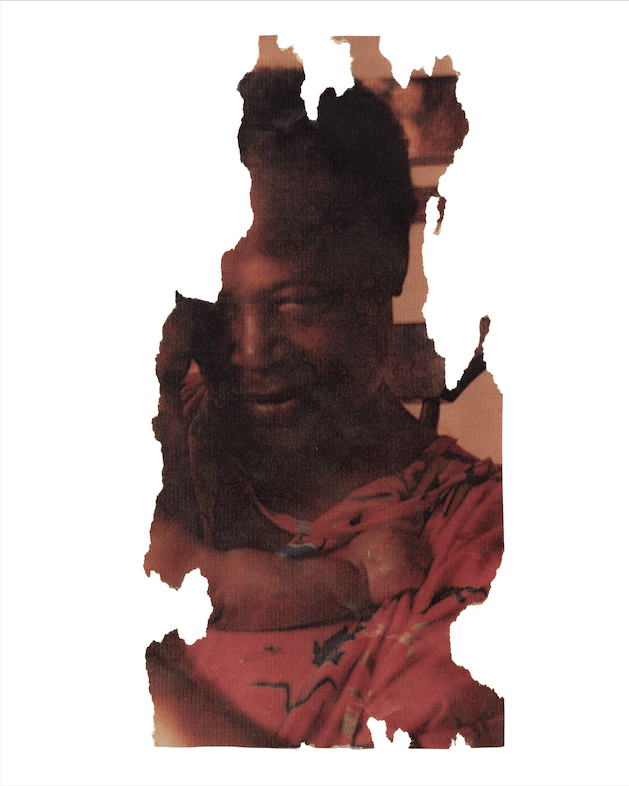
On the right side of the photo, we can see the figure of her great grandmother, Andina. She is tenderly holding a baby, who is the artist’s grandmother. The image is ripped from the sides, grasping from the pieces of the image. The figure of the mother, like iconographic representations of the Madonna, is deconstructed and brought to earth. This reminded me of my Abuela Clara, who is also my namesake. There is a certain serenity and poise that black elders and Caribbean elders hold, which captures such a tender and quiet but powerful scene. In conversation Osorio mentioned that this picture was ever present in her life as she always used to see it in their dining room. Therefore, Osorio relocates the intimate and “quotidian” as something that has meaning, that gives us our sense of identity, lineage. The power of this piece lies in the physical closeness, in the private moments, and the grandiose love and care that the artist has for this portrait.
This work is part of a series titled “Things Men Do Not Know”, a 6-part series that composes images of her family. They were made using newsprint, when discussing the process of making this series, Osorio utilized newsprint, and with help from a friend who was a beekeeper they placed these newsprints; which is a picture of the picture mentioned before inside of the hives. During this interaction they are worked and crafted by the bees, giving the images a nostalgic and atmospheric feeling. Osorio proposes a new way of collaboration and community, that goes beyond the sense of “ownership” of the sense of the author. Bees collaborate, they are matriarchal, and they forge and create communities. Their interventions in these pictures, the thorns and grooves they form in the image are created organically, the artist loses a sense of “control” during this process. Osorio comments on how during this process, she had the images in the beehive, but the artist did not necessarily know what might happen. During this process, the bees had total control of the work and the result, therefore it created a different relationship with the work and photography. The artist lends herself to the process.
The first text-image that opens this series completely entails and illustrates the heart of this body of work:
The Bluest Eye
“What they do not know is that this plain brown girl will
build her nest stick by stick, make it her own inviolable
world, and stand guard over its every plant, weed and doily
even against him. In silence will she return the lamp to were
she put in the first place; remove the dishes from the table
as soon as the last bite is taken; wipe the doorknob after a
greasy hand I touched it. A sidelong look will be enough
to tell him to smoke on the back porch. Children will sense
instantly that they cannot come into her yard to retrieve a
ball. But men do not know these things”.
-Toni Morrison, “The Bluest Eye” 1970
Osorio focuses on the small details, making it clear and apparent the immense role the matriarchs of her family held in keeping her family running, in making sense of everything.
In her work “Titi y yo,” we can see that you reflect on two figures, Andina Marie Osorio on the right and her Tía Cosetta. Both of them are positioned behind a red background. I find this image powerful; it draws upon a linkage and legacy from her Tia. These portraits were made during the Covid-19 pandemic, she could not take photos outside or with people, so she dug and looked for the pictures in her family archive.
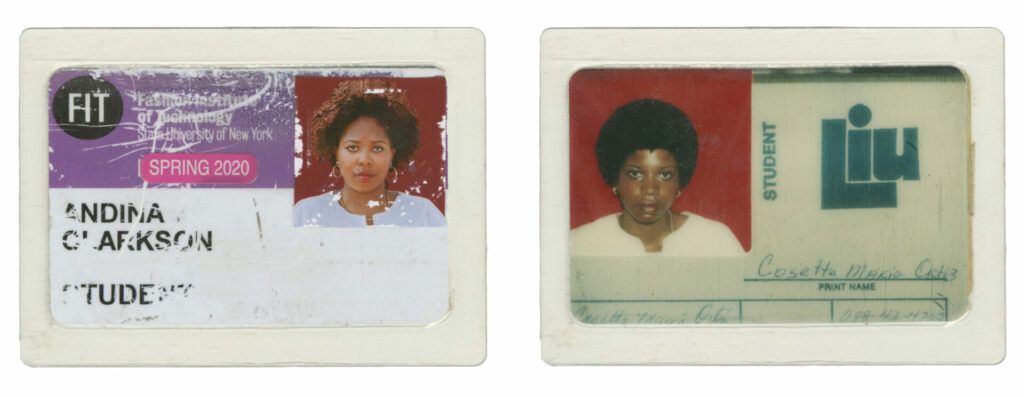
“Tití y Yo” is part of a working series of the artist called “Bendición, Dios Te Bendiga” made during 2020. The concept of “Bendición, Dios Te Bendiga” is a call and response greeting traditionally used in Hispanic and Caribbean households. These images draw upon the artist’s connection with her family, and their archive, connecting in space in time with her aunt. Andina Marie Osorio invites the viewer to look inside their personal archives, to seek the force and legacy that our families, our matriarchs have forged for many generations. Osorio draws upon the complex experiences of inhabiting and experience of being an Afro Caribbean person, her affinity and connection to memory, to Puerto Rico and the reformulations-and formulations of identity that are constantly ever changing and evolving, but are always sustained, cared for by our matriarchs.
References
- Carbajal, Itza A. (2021, November 8). Historical metadata debt: Confronting colonial and racist legacies through a post-custodial metadata praxis. [Special issue on Unsettling the Archives] Across the Disciplines, 18 (½), 91-107
- Olsen, Katie. Cool Hunting. “700 Nimes Road: An “Indirect Portrait” of Elizabeth Taylor”. Last modified September 16 2015. “https://coolhunting.com/culture/700-nimes-road-elizabeth-taylor-photo-book/
- Whitney Museum of Art. Jennifer Packer: The Eyes Is Not Satisfied With Seeing” Archived May 1 2025 at: https://whitney.org/exhibitions/jennifer-packer?section=5
- Hilton Als. “Alice Neel’s Portrait of Difference” The New Yorker Accessed May 1 2025 https://www.newyorker.com/magazine/2021/04/26/alice-neels-portraits-of-difference
- Andina Marie Osorio. Archived at https://www.andinamarie.com/