

será, me digo yo,
que se nos acumulan en uno de estos días,
o en varios de estos días,
o un poquito tal vez todos los días,
el susto y el asombro de encontrarnos
con tanta cosa junta
con tantísima cosa
could it be, i say to myself,
that they pile up on us one of those days,
or on several of those days
or a little perhaps each day,
the fear and the wonder of finding ourselves
with so much stuff together
such overmuch stuff
-Ángela María Dávila, from “será la rosa?”
(Translated by Roque Raquel Salas Rivera)
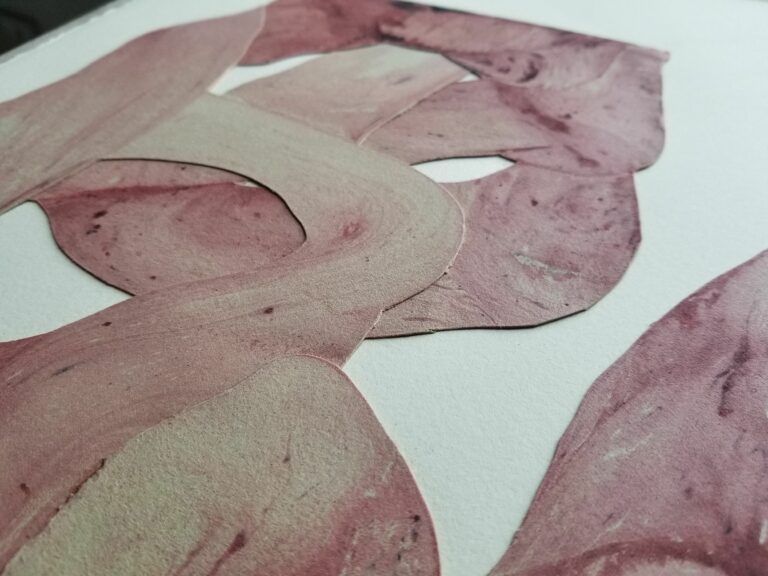
The matter of flesh forms a throughline in Juanita Lanzo’s body of work. Protrusions and involutions of varying density tend to suggest limbs or organelles that inhabit what could be called an antechamber to embodiment: a suspension between abstraction and bodily form. In her visual practice, flesh tends to rest in a state prior to coherent organization. Instead of triggering recognition of this matter as anthropomorphic, vegetal, or animal, Lanzo sidesteps legibility to allow the eye to consider an ongoing mystery: the body as a zone of discovery, a territory of sensuality, and a means of communication. Flesh, seen as such, unfolds as a vessel for experience, a surface for sensing history, and a place of insurgent possibility. To rest in between forms animates these reflections on Remains (2003–4), a collage that extends her characteristic biomorphism into a formal experiment that materializes this metaphor of the flesh as a substance for construction. In it, matter comes together and ruptures through cuts and sutures on oil-painted paper. Remains articulates both the accumulation of residual inscriptions on bodies variously marked by history as well as the miraculous occurrence of a flesh that remains mutable in spite of history’s inscriptive violences.

Collage represents an anomaly within Juanita Lanzo’s pictorial work. She admits to some trepidation when she began the series during her graduate studies at the City College of New York. Accustomed to drawing directly onto paper, Lanzo experienced collaging as a challenge she likened to “not speaking, not seeing, not feeling” (Lanzo 2025 at 6:24). This phenomenological disorientation at the level of process invites us to wonder what becomes sensible through this methodological shift, with this leap into the unknown. To collage, from the French “coller,” means “to glue together.” Although collaging techniques have existed in visual cultures across historical periods and geographical boundaries prior to the twentieth century, collage as an artistic technique solidified its place in the Western aesthetic repertoire in the early stages of 20th century modernism. At a conceptual level, collage reflects modernism’s investigations into the fragmented states and clashing temporalities experienced by the emerging subject of modernity––a subject assimilating rapid industrialization, the clashing rhythms of capitalist temporalities, and the sensory din of incipient urban life.
Considering the specificity of collage, we can contextualize Lanzo’s Remains as a formal investigation into the contrasts, juxtapositions, and incongruencies accumulated within a body’s folds. Collage, as an act of gluing together, paradoxically admits to the partiality of its constitutive segments. The subtle boundaries between the pink and reddish segments of Remains are visible at certain points where the direction of the oil paint flows becomes interrupted or where differential saturations in color meet each other at the edges. Parts come together, and yet tension among them remains unsubsumed. Disaggregation and unity coincide. The poetics of the collage in Remains indexes a societal demand to “get it together. And yet becoming legible is a messy endeavor; a meeting of will and chance. You put scraps together. You make a body, but the seams are never fully hidden. They disclose a history of attempts at attaining coherence. This turn towards the body as a dynamic phenomenon of parts in relation recasts the flesh as a mystery whose power lies precisely in capacity to become indecipherable, mutable, and immanently creative. Lanzo’s deployal of the collage materializes this affective and social process through which flesh transmutes into a body.

Flesh is always already historical. Coherence lands on the surface of the flesh as a demand, as subjection. This fact is all the more pressing within the context of Juanita Lanzo’s commitment to articulating expressive modes positioned from an Afro-Boricua woman’s body marked with the various gender-race-class inscriptions through which coloniality enacts and reproduces its material and symbolic orders. This positioning demands that we read Remains within the social-symbolic matrix of racialized and gendered violence. Hortense Spillers contends that flesh denotes a “primary narrative,” a “seared, divided, ripped-apartness” that connects the consolidation of social personhood to an originary dismemberment (Spillers 1987, 67). Flesh, as a “zero degree of social conceptualization that does not escape concealment under the brush of discourse,” returns to the foreground in Lanzo’s collage to evoke the historicity of the flesh that later becomes legible through the identifications––the names––that sublimate this originary violence: woman, mother, Afro-Boricua, Diasporican (Spillers 1987, 67). These names, however, remain invariably haunted by the carnage that precedes them. As Christina León elaborates, following Spillers, “to be marked is to be a target, to have an ontological condition written upon one, and to be somehow recalcitrant to any comfortable nominalization. The names disseminate into different names, but the condition of the named stays in a loop of this originary violence” (León 2021, 67). The name, as symbolic aftermath of the act of recognition and legibility, leaves its felt and seen impressions upon the matter of the flesh.
Juanita Lanzo’s poetics of the flesh, as expressed in this collage, linger on the scene of primary disjuncture: a disjuncture from which the social nexus crafts the fiction of a body’s seamless unity. Is this what remains after the material and discursive dismemberments through which the racialized and gendered flesh becomes subjected? We are wont to read into Remains the temporality of the ruin that speaks the history of flesh, a document of the wreckage after primary violence. The collage of bloody limbs, partial and visibly sutured, rests as a material memory that haunts any future evocation of the body as distinct from the bloody history that names it.
This is not the whole of it. An animatory ambiguity that moves through Remains demands a return to recalcitrance. Something flees the naming, something folds into Remains a fugitivity that resists the closures of history and the total grip of the metaphor of corporal ruin. Something interrupts capture. For “to remain” also contains within it a presence, an ongoingness suggestive of an insurgent flesh whose capacity to stay slippery troubles the order that marks and mutilates it. It is a flesh sensitized to the quieter, minor occasions unfelt by that very order. I speak of the unknowability of a flesh that also registers acts of remaining. The pleats and cleaves in Lanzo’s collage interrupt the full knowability of the flesh as a territory for symbolic capture. Remainders trouble power’s erasures.

I speak, in short, of a defiance in the key of sensuous mysteries no less felt even if they might go unnamed. Looking at Lanzo’s Remains as a verb, I think of lines from Angelamaría Dávila’s “será la rosa?” I think of the fright and the wonder sensed by its speaker and I look at Lanzo’s collage to remain with all the stuff the flesh is capable of remaining with and remembering: the touch of loving hands, the graze of longing and desire, the creatureliness of care, transits and displacements. What slips from the name remains in the folds of flesh. There, we find each other: the stuff of our days in ourselves, ourselves in the stuff of the other. Here among and as shared flesh whose crevices vessel so very much (“tantísima cosa”), Juanita Lanzo’s Remains grants an image to this unnamable act of remaining (Dávila 2024, 114). Remaining is sourced from our own entrails as much as it depends on the iterative insistence on a collective body sensitized to the always-mysterious flesh of the other, sensitized enough to protect that mystery with loving abandon. This collage of flesh so recalcitrant to identification sketches out a method of being together beyond and in spite of the ordering desires of the name and the demands of recognition. Somos quienes permanecemos, we who are in our remaining opaque in the antechamber of that enfleshed mystery.
Against the multiplied violence of displacement, the expropriation of public shorelines, and the annihilation of historical and cultural memory in the Puerto Rican archipelago and its diaspora, the slogan seguimos aquí (“we are still here,” or “we remain here”) has echoed across landscapes of resistance, from the protest chant to popular music. The collective call at the heart of this phrase makes the act of remaining––in the present participle, in its ongoingness––part and parcel of what binds us. Remaining is perhaps the shape of our commons. And yet the ongoingness of Ricanness, as Sandra Ruiz reminds us, is not without its fatigue and exhaustion (Ruiz 2019). It is difficult, inconclusive even. Through the sinuous corporal geographies of Juanita Lanzo’s collage, Ricanness develops another fleshy dimension: a corporality that troubles the logic of catastrophe that so often forecloses the textures of Puerto Rican revolt. Resting visually in that figural zone of indeterminacy that transforms the scraps of sentient flesh into the prefigurative regard of an “us” to come, of a “we” in formation, Remains lingers on the opaque pleats of flesh and from there pursues a horizon of a collective body to come. Lanzo invites us to consider what flesh can become if we remain with what insists on remaining.
References
- Dávila, Ángela María. 2024. Animal Fiero Y Tierno / Fierce and Tender Animal. Translated by Roque Raquel Salas Rivera. CENTRO Press.
- Lanzo, Juanita. 2021. “Juanita Lanzo: The Gestures of Embodiment | Diasporican Art in Motion.” Center for Puerto Rican Studies (CENTRO). Youtube. <https://youtu.be/8x5ju2aWC4s?si=8GTt1t3WGmCpO3bh>.
- León, Christina A. 2021. “Risking Catachresis: Reading Race, Reference, and Grammar in ‘Women.’” Diacritics 49 (2): 61–71. <https://doi.org/10.1353/dia.2021.0022>.
- Ruiz, Sandra. 2019. Ricanness: Enduring Time in Anticolonial Performance. NYU Press.
- Spillers, Hortense J. 1987. “Mama’s Baby, Papa’s Maybe: An American Grammar Book.” Diacritics 17 (2): 64–81.