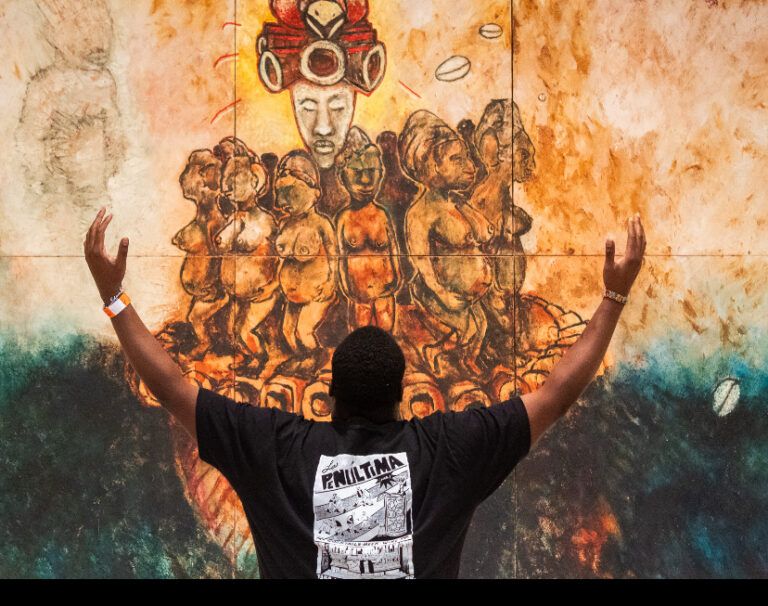


When I step into my home and the homes of my mothers, I see a familiar face rendered in stone that reminds me I am always protected. In theological literature, the practice behind these inheritances is too often regarded as past-tense ritual, but realized at an entrancing scale in the gallery at El Museo de Arte de Puerto Rico, they cannot be turned away from. “Laberinto: Conciencia espiritual,” on view from March 2026, is a solo exhibition of the works of Diógenes Ballester (Playa de Ponce, Ponce, PR, 1956). The curator, Neyda Martínez, says that her aim has been to open toward a fuller engagement with the spiritual, philosophical, and Afro-Indigenous cosmological dimensions of Ballester’s work. According to Martínez’s abstract on the exhibition, the artist’s work extends the mission of historic figures of resistance to cultural erasure in diaspora, such as Arturo Schomburg. Through the exhibits’ immersive installations, majestic encaustic works, and interactive digital interventions, viewers encounter a multivalent field where art channels energy, lineage, and spiritual praxis.

I am arrested by the somatic experience of Ballester’s work. Womanist theology mines lived experiences as theological sources in the years following the articulation of James H. Cone’s and Gustavo Gutiérrez’s visions for liberation theology. Nuyorican experience is inherently one of multi-belonging. Ballester is an Afro-Boricua of Afro-Indigenous descent, whose work integrates culture, memory, and identity through a decolonial framework. He has developed over the course of his practice, Arteología, grounded in his roots in La Playa de Ponce. Manifiesto de un Arteologista (2016), an interactive floor painting at the center of the exhibition, under a skylight in the gallery, within which two monitors housed in a wooden book display a digital program connected to NASA applications, reminding viewers of the cyclical nature of life under the warmth of our star. As visitors are oriented to the elements that compose the exhibition’s mixed-media paintings and encaustic wax works a series of four sculptures Eleguasitos Transmigratorios (2026) advance to the cardinal directions. Here the artist and curator invite joy, agency, and familiarity where familial ties to our earth and to each other have been severed. Wax, carbon, and charcoal transform matter into carrier sites of ancestral knowledge, opening a portal to ethical reflection. Novel D. Sholars terms this experience Black Sublime, wherein “ontology is disclosed through aesthetics and poetics, acting not only as a disruption to western standards of language and the binding narrative of Black/ness as contrary to the reasoning human, but also opens to something transformative and beyond it” (vi). The exhibition reminds us that we live among the sacred, primordial forces of nature and interrogates displacement, death, and loss, imprinting grief as something transmutable and conscious within the cyclical nature of life to awaken communal memory and ancestral presence despite centuries of laic erasure and extraction.
When I sit with Buddhists and witness their altar-keeping traditions, I am always taken aback by how similar these centuries-old practices are to my own creolized rituals. Ritual is intersubjective, like dancing, like speaking, like being seen. Patakis traversed oceans and generations to land on my ears between reruns of I Love Lucy and naps in the rocking chair of my Padrino’s house in Lefferts Gardens. Decades later, they are illuminated in the glass of an iPhone. Ballester has put into form what I struggle to put into verse: the intersubjectivities of being a global citizen in Black skin welcome the opportunity to heal. I may apologize for being a no se kid, but the scholar in me is highly fluent in my inherited visual culture. Color becomes discourse across diaspora, where phonemic awareness is cast away from each generation’s shores of experience. Receptive bilingualism has no visual equivalent. With culture, you either see it or you don’t.
Emerging scholars of theology, read Guitierrez, who has said that “to know God is to work for justice,” as relating to the divine within the labyrinth of multiple belonging traditions from Ballester’s own spiritual inheritance and his decades-long journey of craft and study through his framework, Arteología demonstrates. Along with his global travels, Ballester has conducted a deep study of global religious rituals and practices, allowing him to observe power dynamics between the Global North and Global South, as seen in the works Pensamiento Taino (2016), Vayu-Breathing (2013), and others. Martínez’s scholarship and curation orient visitors to Ballester’s works across painting, encaustic, printmaking, sculpture, installation, digital media, and participatory practice.

When I encounter the suite of four woodcut prints created during his residency as Guest of Honor representing the Americas at the second Guanlan Biennial in China, Guanlan: Global Discourse (2009) works which are part of the collections of the Guanlan Printmaking Museum in China and the Jordan Schnitzer Museum of Art at the University of Oregon, I see a study of Black religion in global discourse generations older than my arrival in the metropole. Sholars offers insight into how such fluency emerges across aesthetics in our culture, now rendered in the sanctuary Ballester has erected in the museum. Ballester has engaged with printmaking artists from Alaska, Bulgaria, Mongolia, Singapore, Egypt, and beyond. In “Laberinto,” the experience of the art is functional rather than literal or visual, and this is what arrests us. In the somatic experience of the exhibition’s labyrinth, Ballester has rendered ritual acts rooted in traditions inherited in Playa de Ponce. Memory, ethics, and spiritual presence activate and remain alive, despite the intended erasure, as we evolve into our truth; the work demands wholeness.
His study is more than visual; it includes intercultural rituals. I try tai chi for the first time in a rehabilitation session meant to cultivate mindfulness and ease pain from my overtaxed body. The facilitator assures me that so long as I am breathing, I am doing well enough. Which is sage advice in any setting. The movements are not as easy as they look. My attitude and flexibility improve as the motion becomes more familiar. This, I am told, is kinesthetic memory, and it heals. Memory that heals. Our shared traditions have a tendency to draw the spirit away from the body. We can be longed for by our ancestors when survival becomes too cruel a task, and memory is too potent a salve. Western medicine offers us few remedies for such states of intoxication. Ritual is a learned source of relief, but indigenous futurity remains under epistemological threat.
Displacement must be engaged with as the body moves through the exhibition. The path forward from our struggle with grief in diaspora lies in a pluralist reconfiguration of the public sphere. National boundaries and borders are defied, and our spiritual heritage transcends both the earthly and the hermeneutical. Ballester renders wholeness in the sanctum, much discussed and longed for by contemporary theologians, and Martínez guides the visitor toward an invitation to healing. In our conversation about how the exhibition came to be, grief emerges, loss and disinheritance are discussed, but all of these are transmuted. Martínez draws on Caribbean philosophy as we discuss how Édouard Glissant’s Poetics of Relation has informed her own insights into the embodied, the seen, and unseen. No favors are offered to unintended audiences. To meet the divine in the work, as a student, descendant, or devotee, shapes take on names known the world over. Voyeurs may pass without ever coming into a felt sense of knowing. Martínez tells me about a visitor to the exhibition during the opening week. A young man on vacation burst into song and prayer, so deeply moved by the viewing. He told her: “I had no idea I would find myself, see myself, here today and through this work.” An experience too often denied in public spaces to those displaced into diaspora.

Historically marginalized diasporic communities translate their sacred iconography into secular public spheres to resist systemic othering and cultural extraction. An authentically democratic society must equip its citizens with the intellectual tools to recognize when economic “laws” function as ideological constructs. Concepts such as the necessity of unemployment to drive corporate profits or the sanctity of debt must be interrogated as products of a system that prioritizes ledger equilibrium over human life. In the exhibition’s sanctum, at the penultimate of nine portals, viewers contend with recontextualized transcripts of enslaved people from the Ponce railway in 1852 named in Espíritu de esclavizados (2008). The very scale of the masterworks offers up the kind of maieutic machine that Paolo Quattrone suggests can untie the relationship between forms of governance and social innovation. The visitor’s song is persuasive, and if we are fortunate, the prayers offered will not fall upon deaf ears in their dialogue with ancestral memory. In our discussion, Martínez describes local memory, Afro-Indigenous cosmologies, and intergenerational creative resistance that tie the artist’s rituals of practice and studio to the military presence and social upheavals that mar the landscape of Playa de Ponce.
Economic democracy requires not a return to theological dominance, but the kind of critical engagement with diverse moral traditions capable of exposing the assumptions embedded in economic life, the opportunity offered in walking the labyrinth of multibelonging traditions. A digital mailbox invites reflection as visitors contend with the portals of the labyrinth. Faced with history, we must face ourselves in the energetic currents of an ever-flowing relationship with our earth. Spiritual heritage is an invitation home to belonging in an ever-changing environment. Works included in Laberinto at MAPR include: Historia de la Memoria Colectiva (2003), Memoria de la Naturaleza: Ritmo de la Vida (2026), as well as the installations Registro Libre (2003–2026); El Tesoro de Doña Milla (El ancla) (2023), El Llanto de la Tierra (2010); and Globalización, Posindustrialismo y Sincretismo (1999), which, according to the Museum, “expand the dialogue on ritual, the environment, and global exchanges.”
References
- Cone, James H. 2020. A Black Theology of Liberation. 50th anniversary ed. Orbis Books.
- Finn, Jim. 2012. “Sunday School with Franz Hinkelammert on Vimeo.” Vimeo.com. Accessed 9 May 2026. <vimeo.com/showcase/7319167>.
- Gutiérrez, Gustavo. 1988. A Theology of Liberation: History, Politics, and Salvation. Translated by Caridad Inda and John Eagleson. Rev. ed. First published 1971 as Teología de la liberación: Perspectivas. Orbis Books.
- Hinkelammert, Franz J. 1986. The Ideological Weapons of Death: A Theological Critique of Capitalism. Translated by Paul Berryman. Orbis Books.
- Martínez Sierra, Neyda. “Laberinto: Conciencia espiritual.” Museo de Arte de Puerto Rico. Accessed May 9, 2026. https://www.mapr.org/es/laberinto-conciencia-espiritual.
- Martínez Sierra, Neyda. “Where Light Remembers: Diógenes Ballester Rodríguez’s Arteología as Visionary Sanctuary.” March 16, 2026.
- The University of Edinburgh. “Prof. Paolo Quattrone – Accounting, Governance and Social Innovation: Establishing the Links.” YouTube video, April 28, 2015. <https://www.youtube.com/watch?v=ATe1JX5gLvo>.
- El Vocero de Puerto Rico. “Diógenes Ballester convierte el arte en experiencia viva en Laberinto: Conciencia espiritual.” April 10, 2026. https://www.elvocero.com/escenario/di-genes-ballester-convierte-el-arte-en-experiencia-viva-en laberinto-conciencia-espiritual/article_6956f764-9a29-47a2-8731-35c25cb2bbfc.html.
- Sholars, Novel Denise. “The Black Sublime and the Possibilities of the Impossible.” PhD diss., Institute for Doctoral Studies in the Visual Arts, 2023.
- Torres Torres, Jaime. “Experiencia arteologista que iluminará su espíritu.” Prensa Sin Censura, April 15, 2026. https://prensasincensura.com/2026/04/15/experiencia-arteologista-que-iluminara-su-espiritu/.