

There is a way of knowing Puerto Rico that doesn’t come from having lived there alone, but from fragments carried across distance, shaped by stories and passed-down symbols, and by landscapes that are remembered as much as they are imagined.
My connection to the island surfaced before I could fully explain it, shaped more by what had reached me through family than what I had lived. Juncos and Guayama met in the womb and bore a child of the Bronx. Identity can feel certain even as its history is still being pieced together. My connection to the island is not held through constant proximity, but through what has been carried and felt over time.
This tension is where Kayleen Berry’s paintings begin. Histories of sugarcane, extraction, and displacement arrive as inheritance, sustained through what remains rather than direct experience.
In her paintings Sweeter Than Sugarcane and Disguised Intentions, Kayleen Berry creates dreamlike scenes that explore how identity emerges through relationships between land, history, and remembrance (Hostos Community College 2024). Berry does not render Puerto Rico as a fixed place. Instead, she rebuilds the island through symbols that carry the weight of colonial history and the conditions through which identity continues to take shape.
In Sweeter Than Sugarcane, a fluorescent pink horse leaps across a field of dry sugarcane. Below it, a bottle of Barolo wine sits beside two empty glasses while a mirror cuts across the landscape.

The composition initially appears surreal, yet each element carries cultural resonance. Sugarcane is not simply part of the Caribbean landscape; it is deeply tied to the colonial plantation economy that reshaped Puerto Rico’s land, labor, and environment. Vast expanses of cane fields once linked the island to global markets while concentrating wealth beyond the communities that cultivated the land.
By placing the horse above this field, Berry introduces a tension between imagination and historical ground. The horse, rendered in an unnatural fluorescent pink, appears suspended above the field rather than grounded within it, creating a sense of separation between the dreamlike figure and the historical landscape below. Its presence suggests movement across histories, hovering between fantasy, aspiration, and the weight of the landscape beneath it.
The objects arranged at the bottom of the composition create what resembles a still life embedded within the field. The Barolo bottle, a luxury wine from northern Italy, gestures toward status. Beside it sit two empty glasses, which the artist has described as representing herself and her wife (Berry 2024). Yet the glasses are unfilled. Their emptiness introduces a tension between proximity and access: the symbols of luxury are present, but not yet fully experienced. Within the broader context of the sugarcane field, this juxtaposition echoes how the value produced from the land has not always remained with those connected to it, reinforcing a sense of distance between what the land has produced and who gets to hold it.
Sitting among these objects is a mirror that becomes the conceptual center of the painting. In it you see the sky, the dry sugarcane, the bottle and glasses reflected back at you. Because no person appears in the reflection, the mirror becomes a space for assembly. It gathers the symbols that shape identity while leaving the self unsettled within them. With the self not fully given back as a defined image, what comes into view instead is a self formed through both history and ongoing experience. Within a diasporic frame, the mirror’s openness becomes especially meaningful. The mirror suggests that Puerto Rican identity, while shaped by colonial history, aspiration, and loss, is not exhausted by them. The reflection leaves room for a self still in development, one that holds these inheritances without being fully contained by them.
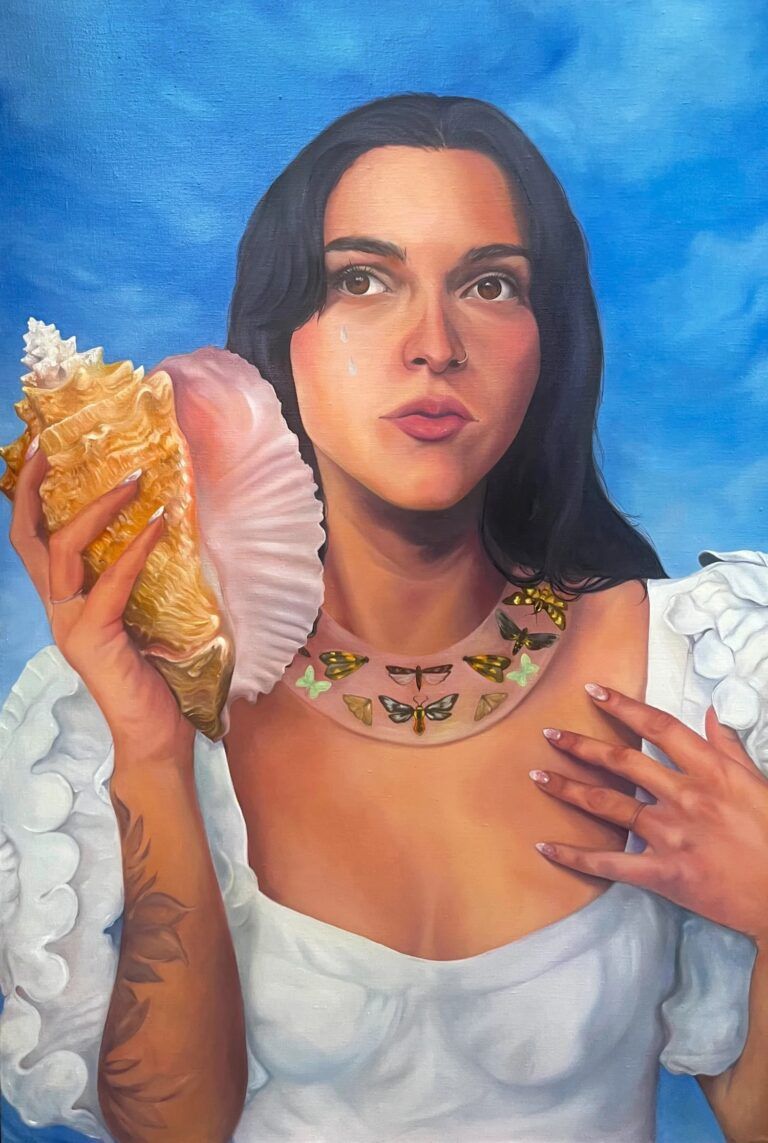
Where Sweeter Than Sugarcane turns toward reflection and layered history, Disguised Intentions shifts inward. A figure, appearing to be the artist, holds a shell to her ear as if listening for the ocean.

Two small tears fall down her cheek. The gesture suggests an attempt to hear something distant but deeply familiar. The shell becomes a small device for holding that distance, allowing what is no longer present to remain perceptible. In this way, it becomes the primary means through which the painting understands connection through a felt sense of presence even when there’s absence. This act of listening does not resolve the distance it reaches toward. Instead, it situates connection within the body itself, in gestures that attempt to connect with what remains physically out of reach.
Around her neck, a necklace composed of insects rests against her skin. These insects evoke life tied to the island’s ecosystems, bringing elements of a living system into direct contact with the body even as she listens outward. The composition holds these movements together, one reaching toward what is distant, the other grounding something of the island within her.
These elements suggest that what endures from the island continues to shift and adapt. In Puerto Rico, moth populations have been observed to recover and reorganize following disturbance (Alonso-Rodríguez et al. 2025). The necklace extends this logic, grounding the idea of change within the body itself. What exists has already been changed, shaped through disruption rather than protected from it. Identity, in this frame, moves away from an original state and becomes an ongoing process of reassembly.
Seen together, these works move between reflection and listening. In Sweeter Than Sugarcane, the mirrored landscape returns an image of the self based on colonial inheritance and contemporary life. In Disguised Intentions, the shell becomes a vessel through which the sound of the ocean remains just within reach, while the body carries traces of the island through the presence of living forms. The paintings don’t resolve distance. They ask what it means to live within it, to carry a place not as final, but as something that continues to take form.
References
- Alonso-Rodríguez, A. M., P. E. Gutiérrez-Fonseca, S. E. Miller, and T. H. Ricketts. 2025. “Moth Communities Reveal High Stability Despite Ongoing Compositional Shifts Over Five Years Following Hurricane Disturbance.” Ecology and Evolution 15 (10): e72278. <https://doi.org/10.1002/ece3.72278>.
- Berry, Kayleen. 2024. Instagram reel. Accessed April 2026. <https://www.instagram.com/reel/C3Y618BuIc8/>.
- Hostos Community College. 2024. “Puerto Rican Artist Kayleen Berry Brings Art, Science, and Culture Together.” Accessed April 2026. <https://www.hostos.cuny.edu/Home-Page-Content/News/Puerto-Rican-Artist-Kayleen-Berry-Brings-Art,-Scie>.