

Nicolás Dumit Estévez Raful Espejo Ovalles Morel: We met through Elia Alba in 2015 and, ever since, I have been curious about your work. You grew up in Philadelphia, where I went to graduate school at Tyler in the late 1990s. However, my experience with diasporic Puerto Rican communities has been mainly in New York City. My recollection of Philly is that of a city deeply segregated by class and race, as well as being a major locus of Black cultures and histories. How was it for you to be New York Rican, Puerto Rican, or Nuyorican in this context?
David Antonio Cruz: I grew up in North Philadelphia, in a Black and Puerto Rican neighborhood that had the highest concentration of Puerto Ricans in the city during the 1970s. The city was—and still is—somewhat segregated, with economics and race playing significant roles in daily life. But growing up I was immersed in Phila-rican and Black culture. My block buzzed year-round with a mix of Spanglish, hip-hop, salsa, block parties, and delicious food.
My parents attended church in El Bloque de Oro, a neighborhood hub for Latinx culture and community. The streets were filled with Puerto Rican shops, record stores, bakeries, and restaurants. At the heart of it all was Taller Puertorriqueño, established in 1974. Taller served as a cultural center, offering a bookstore, various programs, summer events, and art classes. I became involved there as a child, attending weekly art classes that introduced me to Puerto Rican art and music.
I also engaged with organizations like Concilio de Latinos, the oldest Latino organization in Philadelphia, and Congreso de Latinos Unidos, founded in 1977 by a group of Puerto Rican activists. During the summers, I spent time in the Puerto Rican countryside with my grandparents.
It wasn’t until I moved to New York that I began to reflect on my identity and broader societal ideas about what is Puerto Rican-ness; what is masculinity. That’s when I began to negotiate identity through a queer lens, especially through my early jíbaro work.

NDEREOM: We have links that intersect in the Caribbean: yours in Puerto Rico and mine in the Dominican Republic, in my case, with roots in Lebanon. There is a sense of hospitality that I see manifested and manifesting in what you do, what you paint, and how you bring people together that reminds me of what I have lived in South Bronx in my interactions with the diasporic Puerto Rican communities that have so much supported my work. Tell me about your impetus to gather queer friends of different cultures as family.
DAC: Gatherings, in my experience, have always been a way to create support, share space, engage in activism, nurture, feed the soul, share history and stories, and celebrate a sense of home. Culturally, in the Caribbean, food has been at the core of these gatherings. Whether it’s a simple cup of coffee or a meal at the dinner table, it’s an opportunity for an exchange of words, experiences, stories, folktales, grief, and songs.
As a teenager, I used to run around the corner to my best friend’s home during the holidays for some homemade southern cornbread, greens, and macaroni and cheese. Then, we would switch places, and she would come to my house for my mother’s arroz con gandules, lechón, and flan.
This became a kind of chosen fam holiday tradition—a way to share our families, our traditions, and our ancestors.
Some of my earliest memories are of gatherings at my grandparents’ house in Philadelphia after they moved from the island in the 1980s. The family would come and visit on weekends— aunties, uncles, cousins, grandkids, and close family friends; some adopted into the circle. The impromptu gatherings were never planned, and the walls could never contain us. It would spill into the streets, the stoop, and the yard—filled with talk, hanging out, laughter, dancing, games, gossip, and food. Their home was everyone’s home; we all belonged, and everyone was welcome.
After moving to New York, the art studio, openings, evenings in dive bars, the pier, the dance floor, all became a place where people could gather and exchange ideas, share critiques, stories, memories, laughter, inspiration, play, and share food. Those became the sacred places.

NDEREOM: I am interested in your creative investigations regarding families: blood and chosen ones. Can you talk about this in connection to their meaning in your paintings? I am asking because of the work that you have done pictorially and which includes people like your mother as well as the group of queer friends who you have welcomed into your constellation.
DAC: I began working with my family, friends, and chosen family in the early 1990s. The earlier works with my mother were a way to explore my personal and familiar lineage, Philaricaness, gender and masculinity as performance or drag, sexuality, Latinidad, and the male queer gaze. Over time, my focus shifted from capturing their likeness to documenting our community beyond its physical form, in order to explore the complexities of queerness, gender, race, class, history, lineage, language, culture, and desire.
I often say that my work has been a search for home. It’s always been about locating, marking, mapping, and tracing the outlines of home on our skin. I see these images, chosen/fam as vessels, nests, rafts, cages, and landscapes—each a possibility of a voyage back home.
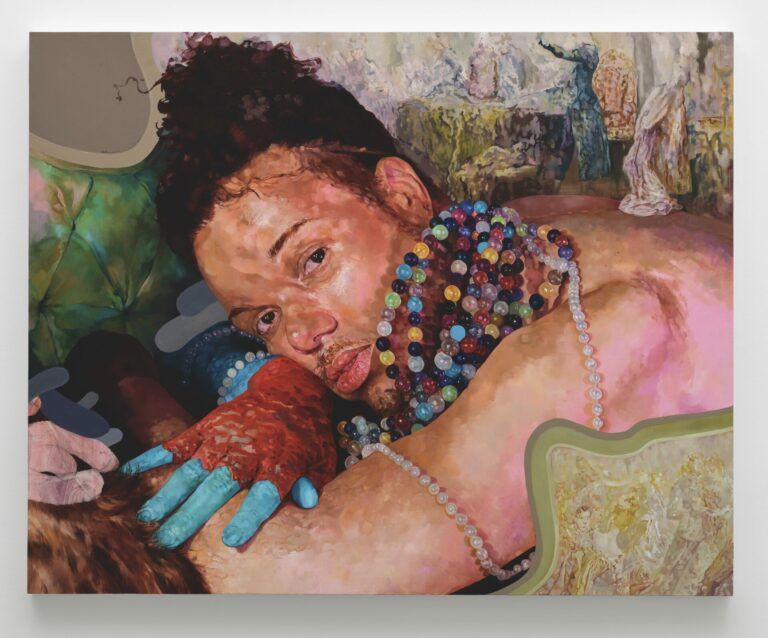
The sitters in my work are invited to pose in opposition to social norms as a form of resistance, play, and queering the act of posing. The subjects are reinterpreting and playing with classical poses, nestled intimately on a couch. The morphed couch is womb-like and shell-like, destabilizing traditional associations, wrapping around their bodies. The bodies, closely seated, play on the idea of homeland, a mound, or sacred ground.

NDEREOM: Disaporic Ricanidades have served as a bastion of activism, struggle for liberation, and revindications. I am wondering about this powering energy vortex in relationship to the forging of new worlds like those you are bringing forward through painting and performance art, for example, and which speak of sexual, gender, and cultural radicalness. I would love to hear from you.
DAC: This question requires a deeper discussion and exploration. It’s one that I ask myself as an artist all the time. My hope is that the work continues a sense of activism and carries the torch of what has been created, that the essence of individuals who fought for freedom resonates
throughout the work. There is a perpetual aspiration for continuity while also complicating and adding to that search for a space for us, the desire to live out loud in the open.
Early on, my artwork and performances came as a reaction to the tropes being projected on me. If I was being viewed certain ways, where did I belong? I wanted to understand my physical form, how I was looked at and viewed.
I delved into the intricacies of masculinity, gender, culture, modes of expression, attire, desire, and sexuality. I was exploring our placement in society and in our families, and I was seeking out a home. My body as a home. Trying to comprehend my physical form, my skin, and the loaded manner in which it was viewed, commodified, and fetishized, I began to manipulate and challenge words and queer gestures and posturing that were historically used to instigate shame, concealment, and coded language. I am still seeking these answers. We are ever-changing.
Art allows us to understand our humanity. It steers us through the ever-evolving struggle, altering our perspectives, enabling us to perceive ourselves differently, and gain a deeper understanding of ourselves.

NDEREOM: There is so much vacuous talk in the arts about care, self-care, and a series of healing terminology that has been co-opted by the system. How might your work be putting into action these concepts without necessarily giving lip service to them. I see the embraces and hugs in your painting and they spell to me both communal rest and support.
DAC: The alchemy of paint and painting enables us to move across time, pause, transform, define, reimagine, melt, harden, conjure, and haunt.
We all love, live, care, share, play, and celebrate in our own unique ways. There’s no single method of living or expressing oneself; rather, our experiences are a rich tapestry woven from diverse individual modes, each equally valid and important. I am interested in the complexities of queer touch, love, desire, fashion, history, culture, and the spaces we call home—our sanctuaries of rest, joy, and intimacy and how these individual modes have the power to distort, disrupt, and challenge the social, cultural, and gender norms and history that have been imposed upon us.
I think of chosen/fam structures as the architectural support beams of our communities—the buttresses and columns that provide strength and stability.
During the pandemic, my close friend April Hunt created a virtual sanctuary by hosting house music parties on Instagram Live. Through these monthly gatherings, she opened a space for us to come together, dance from our homes, and celebrate our community. Each dance session, she invited friends and family to join her live, allowing us to give a shout-out to our loved ones, creating a personal moment within the community.
It was a reminder that during this difficult time we were not that far away from each other. It reminded us of the beauty and love in our community. It took us back to our church, the dance floor. We were loving each other from afar, through a digital space.

2021. Oil and flashe on wood. 72” x 96”.
NDEREOM: Thinking of family constellations and the role of those who are standing behind us in support: grandparents, parents, mentors, teachers, lovers–any words for those in your communities who you might be sending forward into creativity and life, the younger generations of Rican creatives?
DAC: Lately I’ve been thinking about a quote by Toni Morrison: “Sometimes you don’t survive whole, you just survive in part. But the grandeur of life is that attempt. It’s not about that solution. It is about being as fearless as one can, and behaving as beautifully as one can, under completely impossible circumstances.”
To all the young artists, love the process and enjoy the journey. Learn to love yourself, to forgive, be present, be kind, and love/care more every day.
NDEREOM: I thank you very much.
DAC: Gracias, Nicolás. Un abrazo. I’m looking forward to continuing this conversation.